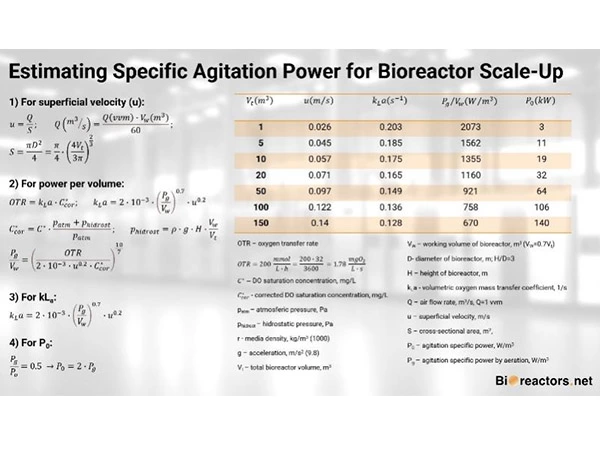
One of the key challenges in scaling up bioreactors is selecting the appropriate power for the agitation drive motor. If the motor is underpowered, the desired productivity may not be achieved. Conversely, an oversized motor complicates integration and increases costs.
This task is further complicated by the lack of reliable empirical formulas for accurate power estimation at scale.
● Experimental data shows that specific agitation power decreases as bioreactor volume increases [1]. Furthermore, studies demonstrate that maintaining a consistent oxygen transfer rate (OTR) across different volumes requires lower kLa values in larger bioreactors [1,2]. This is primarily due to increased hydrostatic pressure, which raises the oxygen saturation concentration (C*), enhancing OTR performance [3].
● These findings support the use of OTR as a robust scale-up criterion. In our approach, we introduced an additional multiplier to C* to account for hydrostatic pressure effects (as illustrated in the image attached to this post). The analysis assumes an agitation system capable of delivering OTR = 200 mmol/L·h, although the target OTR may vary by application.
● Using a widely accepted relationship between kLa and specific power input (Pg/V) [4], was estimated the required agitation power for bioreactors ranging from 1 to 150 m³. Although the formula is based on data from systems using a Rushton turbine, it can be conditionally applied to similar geometries. Only geometric similarity must be maintained by scale-up.
● While this method provides a useful estimation tool, CFD simulations remain essential for precise agitation system design at industrial scale.
References
1.Benz, G.T., 2008. Piloting bioreactors for agitation scale-up. CEP 104, 32–34.
2.Ali Jahanian ,A., Ramirez, J., O’Hara, I. 2024. Advancing precisionfermentation: Minimizing power demand of industrial scale bioreactors through mechanistic modelling. Comp.Chem.Eng. 188 (2024) 108755
3.Knoll, A., Maier, B., Tscherrig, H., Büchs, J., 2005. The oxygen mass transfer, carbon
dioxide inhibition, heat removal, and the energy and cost efficiencies of high pressurefermentation. Technology Transfer in Biotechnology: From Lab to Industry