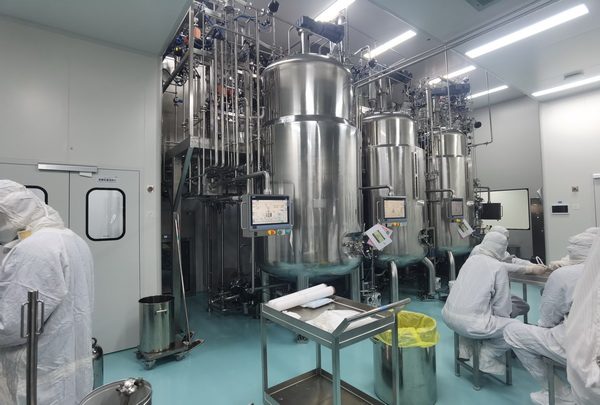
Production scale · Yeast fermentation

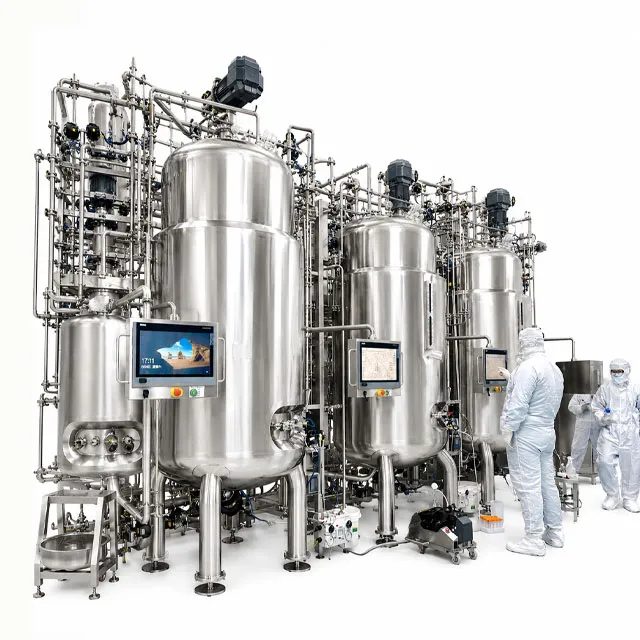
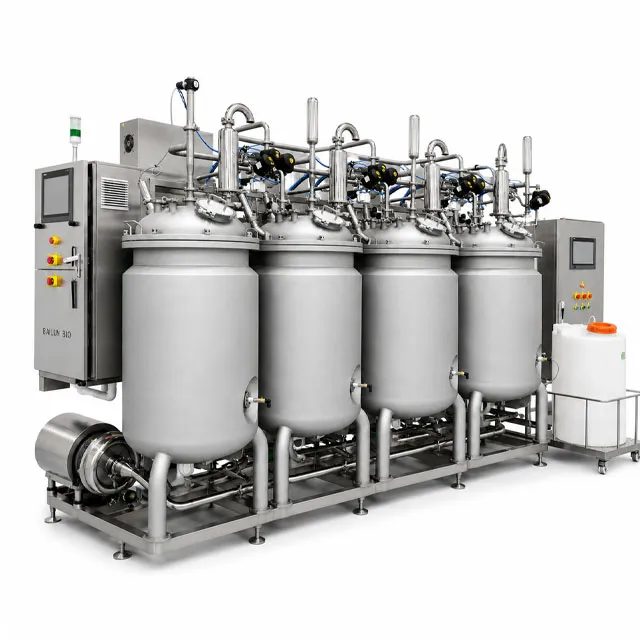
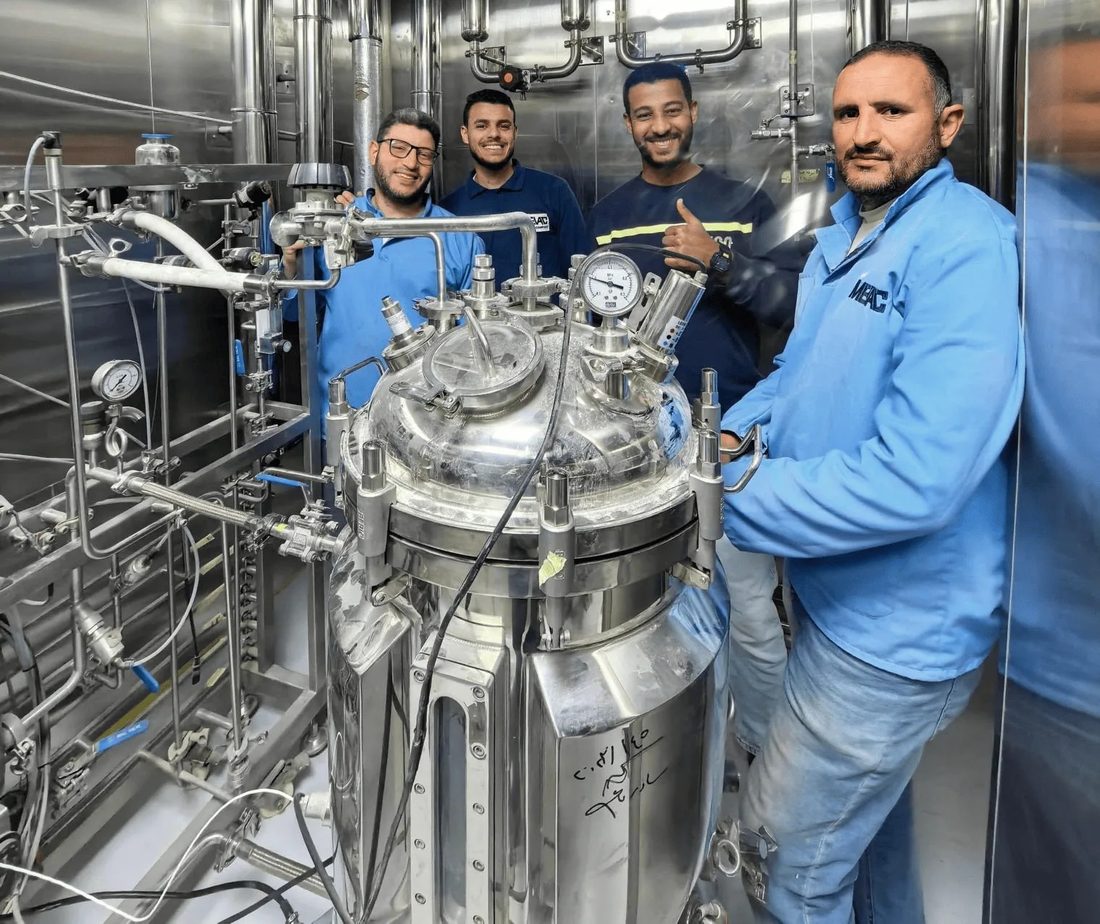
5000L High-Density Pichia pastoris Bioreactor System

A fully automated production bioreactor for high-cell-density fed-batch and continuous Pichia pastoris processes. Vessel, skid, instruments, PLC/SCADA and safety systems come as one integrated package for cGMP plants. The design targets high heat removal and high oxygen transfer at production scale.

  • ASME BPE 2023
  • PED 2014/68/EU Cat. IV
  • GAMP 5
  • 21 CFR Part 11
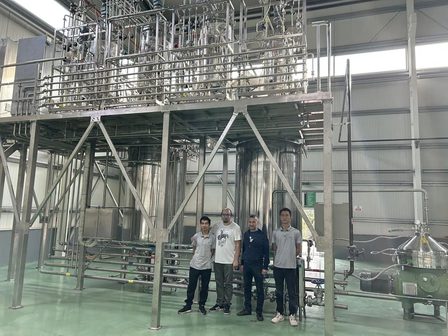
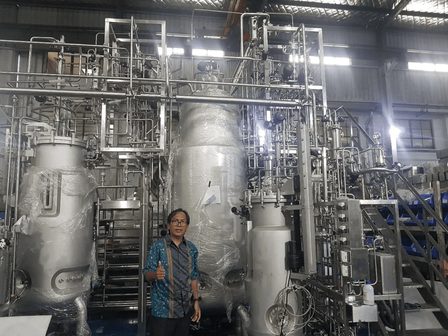
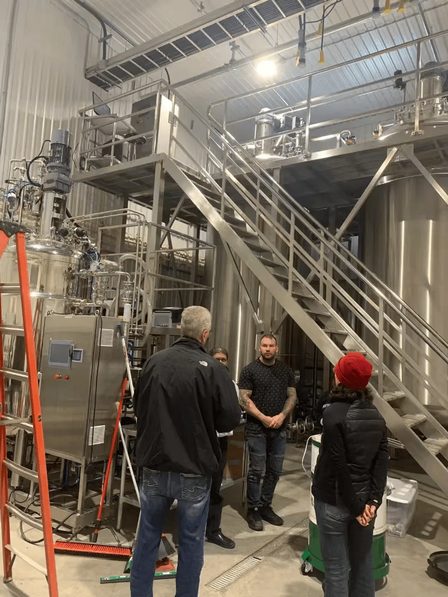
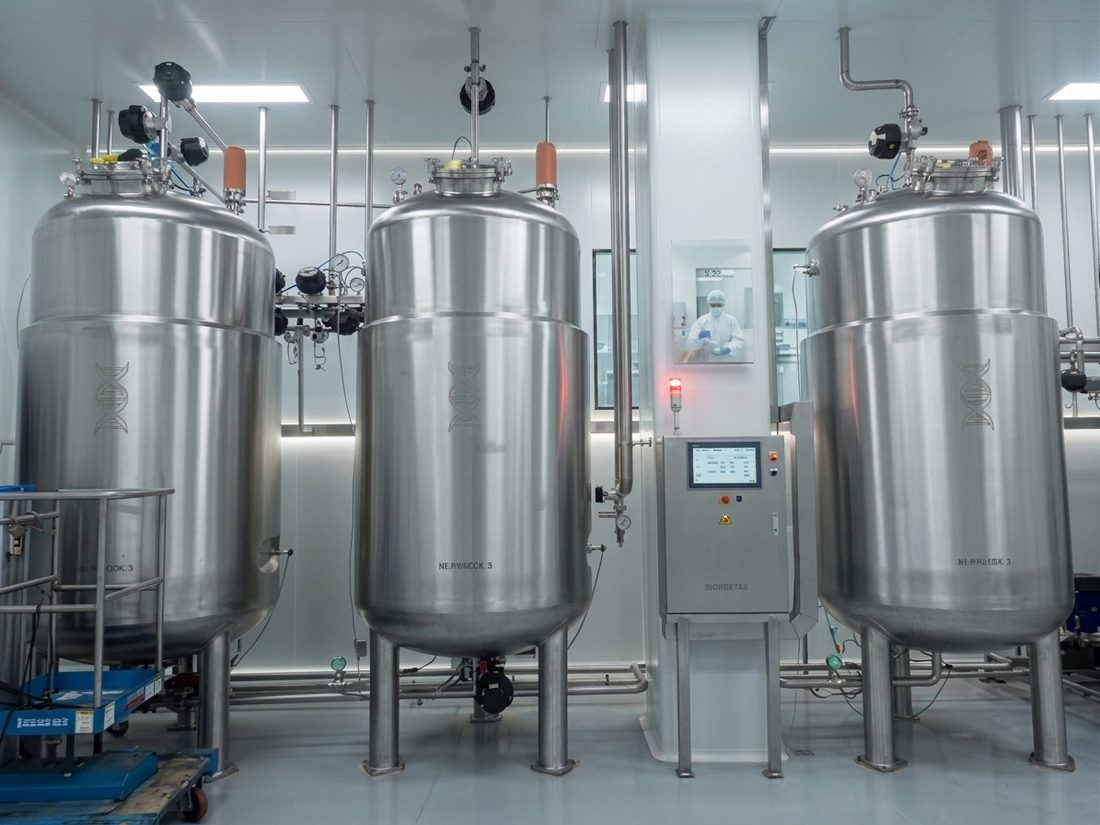
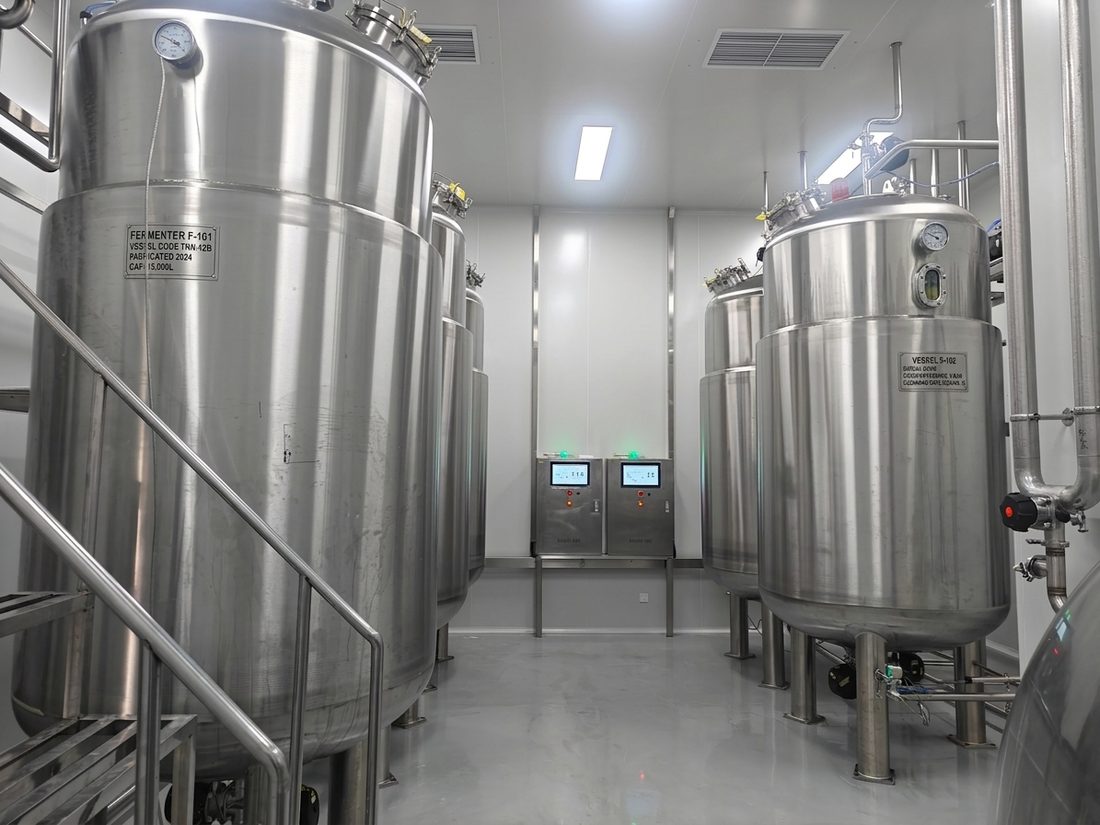
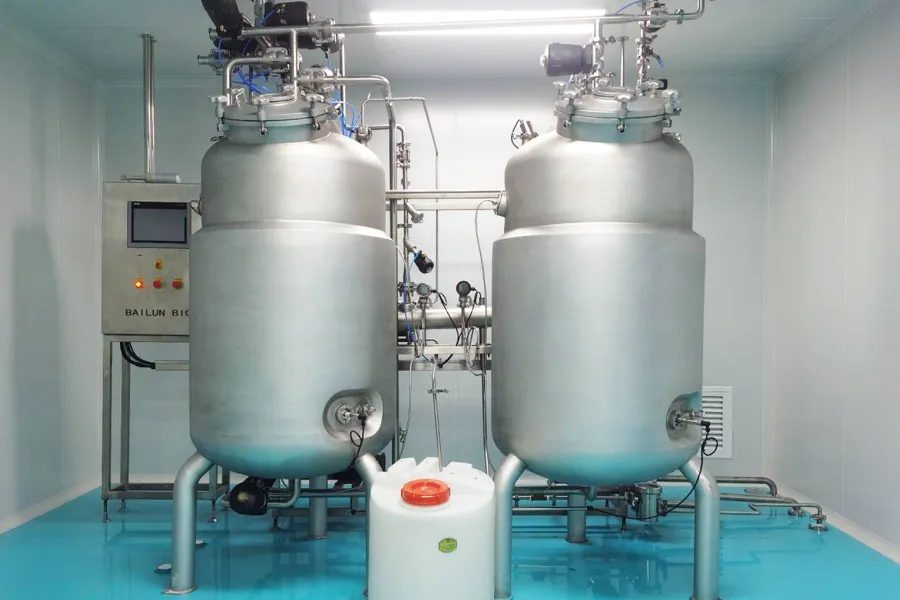
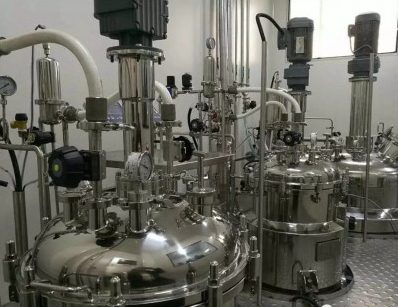
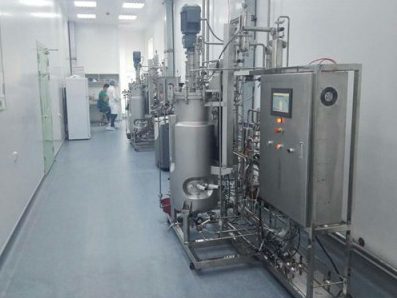
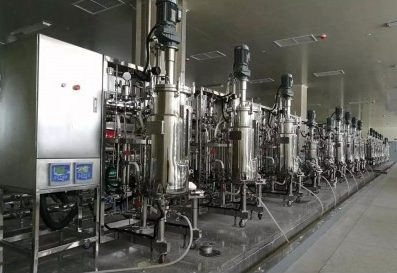
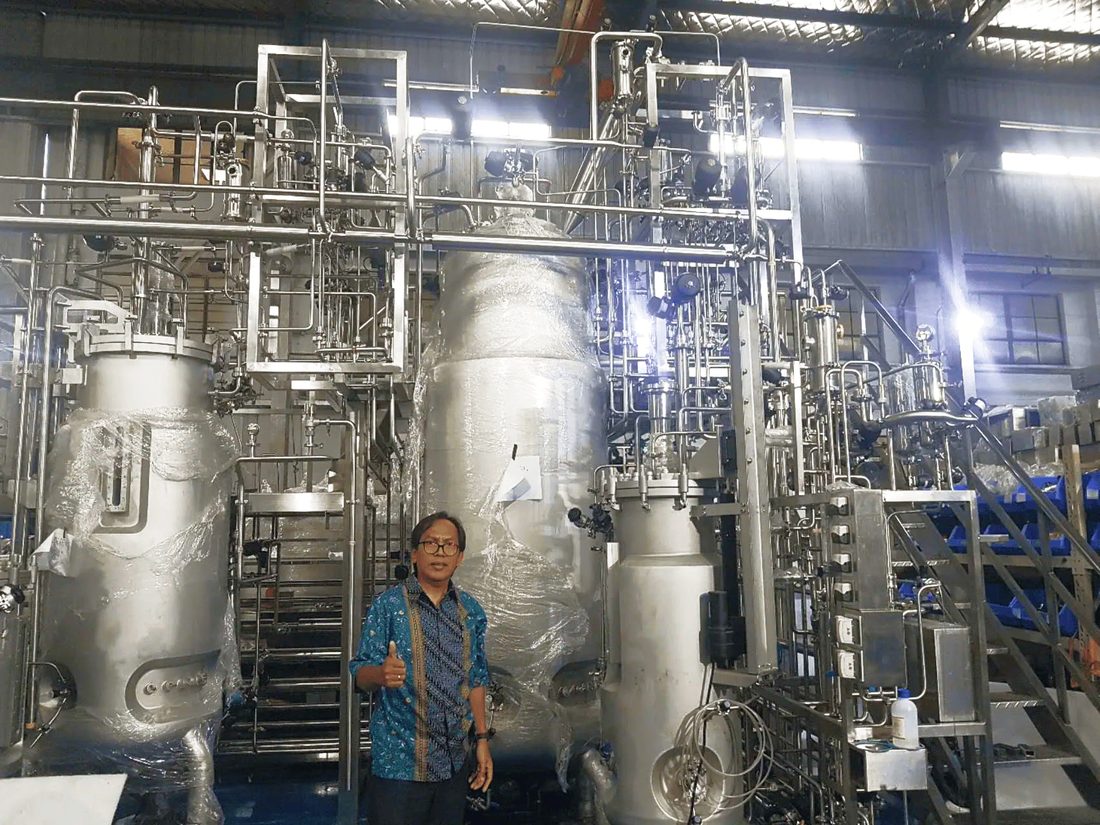
Production bioreactor installation
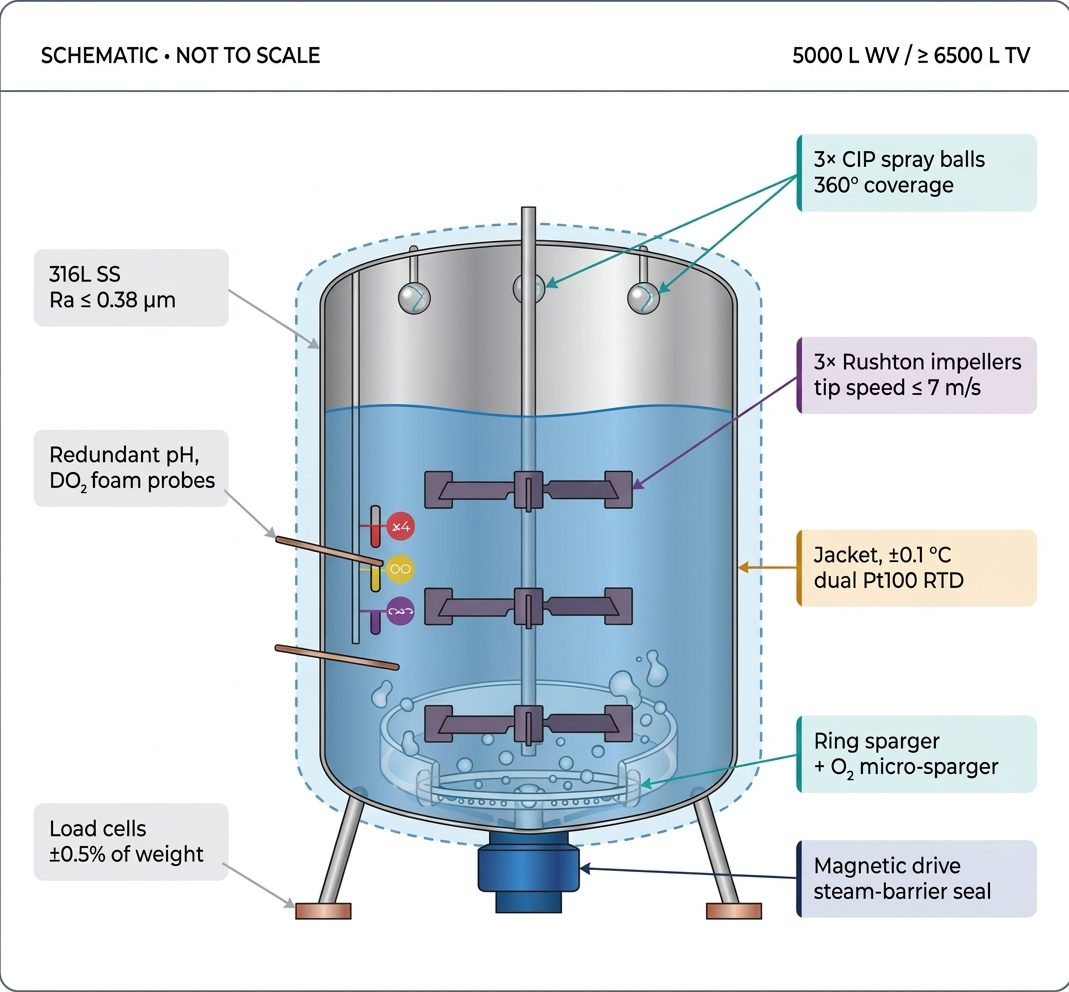
Schematic of the 5000 L bioreactor: 316L SS vessel, CIP spray balls, Rushton impellers, jacket with dual Pt100 RTD, ring sparger, load cells and magnetic drive
5000 LWorking volume, ±10%
≥ 150 g/LDry cell weight at commissioning
≥ 300 h−1kLa in water runs at SAT
F0 ≥ 45 minAt every SIP mapping point
±2%Methanol feed rate vs setpoint

Built for methanol-induced, high-density yeast processes

Pichia pastoris runs push oxygen transfer, heat removal and feed control to their limits. This system is sized for that load, with extra headspace for foam, redundant sensing and a methanol feed loop that keeps residual methanol close to setpoint as cell density climbs.

High-density fed-batch

Three Rushton impellers, ring and micro-spargers and O₂ enrichment support oxygen demand at 150 g/L DCW and above.

Controlled methanol feed

An exponential base feed with off-gas feedback, a Coriolis meter and automatic pump failover. Feed stops if methanol builds up.

Validation-ready

Stamped ASME BPE design reports, 3.1 material certificates, FAT/SAT protocols and IQ/OQ templates ship with the system.

Vessel & mechanical design

The vessel is the first control loop

A deliberately over-specified mechanical envelope gives the process room to manage foam, heat, gas transfer and cell density without compromise.
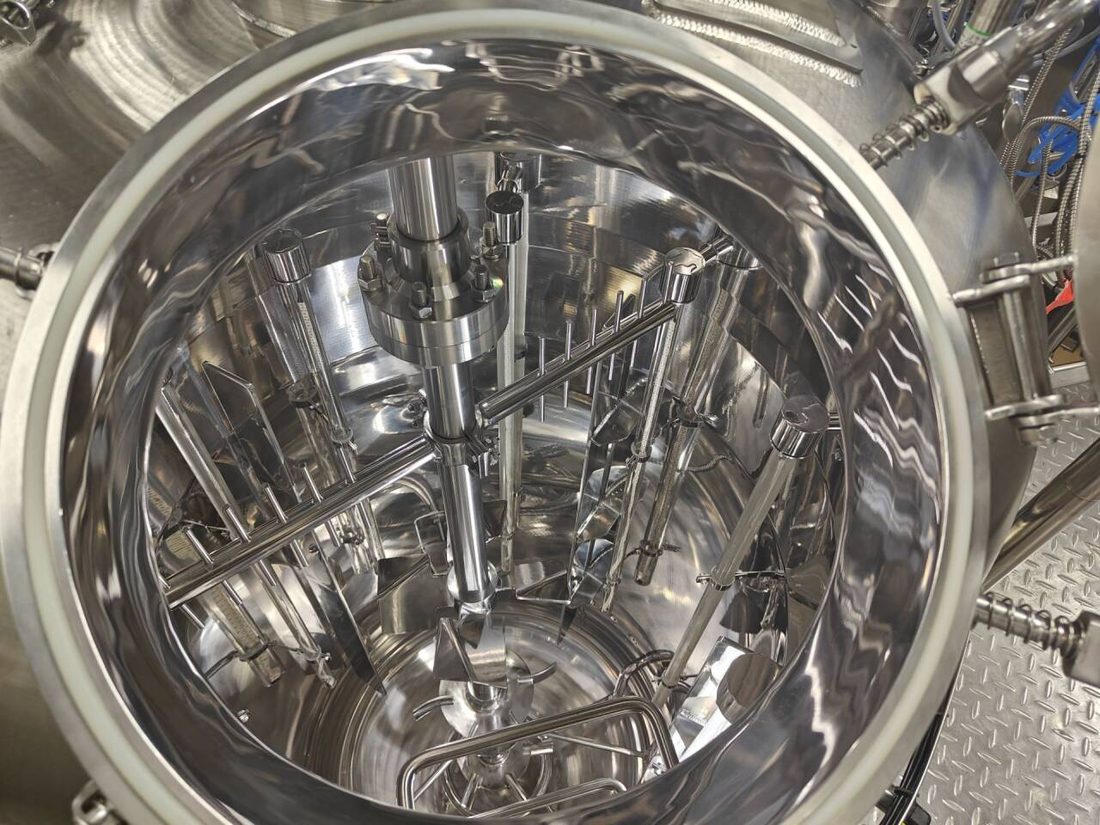
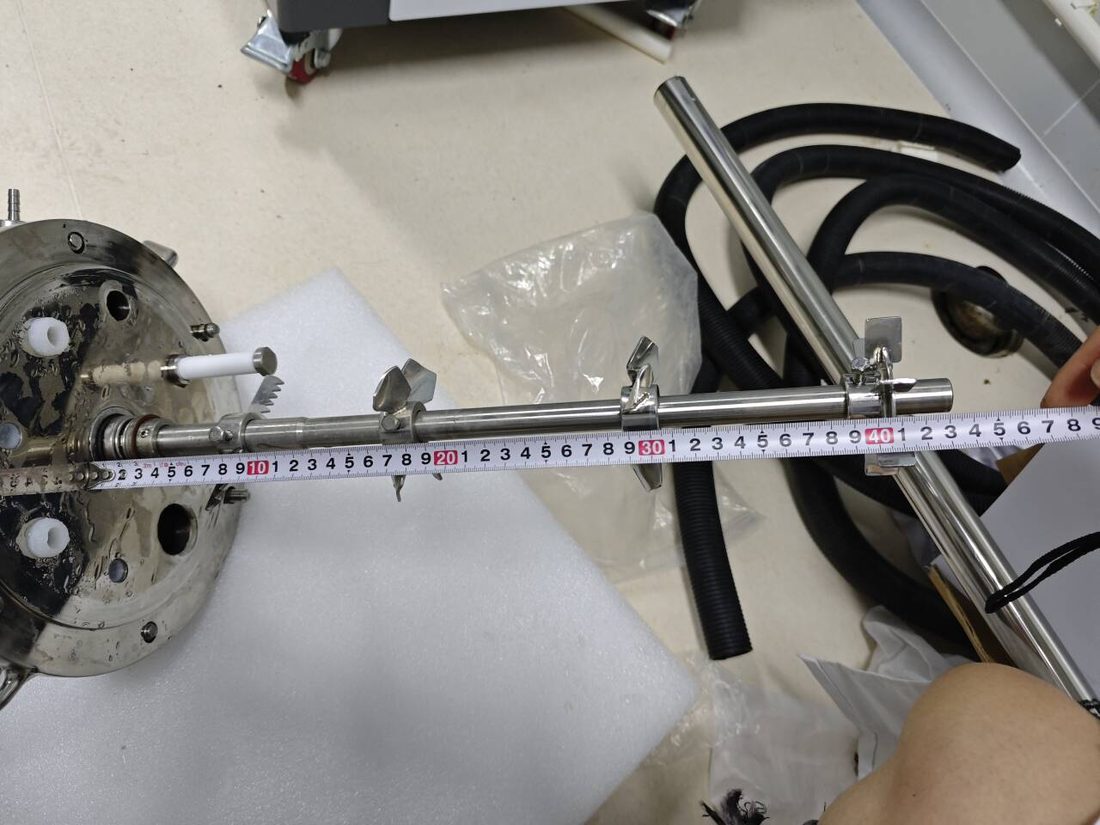
01

Volume & pressure

Working volume 5000 L ±10%. Design pressure 3 bar(g) at 150 °C. Design range −10 °C to +150 °C.

02

Materials & finish

316L stainless steel with electropolished internal surface. FDA / EC1935 silicone or EPDM gaskets. External #4 brushed finish.

03

Agitation & drive

Three Rushton impellers, maximum tip speed 7 m/s. Magnetic drive with double mechanical seal and steam barrier.

04

Sparging & connections

Laser-drilled ring sparger plus micro-sparger for oxygen enrichment. All connections are ASME BPE tri-clamp.

Instrumentation

Every critical loop is measured twice

Redundant pH and DO probes, dual Pt100 sensors and load cells give the control system a second opinion on every value that can end a batch.

Vessel & mechanical design

Working volume
5000 L ± 10%
Total volume
≥ 6500 L (foam headspace)
Design pressure
≥ 3 bar(g) @ 150 °C, PED Cat. IV
Design temperature
−10 °C to +150 °C
Vessel material
316L SS, Ra ≤ 0.38 µm
Surface finish
Internal electropolished (ASME BPE SF-1); external #4 brushed
Gaskets
FDA / EC1935 silicone or EPDM
Connections
Tri-Clamp (ASME BPE), verified face-to-face
Agitation
3× Rushton, tip speed ≤ 7 m/s; VFD 0–120 rpm; torque monitoring with shear-stress alarm > 50 N·m
Drive & seal
Magnetic drive; double mechanical seal with steam barrier
Sparging
316L laser-drilled ring sparger + O₂ micro-sparger

Process control & instrumentation

pH
Redundant Mettler Toledo InPro 3250i; auto acid/base
Dissolved oxygen
Polarographic InPro 6800; O₂/N₂/air cascade
Temperature
±0.1 °C; dual Pt100 RTD
Pressure
0–2.5 bar(g); proportional control of backpressure valve
Foam
Capacitance probes; pulsed antifoam 0.1–5 mL/min
Weight / level
Load cells, ±0.5% of total weight
Methanol feed
Pulsation-free metering + mass flow meter
DO / pH strategy
Adaptive PID + feedforward; O₂/N₂/CO₂ blending
Process gases
Bronkhorst mass flow controllers, 0.1 µm filtered

04 · Methanol feed automation

A feed loop that follows the culture, not a timer

The PLC sets a base exponential feed from the chosen growth rate, then trims it with live methanol readings from the off-gas analyser. If the analyser drops out, the loop falls back to a pre-validated feed curve and raises an alarm.
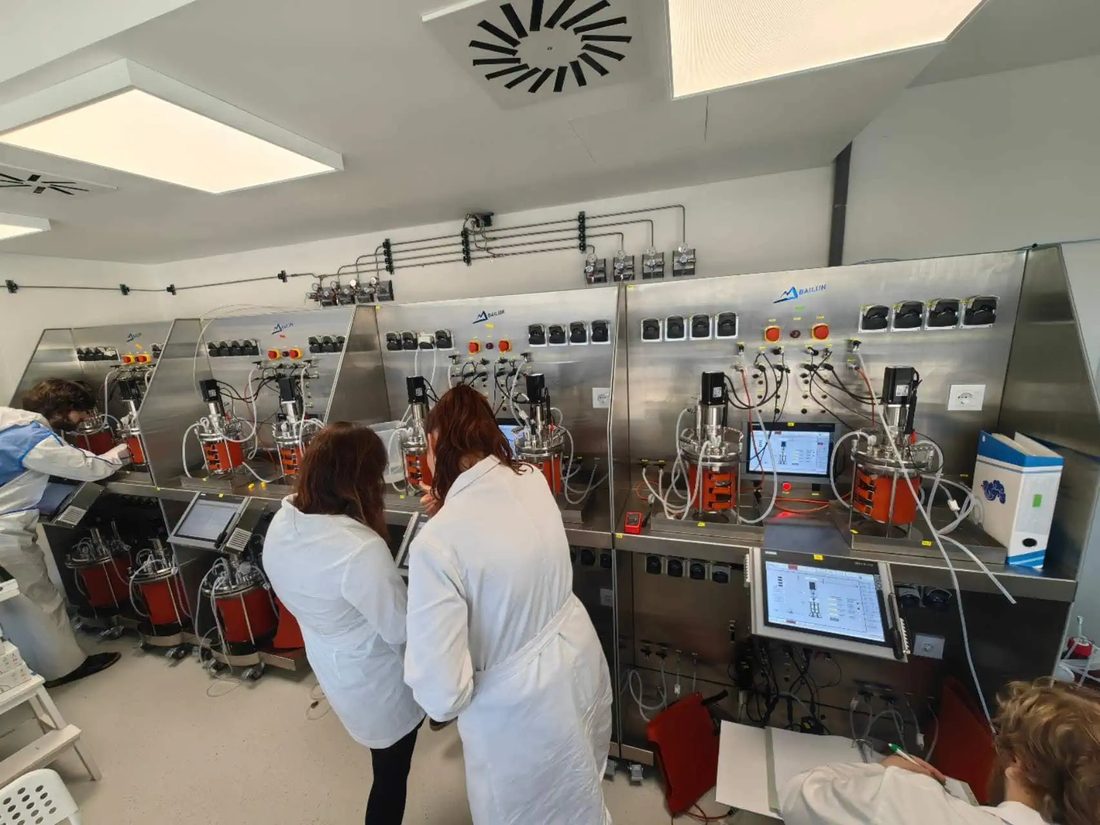
01 · Measure

Off-gas GC/MS

Siemens Maxum Edition II. Methanol range 0–1000 ppmv, sample every 10 min, OPC UA push to PLC.

02 · Decide

PLC feed algorithm

F(t) = F0·e^(μt) + PID trim
μ 0.12–0.18 h−1, user-set. Methanol setpoint e.g. 0.2 g/L.

03 · Deliver

Twin-head peristaltic pump

Watson-Marlow, 0.5–50 L/day, pulsation under ±1%. Auto-switch to backup pump on occlusion.

04 · Verify

Coriolis mass flow meter

Endress+Hauser Promass F300, ±0.1% of reading, HART 7 with density compensation.

Safety overrides

Automatic shutdown if methanol exceeds 1 g/L, or if DO stays below 5% for more than 5 minutes.

Fallback mode

On GC failure, alarm 501 fires within 30 s and the feed returns to the base curve within ±1%.

Locked logic

Control logic is SHA-256 hashed after QA approval. Every feed-rate change is logged with user ID and timestamp.

Fallback strategy and alarm matrix

ConditionResponseAlarm
GC data stale > 15 minSwitch to pre-validated exponential feed curve501
DO below 10% saturationReduce feed rate by 50% immediately511
Flow deviation > ±2% of setpoint for 10 minStop feed and hold for operator intervention522
Torque > 1.5 N·m for 2 sAuto-switch to the backup pump530

Sterilization & cleaning

Every clean cycle leaves evidence

Automated CIP holds 121.0 to 121.5 °C across every port for F0 of at least 45 minutes. CIP delivers verified spray coverage and a WFI-quality rinse before the next batch.
Automated SIP sequence, temperature profileIllustrative · 12 probes logged at 1 Hz
121°C80°C25°C121.0–121.5 °C30 min holdtimer resets ifany probe <120.5 °CN₂ overlay 0.8 bar≤0.5 °C/min to 80 °C1.0 ± 0.2 °C/minfail if <115 °C at 60 min5 min N₂ purgePrepurgeHeat-upSterilizeCool-down

F0 ≥ 45 min

At all points, including the drain valve dead-leg cold spot

12 probes

Pt100 RTDs, ±0.1 °C, mapped across vessel, ports and steam lines

3 cycles

Consecutive runs, time-to-121 °C σ ≤ 2%, F0 spread ≤ 5%

0 positive BIs

B. stearothermophilus indicators, with steam quality to EN 285

Clean-in-place

3× static spray balls in 316L SS with 360° coverage, verified by ATP swabs at RLU ≤ 50 after CIP.

Conductivity and TOC monitoring (0–200 µS/cm) with a final WFI rinse.

Bottom drain with steam block valve and no dead legs, L/D ≤ 2:1 at every port.

SIP interlock matrix

InterlockConditionAction
Steam valve positionOpen while vessel pressure > 3.5 bar(g)Hard stop, valve closes
Condensate drainTemperature > 95 °C at drain outletAlarm 620, check steam trap
Cooling N₂ overlayVessel pressure < 0.2 bar(g) during coolingAutomatic N₂ injection
Heat-up timeoutAverage temperature < 115 °C after 60 minAlarm 601, sequence aborts

Automation & software

The control layer is a living record

Hot-swap PLCs, a virtualized SCADA historian and a network segmented to IEC 62443, built so no single failure interrupts a run in progress.

  • Architecture
  • Monitoring & alarm management
  • Batch management & reporting
Redundant PLC
Dual CPUs with hot-swap failover; HART-enabled I/O
SCADA & historian
Virtualized servers, redundant historians, 90 days at 1 s
HMI
2× 24" rugged touch panels with trends and batch dashboards
21 CFR Part 11
Tiered e-signatures, immutable audit trail, 5-min auto-lock
Batch control
ISA-88 with at least 10 recipes: batch, fed-batch, continuous
Data
AES-256, daily NAS backup, OPC UA and MQTT to MES/ERP
Alarms
3 tiers with cause-and-effect matrix; SMS and email for critical
Network architecture · ISA-95 levels
ERP / MESL3
Historian · virtualized, redundant, 90 days at 1 sL2
IEC 62443 zone firewall
SCADA · WinCC OA or FactoryTalk View SEL1
Redundant PLC · S7-1500H or PACSystems RX3iL0
  • Feed pumps
  • Off-gas GC
  • pH / DO / T
  • Load cells

Utility requirements & safety

Scale-up starts at the tie-in point

The utility schedule is visible for early engineering review, so the vessel is treated as a complete process node. Compliance is expressed in hardware, interlocks and certificates.

Utility / tie-in

1000 kg/h

Clean steam

3 bar(g), dryness ≥ 0.95

Utility / tie-in

500 L/min

CIP water

3 bar(g), 316L pump

Utility / tie-in

25 m³/h

Cooling water

4 °C, ΔT 5 °C, glycol option

Utility / tie-in

Class 0

Compressed air

Oil-free, ISO 8573-1, −40 °C dew point

Utilities at the tie-in point

Pure steam
1000 kg/h @ 3 bar(g); dryness ≥ 0.95. URS also states 2.5 bar(g)
CIP supply
500 L/min @ 3 bar(g); 316L centrifugal pump. URS also states 5000 L/min
WFI rinse
100 L/min @ 2.5 bar(g); TOC ≤ 500 ppb; endotoxin ≤ 0.25 EU/mL (USP <1231>); velocity > 1.5 m/s
Chilled water
25 m³/h @ 4 °C, ΔT 5 °C, via PHE; glycol mix if ambient < 5 °C. URS also states 20 m³/h @ 4–10 °C
Process gases
O₂ 99.5%, N₂ 99.999%, CO₂ 99.9%; 0.1 µm filtered; Bronkhorst MFCs
Compressed air
Oil-free, ISO 8573-1 Class 0, dew point −40 °C; 0.2 µm hydrophobic point-of-use filters. URS also states Class 1
Power
480 VAC, 3-phase, 60 Hz; UPS with 30-min runtime for graceful shutdown
Utility skids
Electropolished; tie-in points marked on vendor P&IDs

Safety & compliance

  • ASME Section VIII (PED certified)
  • Material certs EN 10204 3.1
  • ATEX Zone 1
  • IEC 61508 SIL 2
Pressure relief
Rupture disc + safety valve, ASME VIII, PED certified
Leak detection
Steam-barrier leakage sensor on the double seal
Interlocks
Agitation/O₂ interlock: agitation off if DO < 10% or temperature > 40 °C. SIP pressure/temperature interlocks; SIP aborts on > 0.2 bar deviation
Emergency stop
Category 0 (IEC 60204-1), hardwired to agitator, heaters and gas valves
Functional safety
IEC 61508 SIL 2; ATEX Zone 1 if required
Cybersecurity
IEC 62443-3-3; VLANs and role-based access
Certification
PED 2014/68/EU Cat. IV (replaces 97/23/EC); ASME BPE 2023 stamped reports

Acceptance criteria

From factory floor to three consecutive good runs

The three gates the system must pass before it is considered accepted.
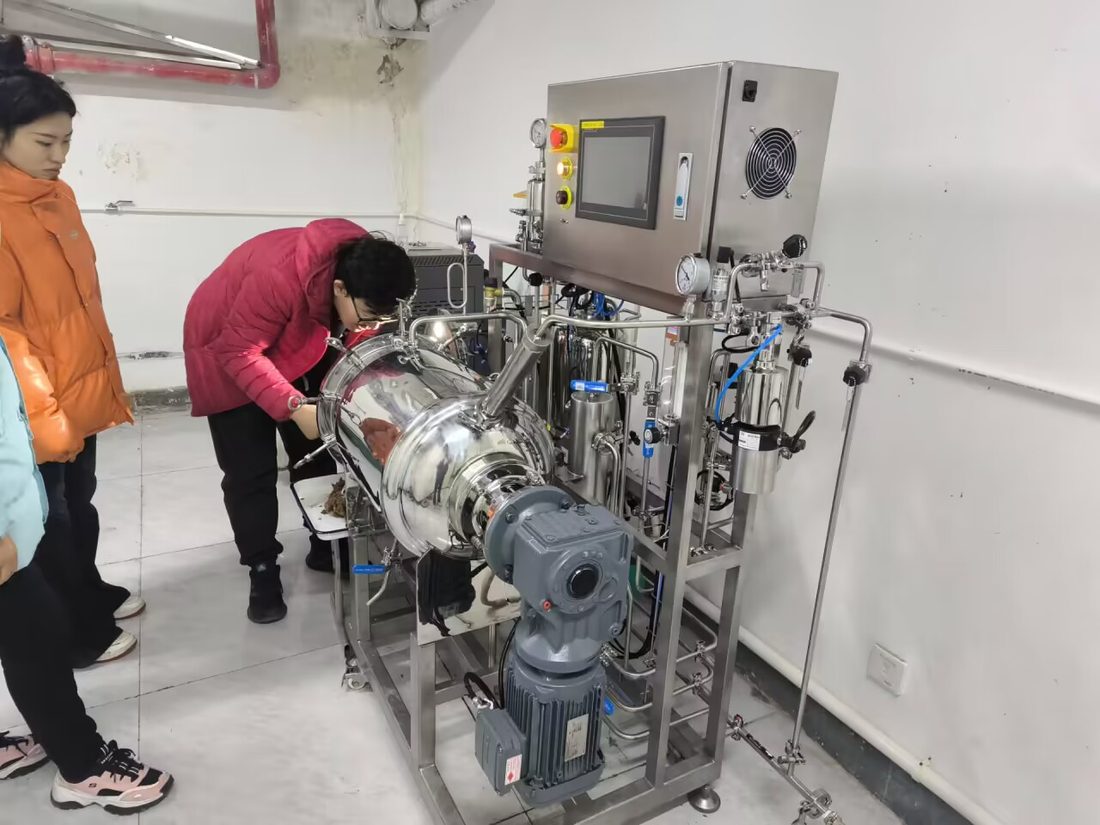
Factory Acceptance Test

STAGE 01

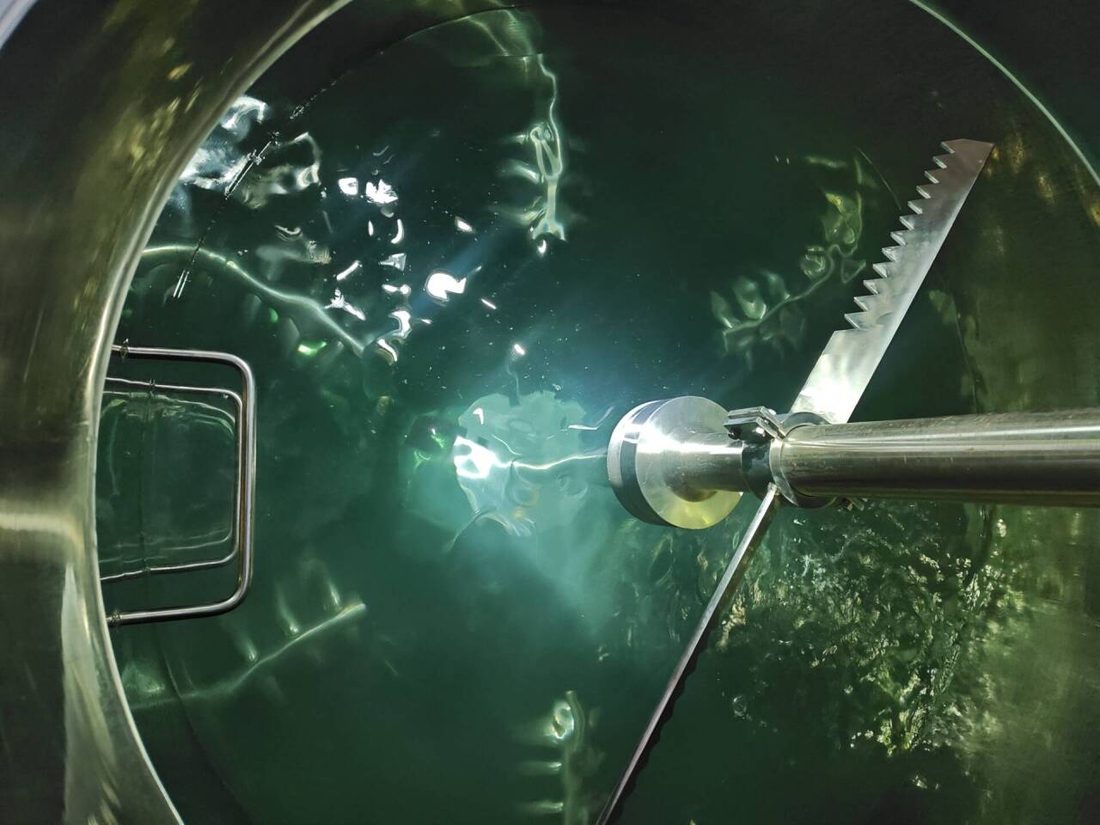
Factory Acceptance Test

Every control function, alarm and SIP/CIP cycle is verified before shipment. The methanol loop runs a 72-hour simulated fermentation with step changes and fault injection.
Site Acceptance Test

STAGE 02

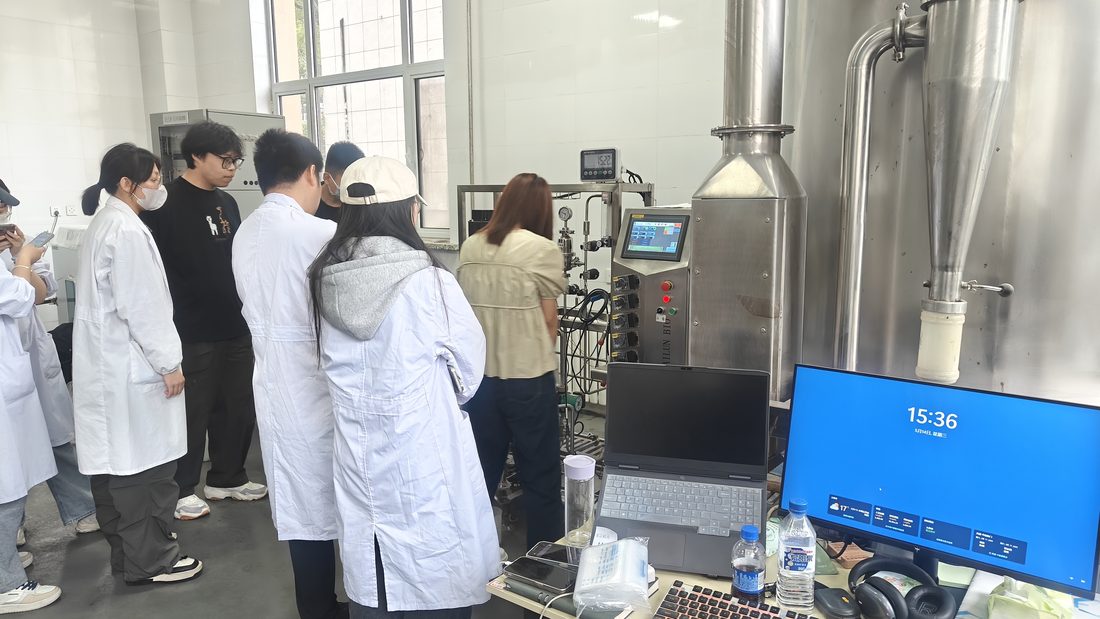
Site Acceptance Test

Water runs confirm kLa of at least 300 h−1. SIP thermal mapping uses 12 thermocouples and biological indicators across three consecutive cycles.
Commissioning

STAGE 03

Commissioning

Handover follows three consecutive successful fermentation runs at 150 g/L DCW or higher and operator training.

  1. Control verified
  2. Performance proven
  3. Process released

Process control & validation specification

Control algorithm logic

Adaptive PID with gain scheduling on dissolved oxygen, an exponential base feed and GC-driven feedback.
Sample values shown for illustration.

Active methanol (M)

0.216g/L, optimal

Loop gain (Kp)

0.842scheduled

System health

99.8%zero faults

Current growth rate

0.152h⁻¹, stable

Core equation

F(t) = F₀·e^(μ·t) + Kp·(M_setpoint − M_actual) + Ki·∫₀ᵗ (M_setpoint − M_actual) dτ

SymbolDescriptionRange / unit
F(t)
Methanol feed rate
0.5–50 L/h
F₀
Base feed rate at t = 0
L/h, user-set
μ
Specific growth rate
0.12–0.18 h⁻¹
M_setpoint
Methanol setpoint
0.2 g/L typical
M_actual
Measured methanol from GC
g/L
Kp, Ki
PID gains, gain scheduled
Kp = 0.8·(1 + 0.05·(DO − 30%))
adaptive_pid_methanol.st
// ADAPTIVE PID BLOCK WITH GAIN SCHEDULING (IEC 61131-3 ST)
IF GC_Data_Valid THEN
  PID.MV := FeedRate_Base * EXP(GrowthRate * T#24h);
  PID.SP := Methanol_Setpoint;          // e.g. 0.2 g/L
  PID.PV := GC_Methanol_Value;
  // Gain scheduling based on dissolved oxygen
  PID.Kp := 0.8 * (1 + 0.05 * (DO_Actual - 30));
  PID.Ki := 0.02;                        // Integral time = 50 s
  PID.Kd := 0.0;                         // Derivative disabled for
stability
  Actual_Feed_Rate := LIMIT(PID.MV, 0.5, 50.0);
ELSE
  Activate_Fallback_Feed();              // Pre-validated exponential
curve
  ALARM 501: "GC OFFLINE - MODEL-BASED FEED ACTIVE";
END_IF;

// Anti-windup protection
IF Actual_Feed_Rate >= 50.0 OR Actual_Feed_Rate <= 0.5 THEN
  PID.Integral := PID.Integral;          // Freeze integrator
END_IF;
real_time_methanol_feed_adjustment.st
// REAL-TIME METHANOL FEED ADJUSTMENT (IEC 61131-3 ST)
F_BASE   := F0 * EXP(mu * T#24h);        // Base exponential feed
GC_VALID := (GC.Status = OK) AND (GC.Timestamp > NOW - T#15m);

IF GC_VALID THEN
  ERROR       := GC.Methanol - SP_Methanol;
  INTEGRAL    := INTEGRAL + (ERROR * dT);
  DERIVATIVE  := (ERROR - PREV_ERROR) / dT;
  F_ADJ       := Kp*ERROR + Ki*INTEGRAL + Kd*DERIVATIVE;
  OUTPUT_RATE := LIMIT(F_BASE + F_ADJ, 0, F_MAX);
ELSE
  OUTPUT_RATE := F_BASE;                 // Fallback mode
  ALARM 501: "GC OFFLINE - MODEL-BASED FEED ACTIVE";
END_IF;
// Anti-windup: clamp INTEGRAL when OUTPUT_RATE is at its limits
sip_automated_sequence.sfc
// SIP AUTOMATED SEQUENCE (Siemens SFC)
PHASE 1: PREPURGE
  Open vent_valve       := TRUE;
  Open condensate_valve := TRUE;
  N2_purge_flow         := 5 L/min;
  Duration              := 5 min;
  // Interlock: N2 flow verified by mass flow meter

PHASE 2: HEATING
  Steam_pressure_SP := 2.5 bar(g);
  Pressure_ramp     := 0.5 bar/min MAX;
  IF (AVG_temp < 115 C) AND (phase_time > 60 min) THEN
    TRIGGER ALARM 601: "HEAT-UP TIMEOUT";
    ABORT_SEQUENCE();
  END_IF;

PHASE 3: STERILIZATION
  Temp_SP    := 121.0-121.5 C;
  Dwell_time := 30 min;
  IF ANY(TEMP[1..12] < 120.5) THEN
    RESTART_DWELL_TIMER();
  END_IF;

PHASE 4: COOLING
  Steam_valve         := CLOSE;
  N2_overlay_pressure := 0.8 bar;
  Cooling_rate        := 0.5 C/min;
  Target_temp         := 80 C;
  // Interlock: vessel pressure monitored during cooling

Control Logic — Pesudocode

Real_time_methanol_feed_adjustment.st
// REAL-TIME METHANOL FEED ADJUSTMENT (IEC 61131-3 ST)
F_BASE := F0 * EXP(μ * T#24h);  // Base exponential feed
GC_VALID := (GC.Status = OK) AND (GC.Timestamp > NOW - T#15m

IF GC_VALID THEN
    ERROR := GC.Methanol - SP_Methanol;
    INTEGRAL := INTEGRAL + (ERROR * dT);
    DERIVATIVE := (ERROR - PREV_ERROR) / dT;
    F_ADJ := Kp*ERROR + Ki*INTEGRAL + Kd*DERIVATIVE;
    OUTPUT_RATE := LIMIT(F_BASE + F_ADJ, 0, F_MAX);
ELSE
    OUTPUT_RATE := F_BASE;  // Fallback mode
    ALARM 501: "GC OFFLINE - MODEL-BASED FEED ACTIVE";
END_IF

// Anti-windup: Clamp INTEGRAL when OUTPUT_RATE at limits

Calibration & Maintenance

  • Pump Tubing — Replace every 10 SIP cycles (certified material: PharMed® BPT).
  • GC Validation — Daily auto-calibration with 100 ppm methanol/N₂ standard.
  • Flow Meter Cal — Weekly 3-point verification (0.5 / 25 / 45 kg/h) using NIST-certified master meter.

One source of truth.

Four review gates, one coordinated package. Keep engineering, validation and operations looking at the same answer.

Back to Top

Variable Definitions

SYMBOLDESCRIPTIONRANGE / UNIT
F(t)Methanol feed rate0.5–50 L/h
F₀Base feed rate at t=0L/h (user-set)
μSpecific growth rate0.12–0.18 h⁻¹
M_setpointMethanol setpoint0.2 g/L (typical)
M_actualMeasured methanol from GCg/L
Kp, KiPID gains (gain-scheduled)Kp = 0.8·(1+0.05·(DO−30%))

PLC Implementation (IEC 61131-3 ST)

adaptive_pid_methanol.st
// ADAPTIVE PID BLOCK WITH GAIN SCHEDULING
IF GC_Data_Valid THEN
    PID.MV := FeedRate_Base * EXP(GrowthRate * T#24h);
    PID.SP := Methanol_Setpoint;  // e.g., 0.2 g/L
    PID.PV := GC_Methanol_Value;
    // Gain scheduling based on dissolved oxygen
    PID.Kp := 0.8 * (1 + 0.05 * (DO_Actual - 30));
    PID.Ki := 0.02;   // Integral time = 50s
    PID.Kd := 0.0;    // Derivative disabled for stability
    Actual_Feed_Rate := LIMIT(PID.MV, 0.5, 50.0);
ELSE
    Activate_Fallback_Feed();  // Pre-validated exponential curve
    ALARM 501: "GC OFFLINE - MODEL-BASED FEED ACTIVE";
END_IF;

// Anti-windup protection
IF Actual_Feed_Rate >= 50.0 OR Actual_Feed_Rate <= 0.5 THEN
    PID.Integral := PID.Integral;  // Freeze integrator
END_IF;

Cybersecurity, data integrity & reproducibility

Locked logic and repeatable evidence

Network segmentation to IEC 62443, recipe lockdown with SHA-256, a tamper-evident audit trail, and the statistical thresholds three validation runs must meet.

  • SHA-256 recipe hashing
  • Role-based access tiers
  • OPC UA with TLS 1.3
  • XML audit trail
ItemRequirement
Recipe
lockdown
SHA-256 hashing of control logic after QA approval
Access tiers
Operator, Engineer and Admin roles; biometric admin login, FAR ≤ 0.001%. Permissions per tier to be confirmed by QA
Audit trail
XML logs: user ID and timestamp for every feed-rate change, plus a checksum of the algorithm code before and after any change
Code signing
PLC logic signed with ECDSA-384
Segmentation
IEC 62443 zone and conduit model, VLANs and firewall
AreaRequirement
Reproducibility
σ of time to 121 °C ≤ 2%; (Max F₀ − Min F₀) / Avg F₀ ≤ 5%
Steam quality
(EN 285:2015)
Non-condensable gases ≤ 3.5% v/v; dryness ≥ 0.95; superheat ≤ 25 °C above saturation
Thermocouples
12× T-type, Omega TJ36-CAXL-116U, ±0.5 °C
Biological indicators
B. stearothermophilus, ≥ 10⁶ spores per vial, at 3 locations
Data sampling
1 Hz continuous, synchronized across all channels

SIP cycle reproducibility

Thermal performance

Validation-grade thermal specifications for steam sterilization of the fermentation vessel and the feed skid.

1.0 ± 0.2 °C/minHeat-up rate
121.0–121.5 °CDwell temperature
≥ 45 minF₀ equivalent lethality
TC #12 ≥ 121 °CCold spot, drain valve dead-leg
ParameterRequirementMeasurement method
Heat-up rate
1.0 ± 0.2 °C/min
12× RTDs (Pt100, ±0.1 °C)
Dwell temperature
121.0 to 121.5 °C at all probes
Data logger, 1 Hz sampling
F₀
≥ 45 min, equivalent lethality at
121.1 °C
Integrated from the logged
profile
Cold spot
≥ 121 °C in the drain valve dead-leg
(TC #12)
Wireless datalogger (Ellab
TrackSense)

F₀ calculation

F₀ = ∫₀ᵗ 10^((T(τ) − 121.1) / 10) dτ

Integrated per probe across the full cycle, with acceptance at F₀ ≥ 45 min at every mapped point (PDA TR01).

Vendor testing & deliverables

Test cases with explicit pass and fail criteria

Factory and site acceptance protocols, referenced by test case number so QA can match each result to its clause.

Test caseMethodAcceptance
TC-107 step response
OUR step change 50 →
150 mmol/L/h
Settling ≤ 15 min,
overshoot ≤ 5%
TC-108 fault recovery
Simulated GC failure at
t = 12 h
Fallback within 30 s;
methanol drift ≤ 0.05
g/L over 4 h
TC-109 accuracy
Calibrated load cell vs
flow meter, 72 h continuous
Cumulative error ≤
0.5% over 72 h
Automation FAT
OPC UA test with
historian, 500 tags at 1 Hz
All tags logged; fault
injection handled
Methanol feed FAT
72 h simulated
fermentation, OUR 10 → 150
mmol/L/h
Feed deviation ≤ ±2%
of setpoint
Test caseMethodAcceptance
TC-213 thermal
mapping
12 thermocouples + 3
biological indicators
All BIs negative; F₀ ≥
45 min at all probes
TC-215 worst-case
drain
5000 L water + thermowell
blocks at drain points
Drain TC ≥ 121 °C for
the full 30 min dwell
TC-218 condensate
TOC
Post-SIP drain sampling,
HPLC analysis
TOC ≤ 500 ppb
Utility SAT, SIP
All validation ports
121 °C ±1 °C for 30 min
Utility SAT, CIP
Spray device velocity check
≥ 5 m/s per ASME
BPE

Site planning

Utility requirements and safety systems

Utilities at the tie-in point

Pure steam
1000 kg/h @ 3 bar(g); dryness ≥ 0.95
CIP supply
500 L/min @ 3 bar(g); 316L centrifugal pump
WFI rinse
100 L/min @ 2.5 bar(g); TOC ≤ 500 ppb; endotoxin ≤ 0.25 EU/mL (USP <1231>); velocity > 1.5 m/s
Chilled water
25 m³/h @ 4 °C, ΔT 5 °C, via PHE; glycol mix if ambient < 5 °C
Process gases
O₂ 99.5%, N₂ 99.999%, CO₂ 99.9%; 0.1 µm filtered; Bronkhorst MFCs
Compressed air
Oil-free, ISO 8573-1 Class 0, dew point −40 °C; 0.2 µm hydrophobic point-of-use filters
Power
480 VAC, 3-phase, 60 Hz; UPS with 30-min runtime for graceful shutdown
Utility skids
Electropolished; tie-in points marked on vendor P&IDs

Safety & compliance

Pressure relief
Rupture disc + safety valve, ASME VIII, PED certified
Leak detection
Steam-barrier leakage sensor on the double seal
Interlocks
Agitation/O₂ interlock: agitation off if DO < 10% or temperature > 40 °C. SIP pressure/temperature interlocks; SIP aborts on > 0.2 bar deviation
Emergency stop
Category 0 (IEC 60204-1), hardwired to agitator, heaters and gas valves
Functional safety
IEC 61508 SIL 2; ATEX Zone 1 if required
Cybersecurity
IEC 62443-3-3; VLANs and role-based access
Certification
PED 2014/68/EU Cat. IV (replaces 97/23/EC); ASME BPE 2023 stamped reports

Engineering detail

Complete technical specification

Component models, control settings, calibration intervals and test protocols for engineering and QA teams reviewing the system against their URS.

Methanol feed hardware

Feed pump
Watson-Marlow twin-head peristaltic, CIP/SIP capable; 0.5–50 L/day
Pulsation
< ±1%; pump head ≤ ±0.8% at 5 rpm, 10 psi backpressure
Pump failover
Auto-switch to backup pump on torque > 1.5 N·m
Coriolis meter
Endress+Hauser Promass F300, DN15, 0.1–50 kg/h
Meter accuracy
±0.1% of reading + ±0.05% FS; zero stability ±0.05 kg/h; repeatability 0.001%
Meter output
HART 7 with real-time density and viscosity compensation
Control valves
Gemü 818 diaphragm valves, 1.5" TC, EPDM, HART positioners; Cv 4.2
Valve leakage
≤ 10−6 mbar·l/s, helium tested
Off-gas analyser
Siemens Maxum Edition II GC/MS with PLOT-Q column
Methanol detection
0–1000 ppmv; LOD 5 ppb; OPC UA data push to PLC

Methanol feed control logic

Base feed
F(t) = F₀·e^(µt); µ 0.12–0.18 h−1, user-adjustable
Feedback
PID on GC methanol residual; gain scheduled on DO and OUR
Feedforward
Model predictive control from growth kinetics (µmax 0.15 h−1)
Setpoint
Residual methanol, e.g. 0.2 g/L
Output limits
Clamped between 0 and F_max, with integral anti- windup
Data validity
GC reading must be under 15 min old, or fallback starts
Fallback
Pre-validated exponential curve; Alarm 501, GC offline
Safety stop
Methanol > 1 g/L, or DO < 5% for > 5 min
HMI faceplate
Feed rate vs setpoint, residual trend, torque vs power draw to detect pump blockage
Accuracy
Within ±1.5% during cell density shifts above 150 g/L DCW, critical for tox and immunogenicity studies

Calibration & maintenance

Flow meter
Weekly 3-point check (0.5 / 25 / 45 kg/h) against a NIST-certified master meter
Pump tubing
Replace every 10 SIP cycles; PharMed® BPT
Off-gas GC
Daily auto-calibration with 100 ppm methanol in N₂

Factory acceptance test (FAT)

Data link
OPC UA test with historian, 500 tags at 1 Hz
Batch simulation
Simulated batch with fault injection: probe failure, agitator jam
72-hour feed run
OUR steps 10 → 150 mmol/L/h; feed deviation ≤ ±2% of setpoint
Step response
OUR 50 → 150 mmol/L/h; settling ≤ 15 min, overshoot ≤ 5%
TC-107 GC failure
At 12 h: Alarm 501 within 30 s, feed to base curve within ±1%. At 16 h: 100 ppm spike, PID back within 5 min
Fallback drift
Methanol drift ≤ 0.05 g/L over 4 h
Feed accuracy
Load cell vs flow meter; cumulative error ≤ 0.5% over 72 h
Pump occlusion
Torque > 2 N·m switches to the backup pump

Materials, drawings & compliance

316L SS
EN 10204 3.1 certs; Cr 16.5–18.5%, Mo 2.0–2.5%
Leachables
All wetted materials pass USP <661.1> after 50 SIP cycles (200 g/L DCW)
Extractables
Vendor study to ISO 10993-12 with methanol exposure
Dead legs
L/D ≤ 2:1 at all ports (ASME BPE GR-8)
Steam slope
Supply ≥ 1:100 (ASME BPE SD-3.4); trap legs ≥ 1:50 on P&ID
P&IDs
Show automation interfaces (Ethernet/IP networks) and utility tie-ins
Loop diagram
Methanol meter 4–20 mA + HART to AI channel 17; RTDs on 03A (primary) and 03B (backup)
Traceability
Algorithm linked to URS clauses (ASME BPE GR-7)
Instruments
NIST-traceable calibration certificates for all instruments

Advanced control strategies

DO and pH
Adaptive-tuning PID plus feedforward that anticipates metabolic shifts; cascade blending of O₂, N₂ and CO₂
Methanol feed
Exponential feed driven by oxygen uptake rate, with feedback from off-gas analysis
Pressure
Proportional control of the backpressure valve
Foam
Antifoam dosed by pulsed peristaltic pump, 0.1 to 5 mL/min resolution
Agitation
VFD driven, 0 to 120 rpm, with torque monitoring and shear-stress alarms above 50 N·m

SIP hardware

Steam inlet
2" TC, 45° downward, laser-aligned per ASME BPE Fig. DT-3-2
Condensate drain
0.5" TC; dual TLV J3S steam traps (duty + backup); free-draining legs
Condensate temp
Discharge ≤ 95 °C, tracked with wireless loggers
Thermowells
12 pockets, depth 80% of shell ID; FEM analysis ΔT ≤ 0.3 °C
Validation ports
3× (top / middle / bottom), thermocouples ±0.5 °C
Steam PID
Kp −0.75 bar/°C, Ki −0.02 bar/°C·s, Kd 0; setpoint 121.5 °C
Valve deadband
±0.2 °C to prevent valve chatter
Heat-up ramp
Steam to 2.5 bar(g) at max 0.5 bar/min
Cool-down
Pressure-controlled venting; overpressure > 0.5 bar, ±0.1 bar
Steam quality
EN 285: non-condensables ≤ 3.5%, dryness ≥ 0.95

SIP validation

Mapping
12× T-type thermocouples (Omega TJ36, ±0.5 °C) per ASME BPE TD-2.0
Probe locations
Vessel bottom (TC01), top headspace (TC03), spray ball dead-legs (TC07, TC09), drain valve stem (TC12)
Cold spot
Drain valve dead-leg ≥ 121 °C; Ellab TrackSense wireless logger
Lethality
F₀ ≥ 45 min at all points (PDA TR01); Min/Max F₀ ≥ 0.98
Uniformity
Max/min spread ≤ 1 °C across probes; dwell σ < 5 s
Worst case
5000 L water plus thermowell dummy blocks; drain TC ≥ 121 °C for 30 min
Utility SAT
121 °C ±1 °C for 30 min at every validation port
Revalidation
SIP recipes revalidated after any steam system change

Automation hardware

Platform
Siemens PCS 7 or Emerson DeltaV
PLC
Redundant Siemens S7-1500H or Emerson PACSystems RX3i; dual CPUs, hot-swap failover
I/O modules
HART-enabled: 8 AI, 6 AO, 16 DI, 12 DO; intrinsically safe for ATEX Zone 1 if needed
Servers
Virtualized (VMware ESXi); redundant historians; SQL database
HMI
2× 24" rugged touch panels, 1920×1080; redundant servers
Remote access
VPN / VDI

Software & data integrity

SCADA
Siemens WinCC OA V7.5 or Rockwell FactoryTalk View SE
Process library
Pre-configured Pichia pastoris growth-phase templates
Batch control
ISA-88 / S88.01; at least 10 recipes with phase logic
Reporting
Automated PDF / Excel batch reports with all parameters and events
Trends
Real-time trend analysis, 90 days at 1 s
Audit trail
XML logs: event type, user ID, old and new value, SHA-256 checksum
Encryption
AES-256; automatic daily backup to NAS
Integration
OPC UA and MQTT to MES / ERP
Alarms
Visual, audio, email and SMS; rationalized for 500+ monitored tags

Cybersecurity

Standard
IEC 62443-3-3; zone firewall and VLAN segmentation
Access roles
Operator / Engineer / Admin
Admin login
Biometric, FAR ≤ 0.001%
Code integrity
PLC code signed with ECDSA-384; logic locked by SHA- 256 hash after QA
Recipe access
Role-based encryption keys

Site acceptance test (SAT)

Oxygen transfer
Water runs, kLa ≥ 300 h−1
SIP mapping
12 thermocouples + 3 biological indicators (B. stearothermophilus); all BIs negative
CIP
Spray device velocity ≥ 5 m/s (ASME BPE)
TC-213 condensate
Flow ≥ 1.5 kg/min at 2.5 bar(g); 3× 100 mL samples, TOC ≤ 200 ppb (Shimadzu TOC-L)
Commissioning
3 consecutive runs at ≥ 150 g/L DCW

Documentation & deliverables

The handover is part of the deliverable

One source of truth. Four evidence buckets.

A production asset is only procurement-ready when drawings, certificates, validation templates and manuals are as traceable as the steel. Four review gates, one coordinated package, so engineering, validation and operations all look at the same answer.

Design documentation

  • P&ID and GA drawings
  • As-built P&IDs with ASME BPE symbols (Fig. PI-1)
  • Surface finish reports
  • Instrument loop diagrams

Compliance certificates

  • PED Declaration of Conformity
  • ASME BPE 2023 stamped design reports
  • EN 10204 3.1 material certificates
  • Steam quality certificates (EN 285:2015)

Validation support

  • IQ/OQ templates
  • FAT and SAT protocols
  • NIST-traceable calibration certificates
  • SIP thermal mapping reports (ISO 17665-1)
  • Loop test reports

Manuals

  • Operation manual
  • Maintenance manual
  • Troubleshooting manual
  • Operator training material

Methanol control dossier

  • Traceability matrix: algorithm to URS clauses (ASME BPE GR-7)
  • FAT records of 72 h simulated runs with raw data
  • Methanol feed validation report with MPC coefficients

SIP validation package

  • Thermal mapping reports, 3 consecutive runs
  • Steam quality certificates, per cycle
  • TC calibration certificates, ±0.1 °C, all 12 probes
  • SIP raw data, CSV at 1 Hz, 12 channels

Cybersecurity file

  • Network segregation diagram, IEC 62443 zone and conduit model
  • Code signing certificate for PLC logic
  • IEC 62443-3-3 risk assessment
  • Extractables study (ISO 10993-12)

Pre-shipment deliverables checklist

Documentation package

What ships with the system

Request the full spec sheet
  • P&ID and GA drawings
  • As-built P&IDs with ASME BPE symbols (Fig. PI-1)
  • EN 10204 3.1 material certificates
  • Surface finish reports
  • PED Declaration of Conformity
  • ASME BPE stamped design reports
  • Traceable compliance matrix for every URS clause
  • FAT and SAT protocols
  • FAT videos of methanol feed step response
  • IQ/OQ templates
  • NIST-traceable calibration certificates
  • Loop test reports
  • Methanol control dossier with MPC coefficients
  • SIP thermal mapping reports (ISO 17665-1)
  • SIP raw data, CSV at 1 Hz, 12 channels
  • Steam quality certificates (EN 285:2015)
  • IEC 62443-3-3 cybersecurity risk assessment
  • Network diagram and PLC code signing certificate
  • Operation, maintenance and troubleshooting manuals
  • Extractables study (ISO 10993-12)

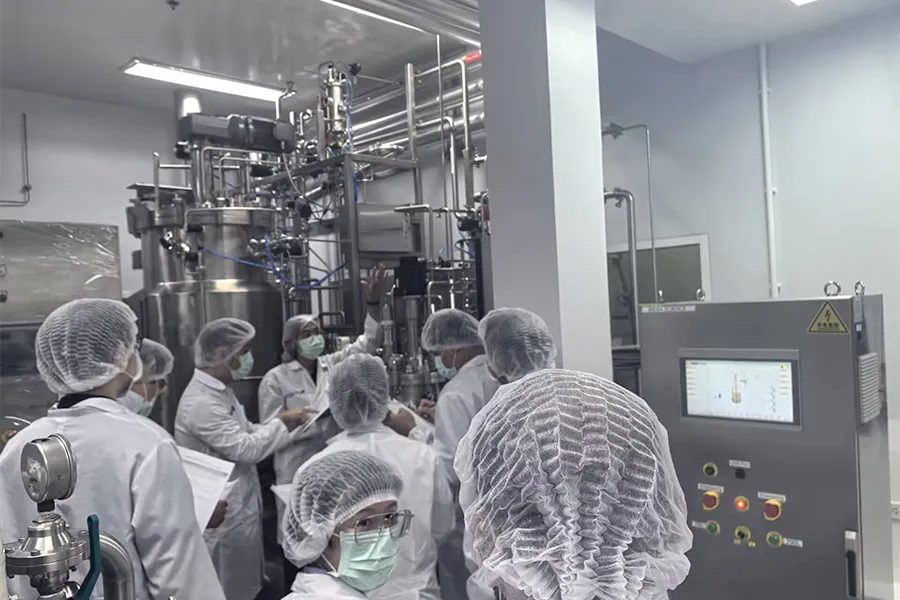
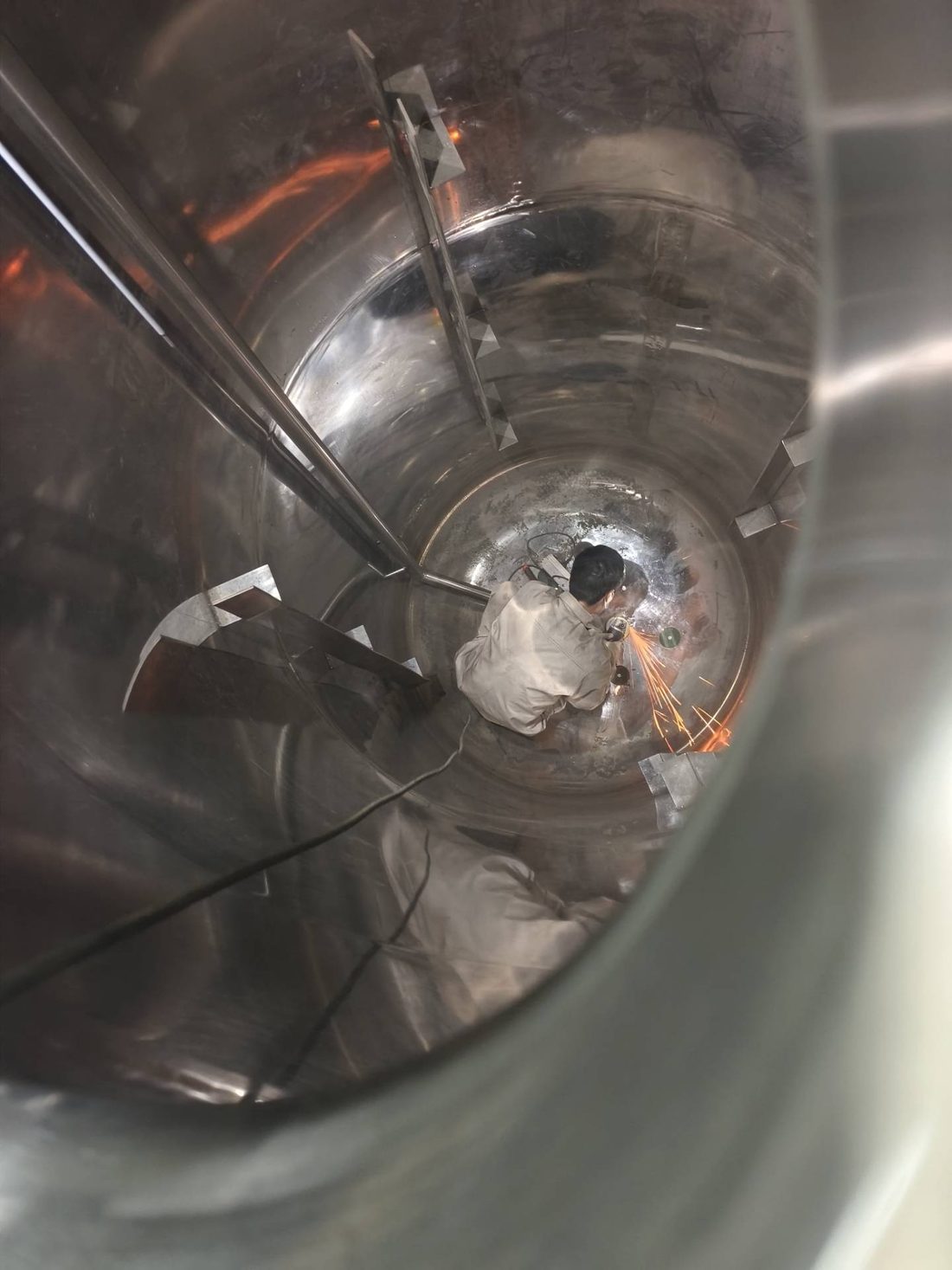
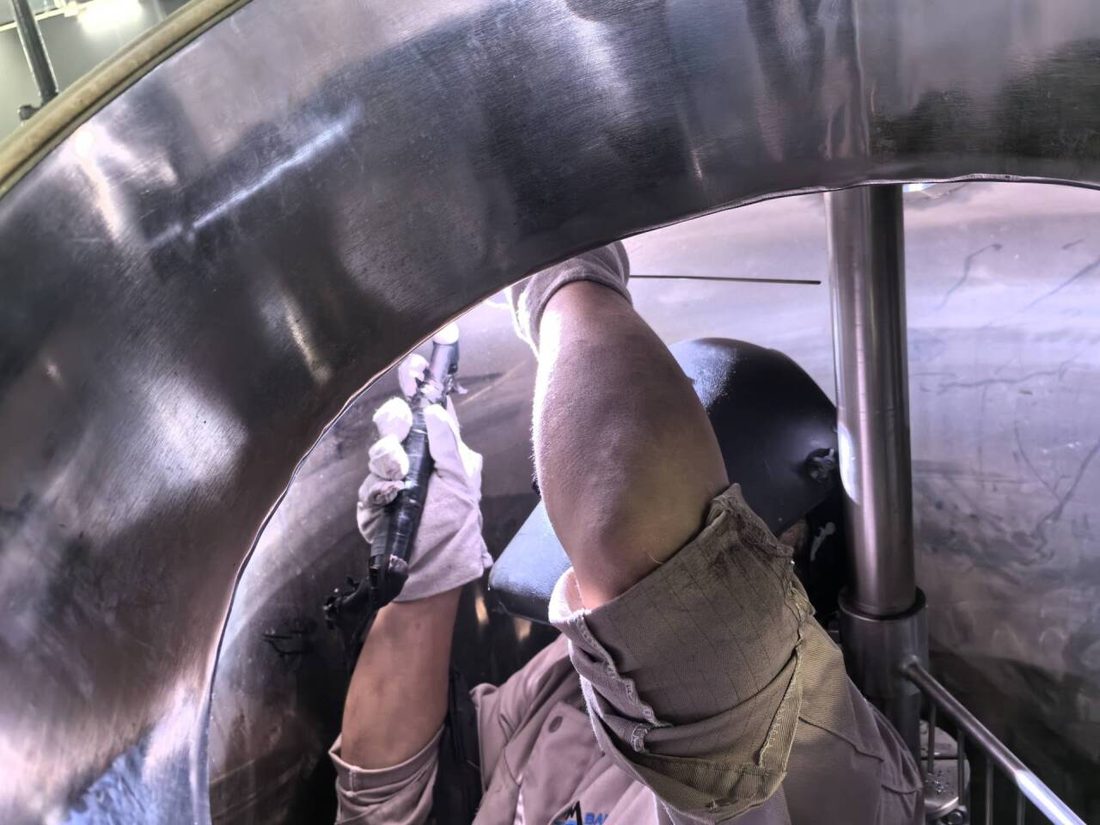
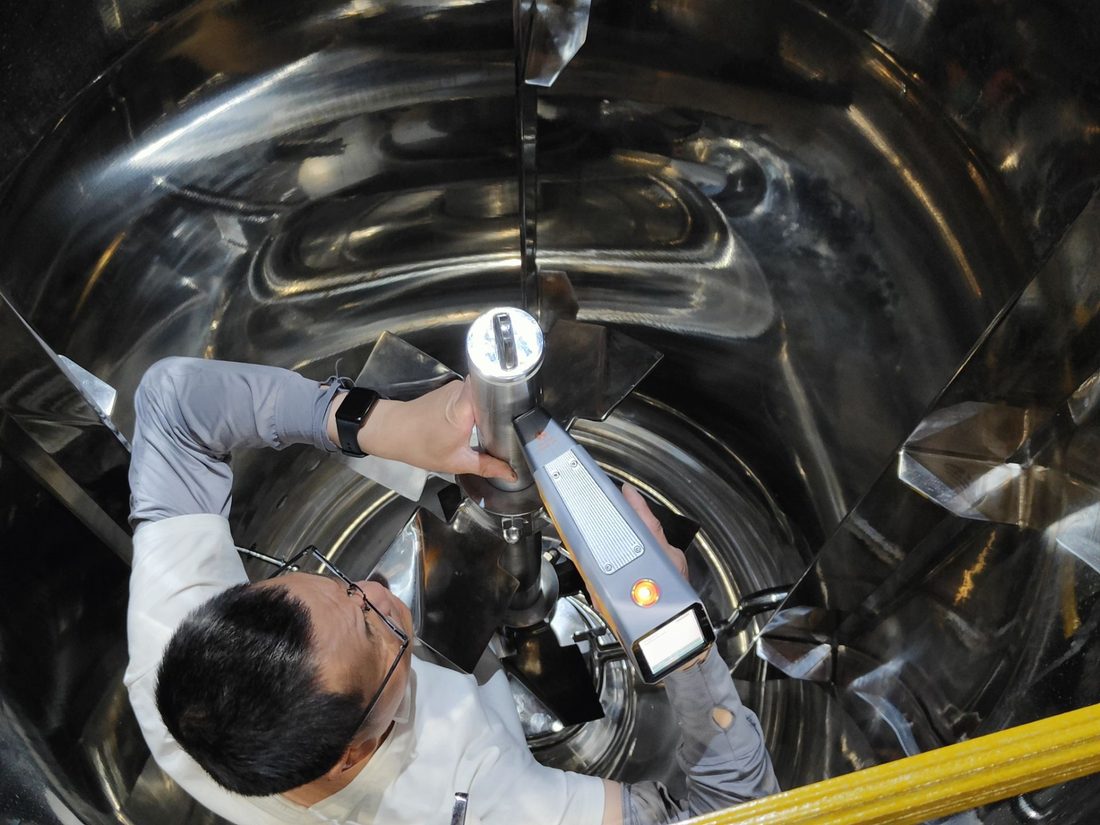
KNIK workshop

Inside the build

OUR CLIENTS

Bionovatic logo
Artechno logo
AstraZeneca logo
Biocon logo

Send us your URS

Share your URS or project brief. Our engineers review it and reply within 24 hours.

grace@kniktech.com

+86 139 6800 6641

HQ: No.48 Liuxiang Road, Jiading District, Shanghai, China

You can attach your URS or P&ID in the reply email.