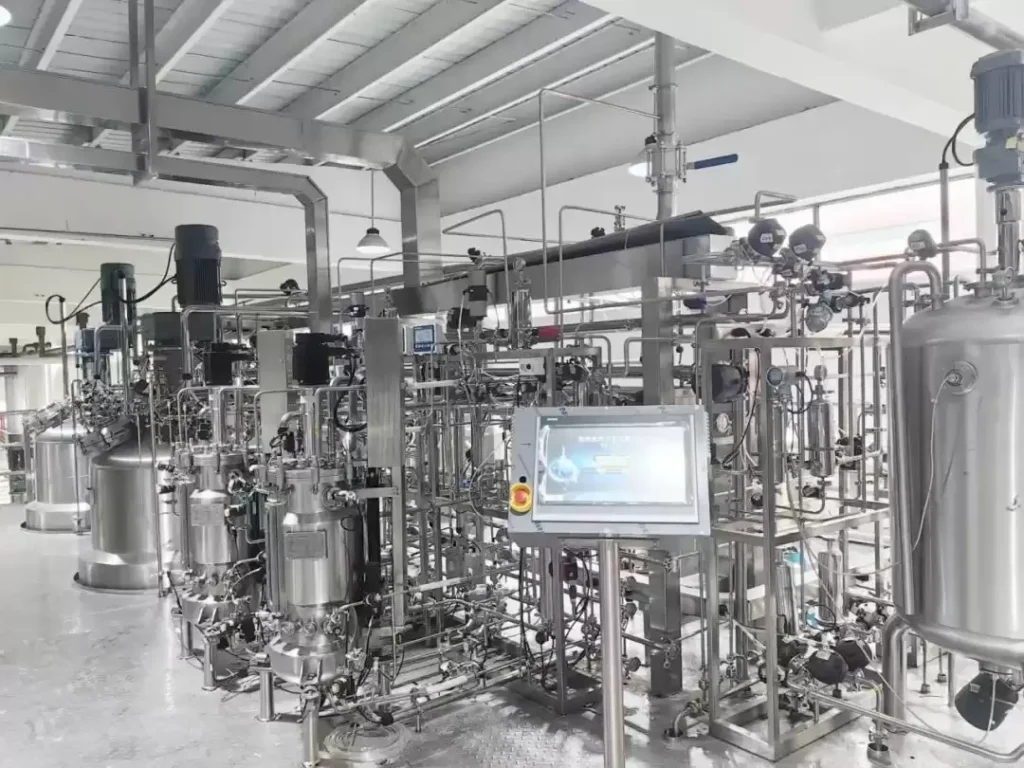
Introduction
With the development of modern science and technology and the advancement of biomanufacturing technology, more and more scientists have begun to study the application of artificial intelligence technology in the field of biomanufacturing. Artificial intelligence technology can help biomanufacturing achieve highly precise operations and optimize the production process, improving product quality and efficiency. This article will start with basic biomanufacturing technology and artificial intelligence technology, and discuss the application of the combination of the two in biomanufacturing.
◆Basic biomanufacturing technology
Biomanufacturing is the use of modern chemistry, biology, and engineering technologies to produce high-quality chemicals, drugs, nutrients, and biological products that can be used in medical treatment, daily life, and industry through biological manufacturing technologies such as biological reactions and heating. Compared with traditional manufacturing methods, biomanufacturing has the following advantages:
❶environmental protection
Biomanufactured products use natural resources and organisms instead of traditional chemical raw materials to reduce environmental pollution.
❷Efficient production
High automation in biomanufacturing
❸high quality products
Biomanufactured products undergo highly precise processes that produce substances that are highly pure and precisely meet specific needs.
◆Application of artificial intelligence technology
Artificial intelligence technology has many applications in biomanufacturing and can achieve the following goals:
❶Optimize production process
Artificial intelligence technology can realize the visualization of the manufacturing process and provide convenience for technicians to quickly improve production efficiency and optimize processes. It supports real-time production process optimization and adjustment, and improves production efficiency and benefits.
❷Automatic detection and quality control
By integrating vision, computer vision, machine learning and other technologies, artificial intelligence can reduce quality variation and ensure the production of high-quality products. Sensors applying machine learning technology enable real-time detection and feedback, which can help control production variables to achieve consistency with specifications. In this way, not only the quality of the product is guaranteed, but productivity is also substantially improved.
❸Intelligent decision-making
Using machine learning, adaptive control algorithms and sensors to collect and process production process information and quality characteristics, accurate offline decision-making has been achieved. Based on multiple sources of research data, production processes and related quality characteristics, intelligent decision-making can consider a range of production effect parameters. to automatically adjust production equipment and processes.
◆Case analysis
The following uses some cases to describe in detail the application of artificial intelligence technology in biomanufacturing:
❶Intelligent control of biological production systems based on deep neural networks: Deep neural network algorithms have been successfully used to predict key biological parameters, such as the concentration of red blood cells and chlorophyll in the beer brewing process, and the prediction of biochemical changes in yeast, effectively monitoring and controlling production. process.
❷Spectral analysis based on score reporting and deep learning: The basic technology of using optical spectrum analysis technology to infer the mass of matter has applications in many fields. This technology combined with deep learning can scan biological materials through laser heating technology to achieve characterization properties. depth image. This can minimize dependence on personnel, save a lot of resources and time, and improve production efficiency and quality.
❸Optimized manufacturing forecasting based on machine learning: Using machine learning technology to optimize production process forecasting relies on previous production data to directly predict future results. The algorithm could, for example, call on this data in a library of algorithms to predict whether drugs need to be added to speed up production, and also to decide which formulation will make the most effective biomaterial. This will greatly improve production efficiency, reduce production costs, and reduce environmental pollution.
◆Trends and Research Outlook
In terms of research, artificial intelligence applications will continue to play an important role in the future. Artificial intelligence will help the biomanufacturing industry respond to changing environments and needs, and promote the development of biomanufacturing technology in a more advanced, automated, and intelligent direction.
In terms of trends, with the promotion and application of more successful artificial intelligence technology, we will see more AI companies participating in biomanufacturing, which will promote continued innovation and progress in biomanufacturing technology. In addition, artificial intelligence technology is also widely used in the medical field. In the future, the integration of biomanufacturing technology and the medical field may bring about more revolutionary technological innovations.
By optimizing production processes and improving product quality and efficiency through artificial intelligence technology, the biomanufacturing industry will usher in a higher-end, automated, and intelligent production model. In future exploration, artificial intelligence will play a very important role in supporting biomanufacturing to meet new challenges and broaden new development directions.