
Vero cells are African green monkey kidney cells, a kind of aneuploid cells, which are isolated and cultured from the kidney epithelial cells of African green monkeys. Vero cell lines are continuous aneuploid cells that can go through many division cycles without senescence.Compared with primary cells and diploid cells produced as vaccines, Vero cells have the following characteristics:
● The source is convenient, the growth speed is fast, easy to cultivate, sensitive to the infection of various viruses, and the titer of virus proliferation is high;
● Stable genetic traits, low degree of malignant transformation, can be used in the production of biological products;
● Large-scale cultivation can be carried out by means of microcarrier and suspension culture.
Vero cells have been approved for the production of many human viral vaccines such as rabies vaccine, influenza vaccine, polio vaccine, etc. in the past two decades.
VERO large-scale culture technology
The technical process of large-scale culture of VERO cells after suspension acclimation is limited in the production of biopharmaceuticals, and the technical process is not yet mature. Therefore, in actual production and application, VERO’s culture technology used in the large-scale production of biopharmaceuticals generally adopts the microcarrier suspension culture mode. This culture mode combines monolayer culture and suspension culture, and has the advantages of both methods. Compared with the training method, it shows great advantages:
● The microcarrier culture system has the highest surface area/volume ratio, which can provide sufficient surface area for cell attachment and growth in a small space, and the yield of cultured cells per unit volume is greatly high. Compared with two-dimensional culture, it is not limited by surface area, so that it is possible to obtain higher cell density;
● After chemical modification, the microcarrier has no toxicity to cells, has a size and surface more suitable for cell growth, and has a certain degree of transparency, which can directly observe the attachment, expansion and growth of adherent cells under a microscope;
● The microcarrier is suspended in the culture medium, which provides a uniform growth environment for the cells. The culture parameters (such as pH, gas pressure, DO, etc.) are easy to monitor and control online, and the production process is more repeatable;
● The cell harvesting process is simple, reducing the waste of human, physical and financial resources, low labor intensity, easy operation, less personnel required, greatly reducing pollution, and the process is easy to scale up production.
VERO microsphere carrier 3D culture solution
Seed cell recovery culture:
Frozen VERO cells were revived in a water bath at 37°C, seeded in T175 culture flasks at a density of 40,000cell/cm2, and cultured. After 4-5 days, observe that the cells had grown to double layers and could be digested (300,000-350,000cell/cm2).
VREO subculture and amplification culture:
VERO cells were digested and inoculated at 40,000cell/cm2 into a 10-layer cell factory for amplified culture until the amount of cells required for carrier culture in the upper bioreactor was reached.
Carrier handling and bagging preparation:
Prepare the spherical carrier required for bagging at 3g/L, and hydrate each gram of carrier with 100mL of DPBS in a siliconized container. Wait for the carrier to absorb water, swell and settle, and stir gently for at least 3 hours.
Remove the supernatant, re-add DPBS at 50 mL per gram of carrier, stir gently, let stand for more than 15 minutes, and remove the supernatant. Re-add DPBS and sterilize.
After the carrier is cooled to room temperature, it is pumped into 2LCES-BAG. After the carrier settles, the supernatant is discharged through the perfusion membrane. Afterwards, use medium to rinse once, add 100mL of medium per gram of carrier again, set the angle to 4, the speed to 10, turn on the temperature control at 36.5°C, and inject 5% CO2 equilibrium medium (pH 7 .2-7.4).
VERO bag inoculation:
1. Calculate the amount of inoculated cells according to the surface area of the carrier, add the cell suspension digested by the cell factory into the pre-balanced 2LCES-BAG with 3g/L microcarriers at 40000cell/cm2, and control the culture volume to 1L.
2. Set the CES parameters at a temperature of 36.5°C, an angle of 6°, and a speed of 16 rpm, and run for 5 minutes to fully contact the carrier with the VERO cell suspension;
3. Set the CES parameters at a temperature of 36.5°C, an angle of 1°, and a speed of 1 rpm, and run for 2 hours at a low angle of speed to provide a stable environment and promote cell attachment.
4. Repeat steps 2 to 3 for 2 to 3 times, and observe the cell adhesion under the microscope.
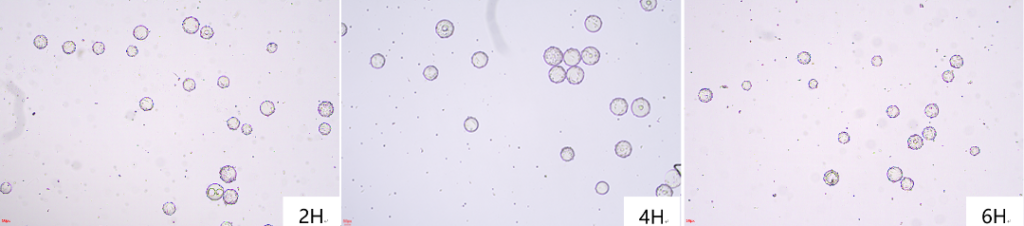
With the prolongation of standing time, 2h-4h-6h free VERO cells decreased continuously, and gradually adhered and stretched.
VERO cell expansion culture:
Start the cultivation (D0), set and run the CES parameters at a temperature of 37°C, an angle of 4°, and a speed of 6rpm. Samples are taken every day for observation and to detect the contents of glucose and lactic acid.
D2 increases the rotating speed to 8rpm, and continues to cultivate.
Perfusion was started on D3, and continuous perfusion culture was carried out at 1L/24h.
VERO Harvesting & Counting:
On D5, cells were collected by trypsinization, stained with crystal violet and counted (harvested cells can be used for next-level scale-up culture).
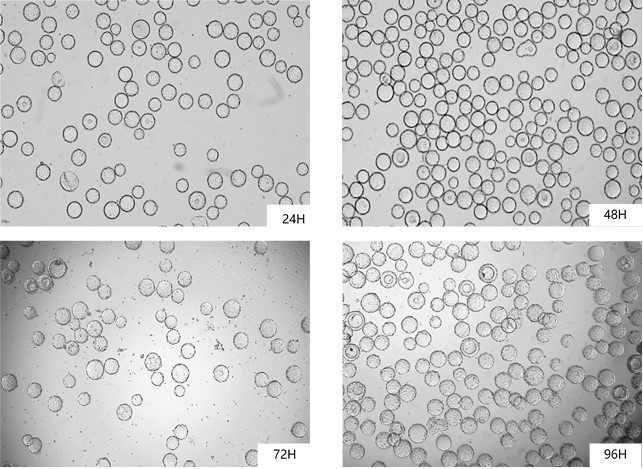
Comparison of TNC before and after VERO microsphere carrier culture and expansion
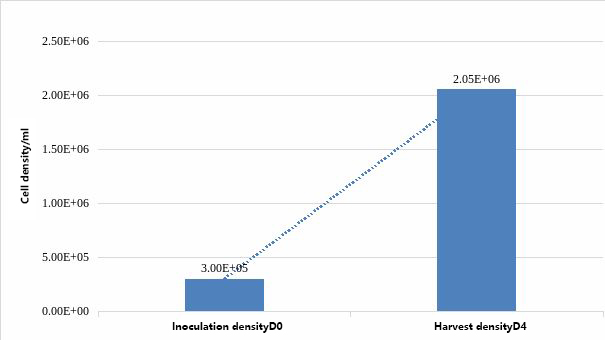
It can be seen from the figure above that VERO was inoculated at 3E5/mL into the microsphere carrier for culture. Under the culture system composed of serum-free medium, the cell density reached 2.05E6/mL on D4, the cell expansion was 6.83 times, and the average doubling time PDT was 34.625h.