
In early March, the White House unveiled a 64-page plan outlining goals to strengthen U.S. biotechnology and biomanufacturing, including deployments to agriculture, commerce, and health and human services.
No news from the Department of Defense, but that doesn’t mean the Pentagon doesn’t understand how a stronger national biomanufacturing can enhance national security.
President Biden announced his executive order in September 2022 calling for a “whole-of-government approach” to homegrown innovation in biomanufacturing to address issues ranging from healthcare and climate change to supply chain resiliency, energy, economic and national security all questions. Two days later, the Ministry of Defense confirmed that it plans to spend $1.2 billion over five years to establish a domestic biomanufacturing industrial base, while developing biosafety and cybersecurity-related policies for these facilities and improving supply chain resilience.
“The Department of Defense recognizes that biotechnology is a critical technology area that will transform the way the Department of Defense develops new capabilities, executes missions, and adapts to major global changes,” Heidi Shyu, undersecretary of defense for research and engineering, said at the time. The executive order will advance and synchronize Department of Defense and Federal Government programs to strategically leverage biotechnology to maintain our Nation’s economic, military, and technological advantages.”
The Biotech Market Is Soaring
Biotechnology is the use of biological mechanisms to create products. The market is booming and is expected to grow from US$372.8 billion in 2021 to more than US$1.3 trillion by 2030. The market is huge and involves everything from food and medicine to fuels, chemicals and construction materials. Progress in many of these areas will have a positive impact on the defense establishment. For example, better nutritious food and medical care will result in better armies and navies.
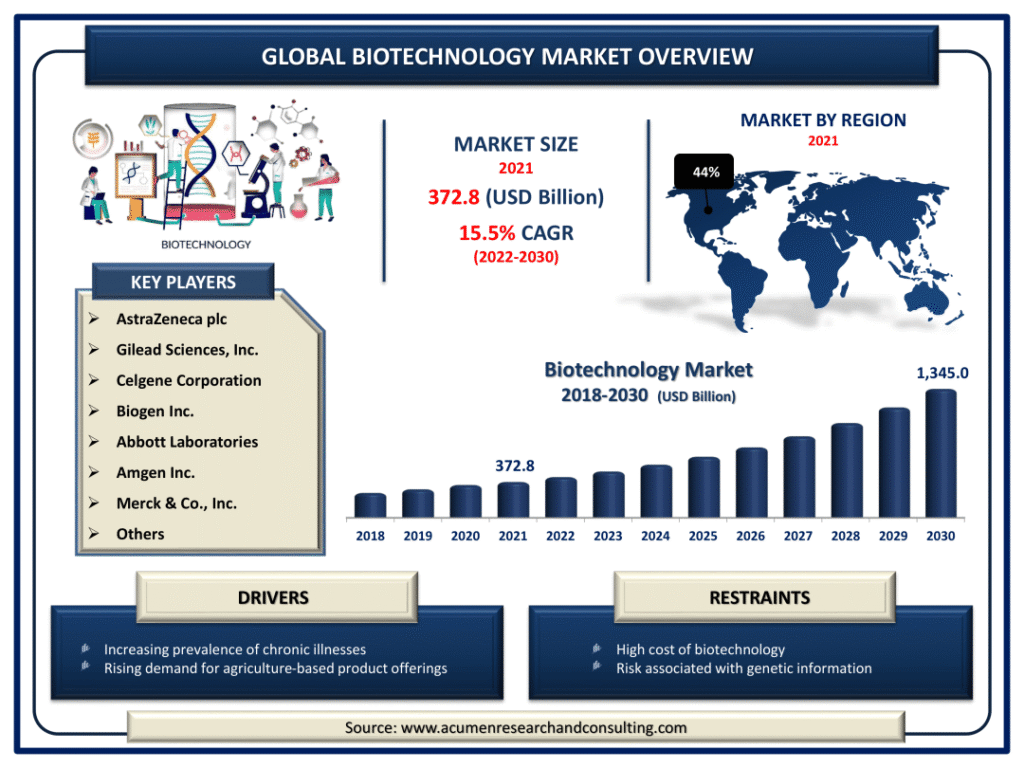
Global Biotechnology Market Overview
Image source Acumen Research and Consulting
But biotechnology and the biomanufacturing that supports it will spread its tentacles into myriad areas of the military.
RAND Corporation researchers Timothy Marler and Daniel Gerstein wrote in an October 2022 report: “Applications that can support the rapidly emerging bioeconomy could also have major national security implications. Using engineered biomaterials could provide The ability to rapidly prepare camps, construct structures and monitor the environment. Defense capabilities and the ability to sense attacks may be priorities for addressing these issues.”
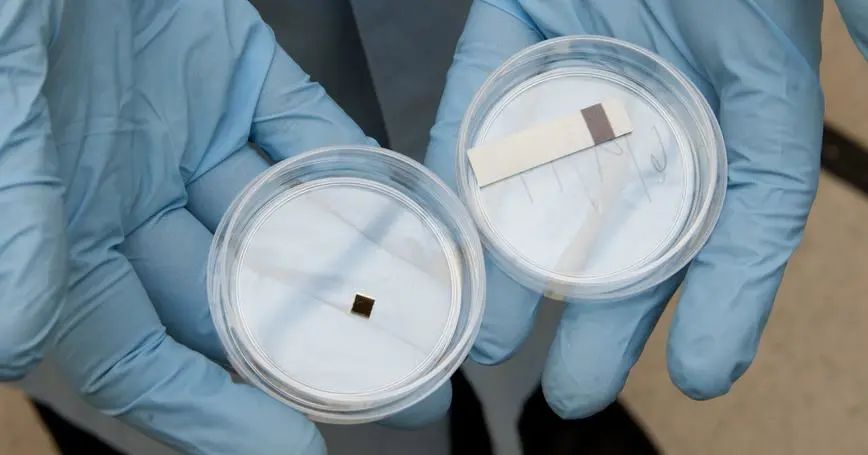
A scientist holds a biosensing material he is working on at the U.S. Army Research Laboratory in Adelphi, Maryland, on Jan. 15, 2015. Source: U.S. Army
Department of Defense and its biomanufacturing strategy
Weeks after the White House released its “Great Goals for American Biotechnology and Biomanufacturing” plan last month, the Department of Defense unveiled its own strategy for deploying domestic biomanufacturing, a 10-page document that includes There are three main goals:
① Find transition partners for early-stage innovations.
② Expand bio-manufacturing in the United States and allies.
③ Establish indicators to monitor changes in the new field of biomanufacturing.
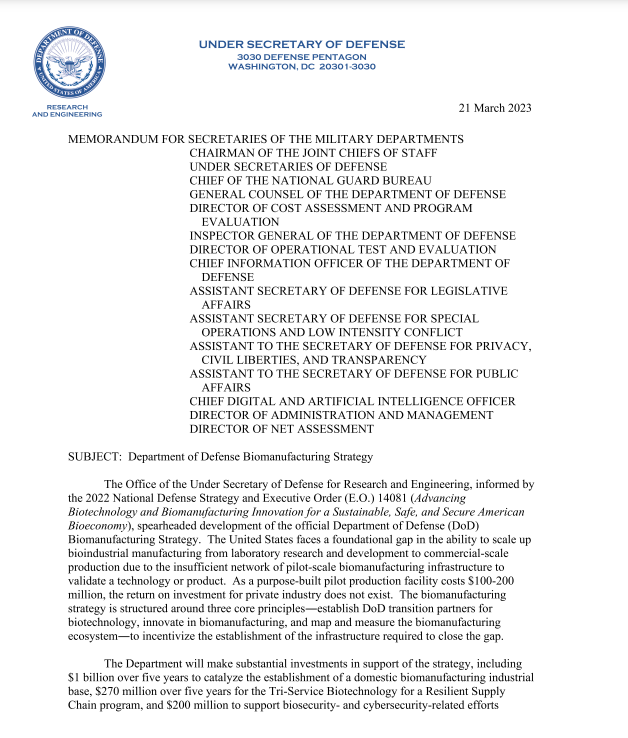
Department of Defense Biomanufacturing Deployment Strategy Source: U.S. Department of Defense
“Biotechnology can support the U.S. military and those of our allies and partners if resources are deployed strategically,” the document reads. “The strategy builds on initial investment in biomanufacturing to accelerate its maturation and use.”
The Department of Defense’s views on the need for a stronger domestic biomanufacturing ecosystem dovetail with the White House’s position. To maintain global dominance in biotechnology, the United States needs to be able to innovate and build within its borders. Significant investment in domestic biomanufacturing is necessary at a time when rivals like China are accelerating their own advances in the global biotech space.
The DoD strategy report reads: “Currently, strategic competitors are investing in flexible ‘multi-product and multi-organism’ biomanufacturing facilities that enable them to produce different products in a single facility to meet product needs. As a result, many U.S. companies It is only a matter of time before US companies go to China for their bio-manufacturing needs and go to Europe for their bio-manufacturing needs.”
Avoiding the Semiconductor Trap
The Defense Department’s strategic report also pointed out that the semiconductor industry will be a cautionary tale as the US’s high-end manufacturing industry loses to regions such as Taiwan. When the new crown pneumonia epidemic broke out, the problem of supply chains relying on other countries to produce important products received full attention. Now, the administration is spending billions on the Chips Act and working with Intel and others to bring more chipmaking facilities to the United States.
The Department of Defense believes that the government must invest in biomanufacturing domestically, and that the Pentagon has a great interest in this because by mitigating supply chain weaknesses, addressing logistical hurdles through demand point manufacturing, and bringing materials with unique properties to the military, Can produce national defense capabilities.
“Biologically derived products, such as chemicals in paint, are already part of the DoD supply chain and are poised to continue to increase in importance in the future,” the report reads. As such, DoD cannot wait for a supply chain crisis for critical biomanufactured products Only then did we discover that the United States had already become dependent on biomanufacturing from rival countries.”
biotechnology and military
According to the RAND Corporation report, the benefits of biotechnology are profound. The report identifies ways to improve performance among military personnel, including improving digestive and mental health by balancing the body microbiome, microorganisms such as fungi, bacteria and viruses, and enhancing the ability to sense the environment. Additionally, the Department of Defense says it is developing advanced neural interfaces to improve cognition and decision-making skills.
The RAND Corporation’s Marler and Gerstein write: “Biomaterials can be used to develop new agents for next-generation explosives, harvest rare-earth materials, enhance armor protection, bio-based construction of airports, and develop specialized Bioresins and polymers. As the field of biotechnology continues to expand, many more useful applications may emerge.”
They also warn that “biotechnology is inherently dual-use” — it can improve every aspect of modern life, but can also be used by international agents or nation-states to create biological weapons or create deadly pathogens. This, they say, is one reason the U.S. government needs to increase its focus and investment in biotechnology and biomanufacturing.
keep an eye on china
Another reason is growing competition with China, where spending on biotech is expected to increase by 7% annually through 2025. Marler and Gerstein also write that China has worked to weaponize biological data and build facilities in the United States and other allies that allow it to gather information on American technology with little scrutiny.
They also pointed out that the outbreak has shown the United States that it is not prepared to respond to a major biological event, a vulnerability that could spill over to the military. RAND researchers noted that a March 2020 COVID-19 outbreak aboard the Theodore Roosevelt aircraft carrier “underscored the challenge of maintaining force health protection and mission readiness in the face of a large-scale biological event.”
The U.S. government’s initial executive orders and strategies are a good start, but they will require more initiatives to balance central coordination with the need for decentralized government and to work closely with the private sector and academic institutions.
Marler and Gerstein write: “As the biotechnology field continues to mature, it will be necessary for the federal government to develop proactive policies to effectively leverage emerging capabilities and remain competitive. Ongoing communication, coordination, and collaboration may help maintain this competitiveness and most effectively support today’s warfighter.”