

Pure beauty originated in Europe and the United States. Once the concept was raised, it quickly spread around the world. In the past two years, brands positioning pure beauty have also emerged in the Chinese market.
On July 10, 2022, the “General Principles of Pure Cosmetics Cosmetics” initiated by MCL Hua Xikou first officially defined pure beauty: pure beauty is a life cycle that should be open, transparent and traceable, responsible for human health and safety, Cosmetics that are environmentally friendly and kind to animals and take social responsibility and humanity. This is the first standard document formulated for pure beauty in China. Since then, China’s pure beauty has gradually entered the “standard era”, and synthetic biology has played a key role.
The rapid development of synthetic biology has driven pure beauty to sweep the cosmetics industry. The traditional production methods of cosmetic raw materials include biological extraction, chemical synthesis and traditional biosynthesis. Synthetic biology, on the other hand, uses transformed organisms as highly efficient cell microfactories for directional, high-efficiency, and large-scale material processing and transformation, which greatly improves production efficiency and reduces input costs.
Compared with the traditional production methods of cosmetic raw materials, synthetic biology replaces non-renewable fossil resources with renewable biological resources, and replaces high-energy and high-pollution petrochemical and coal chemical processes with green and clean biological manufacturing processes, which can effectively solve the high energy consumption of chemical production. , high pollution and other issues, conforming to the current trend of pure beauty.
Take the use of synthetic biology technology to produce squalane as an example. Squalane is skin-friendly and permeable, and can assist in the repair of sensitive skin.
Traditional squalane is obtained by hydrogenating squalene extracted from the liver of deep-sea sharks. Only 1 ton can be extracted from 3,000 sharks, which greatly destroys the ecological balance.

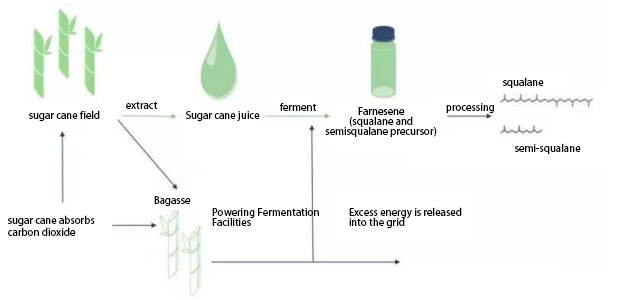
Amyris Corporation of the United States has developed a semi-synthetic pathway starting from sugar fermentation to produce squalene by using synthetic biology, which not only reduces the cost, but also caters to the protection of the ecology. In this business line, Amyris has established cooperation with major manufacturers such as L’Oreal, Estee Lauder, and Yifan Pharmaceutical.
The application of synthetic biology can obtain high economic output through smaller environmental costs, which meets the requirements of pure beauty for environmental friendliness and animal-friendly, or one of the future trends in the production of raw materials for beauty products.
The rapid development of synthetic biology has helped transform the cosmetics industry. The advancement of the three underlying biotechnologies of gene sequencing, gene synthesis, and gene editing has accelerated the development of synthetic biotechnology.
On this basis, by combining artificial intelligence and big data, the use of high-throughput screening technology to further build cell factories may improve production efficiency and produce rare substances in nature on a large scale. Many well-known functional ingredients in life, such as ergothioneine, collagen, salidroside, etc., can be produced through synthetic biotechnology.

Collagen Dynamic Chart
Taking collagen as an example, synthetic biotechnology empowers recombinant collagen to open up new space. Collagen is a key bioactive ingredient used in the field of cosmetics. Its main functions are skin repair and anti-aging. Traditional collagen is usually derived from animal tissues. With the development of synthetic biology technology, the way to obtain collagen has changed.
Compared with animal-derived collagen, recombinant collagen produced by synthetic biology technology has the advantages of higher biological activity and biocompatibility, lower immunogenicity, lower risk of missed pathogens, and no cytotoxicity. At present, it is widely used in the fields of cosmetics and medical dressings.
China is the first country in the world to achieve mass production of recombinant collagen, and has a leading position in the industry. According to Frost & Sullivan’s forecast, the market size of China’s recombinant collagen products will increase from 10.8 billion yuan in 2021 to 108.3 billion yuan in 2027, corresponding to a CAGR of 46.8% from 2021 to 2027.
Many countries have introduced policies to promote the implementation of synthetic biology technology achievements.
At this stage, the recombinant collagens developed by synthetic biology companies still focus on human-like collagens and humanized collagens, and have not successfully mass-produced recombinant human collagens with a complete triple helix structure. The application scenarios mainly focus on relatively low technical thresholds. Low-cost medical dressings and efficacy skin care products.
In the future, with the development of synthetic biology technology, starting from the directional design of collagen molecules, cell factory construction and adaptation regulation, through design, construction, debugging and optimization, we will break through the limitations of natural evolution and realize the quantification of collagen under the guidance of artificial design. Controllable expression, functional directional enhancement and large-scale production are worth looking forward to.

Ergothioneine is found in mushrooms
Under the trend of efficacy and pure beauty, domestic brands have increased their synthetic biology in order to overtake on corners. The domestic cosmetics market is highly competitive. Under this background, some domestic brands have stepped up product research and development, and tried to use synthetic biology as a breakthrough to compete with foreign brands.
1.Juzi Bio is committed to the design, development and production of professional skin care products with recombinant collagen as the key bioactive ingredient, as well as the development and production of functional foods based on rare ginsenoside technology;
2.Bloomage Biotechnology has built a synthetic biology industry chain platform. Through synthetic biology technology, high-purity ergothioneine, 5-ALA, vitamin C glucoside, salidroside and other substances have completed fermentation process verification;
3.Jiabiyou has further improved the underlying technical reserves of synthetic biology, and the development of high value-added products such as sialyllactose, ectoine, and α-arbutin is steadily advancing;
4.With the cutting-edge technology of synthetic biology as the driving force for innovation, Huaheng Biology has launched new bio-based D-panthenol, β-arbutin, 1,3-propanediol and other products that are milder, more efficient and more sustainable.
We believe that whether it is possible to continue to expand the product pipeline of “what no one else has” or the focus of evaluating the company’s competitiveness. In the long run, companies that can achieve technological breakthroughs and enter high value-added applications are expected to build core competition barriers and further open up growth. space.