
With the development of science and technology, solid-state fermentation has changed from traditional open fermentation to closed fermentation, empirical fermentation to controlled fermentation, and manual fermentation to mechanized fermentation, achieving control of parameters in the fermentation process.
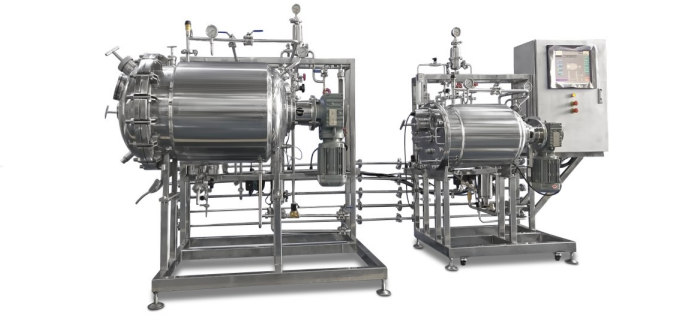
Ⅰ.Closed solid state fermentation technology
Solid-state fermentation (SSF) is a fermentation method of microorganisms on a solid substrate with no or basically no free water. The substrate not only provides nutrients and growth environment for microorganisms, but also contains a continuous gas phase and a small amount of liquid water, making The system remains stable.
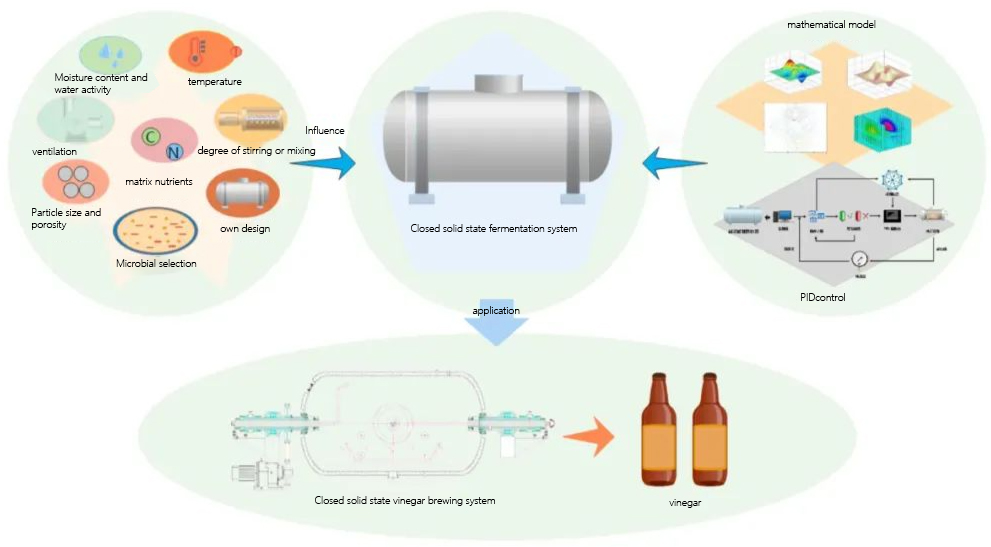
A layer of water film is attached to the surface of the solid matrix, but the liquid phase is not continuous and most of the gaps are filled with the gas phase. The water in the system is mainly adsorbed between the solid matrix particles. Therefore, in the absence or very small amount of free water, microorganisms can still utilize sufficient moisture in the solid matrix to complete growth and metabolism.
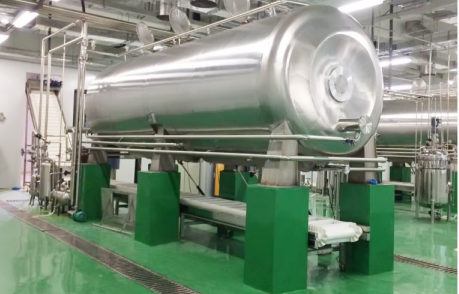
A closed solid-state fermentation system is a space that provides suitable environment and conditions for the growth and metabolism of microorganisms on a solid substrate. It can prevent the entry of external microorganisms and the spillage of internal substances. It must be non-toxic, resistant to vibration, not easy to corrode, and have good stirring, Ventilation, heat dissipation and cooling systems enable aseptic operation.
Ⅱ.Closed solid state fermentation system
Due to the nature of the substrates and organisms used, the mixture in a closed solid-state fermentation system is usually inhomogeneous, which is not conducive to heat and mass transfer. Therefore, different types of closed solid-state fermentation systems can be used to solve the corresponding problems.
01 Disk solid state fermentation system
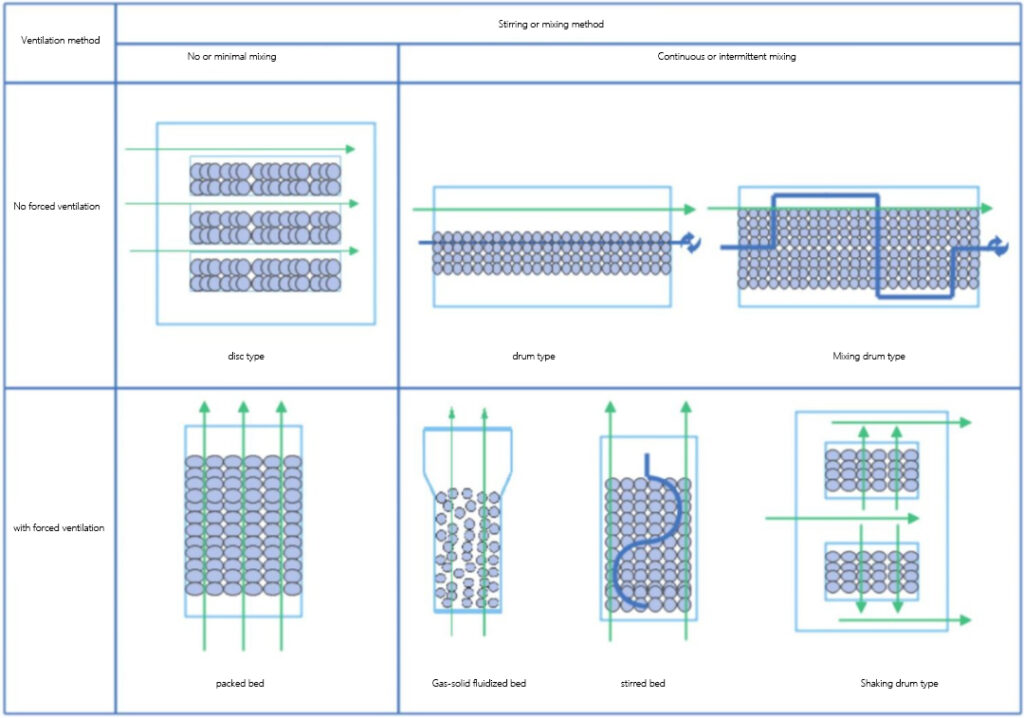
Disk-type solid-state fermentation systems generally consist of multiple trays stacked on top of each other in a closed culture room or incubator. There is a certain gap between the trays to allow air to circulate between the trays and on the surface of the solid fermentation substrate. The system does not contain stirring devices or forced ventilation measures, achieving true static solid-state fermentation.
The fermentation system has a simple structure, is easy to make and has low cost, but has poor heat dissipation. During the fermentation process, the growth and metabolism of microorganisms will generate a large amount of heat, and the disc solid-state fermentation system lacking forced ventilation will lead to the occurrence of temperature gradient differences, affecting the quality and yield of the final product.
02 Packed bed solid state fermentation system
The main body of the packed bed solid-state fermentation system is a vertically placed cylindrical tube with a porous plate or screen at the bottom, which is used to hold the solid-state fermentation substrate and form a column bed of a certain height. There are air inlets and air outlets at the upper and lower ends respectively to provide air circulation and maintain the normal progress of fermentation.
The fermentation system is highly efficient, easy to operate, has a simple structure, and adopts forced ventilation measures to strengthen the heat and mass transfer processes, but the mass transfer coefficient and heat transfer coefficient are relatively low. As the bed height increases, the ventilation rate decreases and the temperature gradient in the fermentation system gradually increases. When the temperature exceeds a certain value, the growth and metabolism of microorganisms are inhibited, resulting in damage to the bacteria.
In addition, although forced ventilation can promote evaporation through air circulation to achieve temperature control, excessive ventilation will cause the solid fermentation substrate to become dry, and excessive water loss is not conducive to fermentation.
03 Rotary drum solid state fermentation system
The main body of the drum solid-state fermentation system is a horizontal or inclined cylindrical tube, which is filled with a solid fermentation substrate. Oxygen is introduced from the top and circulates inside the fermentation system to meet the growth and metabolic needs of microorganisms. The closed design can prevent hot and humid air from escaping and ensure good fermentation hygienic conditions.
As the cylinder rotates, the solid fermentation substrate can be turned and mixed, which is beneficial to the transfer of oxygen and heat, improves fermentation efficiency, and also prevents the substrate from adhering to the inner wall of the fermentation system. However, if the rotation rate is too high, the large shear force generated will hinder the growth and metabolism of microorganisms and even lead to death.
04 Stirring drum solid state fermentation system
The basic structure and operating parameters of the stirred drum solid-state fermentation system are similar to those of the rotating drum solid-state fermentation system. The difference is that the main body of the stirred drum type remains stationary, while the bed is dynamic.
The fermentation system is equipped with a stirring device on the central axis, which maintains uniform mixing of the solid fermentation matrix through continuous or intermittent stirring, avoids the solid fermentation matrix from condensing into lumps, and improves heat transfer, ventilation and uneven moisture distribution. It can promote the growth and metabolism of microorganisms, increase the transfer and utilization of oxygen and nutrients, and improve fermentation efficiency and yield.
05 Stirred bed solid state fermentation system
The stirred bed solid-state fermentation system is similar to the packed-bed solid-state fermentation system. The difference is that the stirred bed has a stirring device embedded in the bed, which can intermittently or continuously stir the solid fermentation substrate.
This design makes the solid fermentation matrix mix more evenly, and the internal ventilation regulates the humidity inside the fermentation system, achieving a more even fermentation effect of internal heat dissipation. Therefore, the design and operation of the agitator is also an important consideration when designing and operating a stirred bed.
06 Shaking drum solid state fermentation system
The shaking drum solid-state fermentation system is a fermentation equipment that causes stirring through its own motion. It is mainly composed of three horizontally placed open-hole inner cylinders, open-hole outer cylinders and the outermost solid-shell outer cylinder. The solid fermentation substrate is located between two open-celled cylinders and is loosely arranged.
During the fermentation process, air and a small amount of water are introduced into the innermost cylinder. The air moves radially and the water penetrates downward into the bed. At the same time, the two outer cylinders of the fermentation system rotate around the central cylinder to promote mixing in the bed and achieve basic mixing of the solid fermentation matrix.
In this fermentation system, flowing air and water can control temperature, humidity and oxygen concentration, which is beneficial to the growth and metabolism of microorganisms. However, the stirring effect caused by its own motion is not ideal and needs further improvement.
07 Gas-solid fluidized bed solid-state fermentation system
The gas-solid fluidized bed solid-state fermentation system consists of a vertical chamber with a porous bottom plate. The gas is introduced from the bottom of the fermentation bed, and a dispersing device is installed at the bottom to break up the agglomerated materials and make them suspended, thereby improving the gas-solid flow. The fermentation effect of the chemical bed.
The substrate of the fermentation system is evenly mixed, which can prevent temperature gradients and humidity gradients from occurring during the fermentation process, and is beneficial to the control of fermentation process parameters. It has excellent ventilation, mass transfer and heat transfer effects, and also helps the growth of aerobic microorganisms.
However, if the viscosity of the solid fermentation matrix is too high or the particle size is inconsistent, it will lead to differences in particle suspension during the fermentation process. It is necessary to adjust the fluidization behavior of the bed in the fermentation system by optimizing operating parameters such as bed thickness and air flow rate.