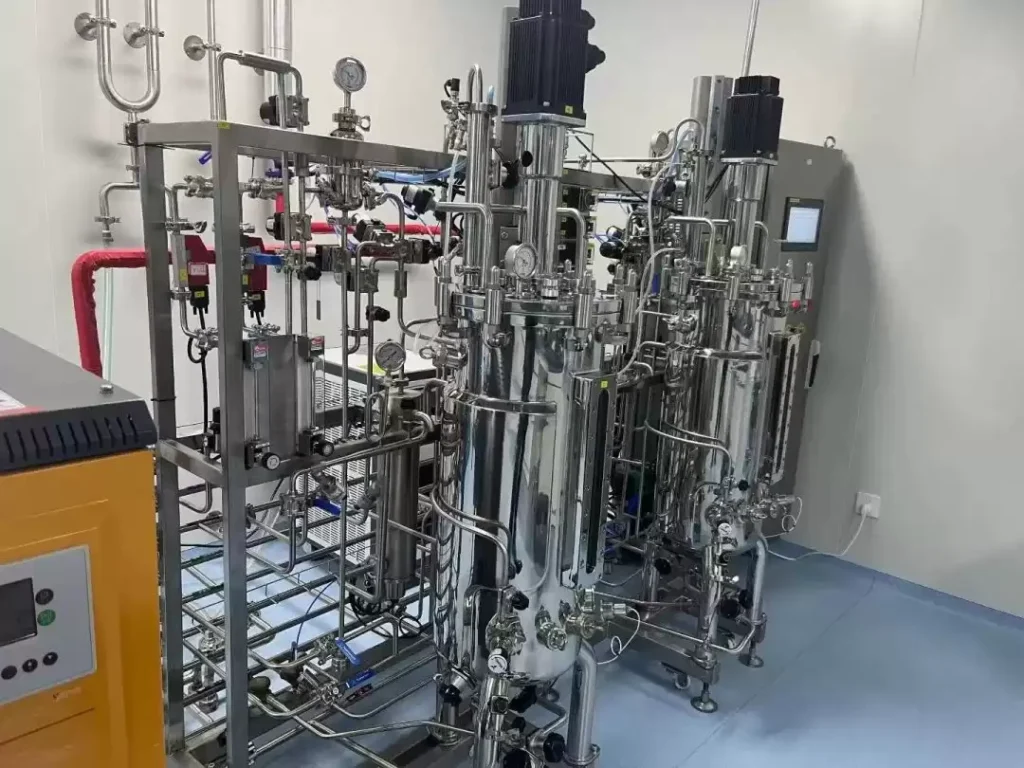
Maintenance of fermentation tanks
❶The precision filter of the fermentation tank generally has a service life of half a year. If the filtration resistance is too large or the filtration capacity is lost, which affects normal operation, it needs to be cleaned or replaced.
❷When cleaning the fermentation tank, use a soft brush to scrub and do not scrape with a hard object to avoid damaging the surface of the fermentation tank.
❸The supporting instruments of the fermentation tank should be calibrated once a year to ensure normal use.
❹Fermentation tank electrical appliances, instruments, sensors and other electrical equipment are strictly prohibited from direct contact with water or steam to prevent moisture.
❺When the fermentation tank is out of use, it should be cleaned in time to drain the remaining water in the fermentation tank and each pipe; loosen the fermentation tank cover and hand hole screws to prevent the sealing ring from deforming.
❻Carbon steel equipment such as the operating platform of the fermentation tank and the constant temperature water tank should be painted regularly (usually once a year) to prevent corrosion.
❼Carbon steel equipment such as the operating platform of the fermentation tank and the constant temperature water tank should be painted regularly (usually once a year) to prevent corrosion.
❽ Regularly replace the reducer lubricating oil to extend its service life.
❾ If the fermentation tank is not used temporarily, the fermentation tank needs to be sterilized and the remaining water in the tank and each pipe must be drained.
Reasons and solutions for non-fermentation in fermentation tanks
❶ The fermentation system must be used when all individual pieces of equipment of the fermentation tank must be ensured to function properly.
❷ When disinfecting the filter, the steam pressure flowing through the air filter must not exceed 0.17MPa, otherwise the filter element will be damaged and the filtering capacity will be lost.
❸ During the fermentation process, it should be ensured that the fermentation tank pressure does not exceed 0.17MPa.
❹ During the actual elimination process, when the jacket is preheated with steam, the inlet steam pressure must be controlled within the working pressure range of the equipment (should not exceed 0.2MPa), otherwise it will cause damage to the fermentation tank.
❺ When the fermentation tank is empty and actually sterilizing, the remaining water in the jacket of the fermentation tank must be drained. Otherwise, the cylinder in the fermentation tank may be flattened, causing damage to the equipment; during actual elimination, too much condensation water may cause the culture solution to be diluted, making it impossible to meet process requirements.
❻ During the cooling process after air digestion and real digestion, it is strictly forbidden to generate negative pressure in the fermentation tank to avoid contamination or even damage to the fermentation tank.
❼ During the fermentation process, the tank pressure of the fermentation tank should be maintained between 0.03 and 0.05MPa to avoid pollution.
❽ During the operation of the fermentation tank, the pressure in the air pipe must be kept greater than the tank pressure of the fermentation tank. Otherwise, the liquid in the fermentation tank will flow back into the filter, blocking the filter element or causing the filter to fail.
Reasons and solutions for non-fermentation in fermentation tanks
◤PART1◥
The temperature is too high or too low
The temperature in the fermentation tank is one of the key factors in fermentation. If the temperature is too high or too low, the microorganisms in the tank may not be able to reproduce and grow normally, thus affecting the fermentation process. Generally speaking, the optimal temperature range for yeast fermentation is between 20 and 30 degrees. If the temperature exceeds this range, the fermentation ability of the yeast will be greatly reduced, resulting in no fermentation.
Solution
This problem can be solved by adjusting the temperature inside the tank. If the temperature is too high, you can lower the room temperature or use cooling equipment. If the temperature is too low, you can raise the room temperature or use heating equipment.
◤PART2◥
Humidity is too high or too low
Humidity is also one of the factors that affects fermentation. Too high or too low humidity will affect the growth of microorganisms in the fermentation tank, resulting in no fermentation. For yeast, the humidity should not be too high, because yeast needs appropriate oxygen, and excessive humidity will reduce oxygen, thus affecting the fermentation ability of the yeast.
Solution
This problem can be solved by adjusting the humidity inside the tank. If the humidity is too high, ventilation, humidification, and cooling can be used. If the humidity is too low, humidification can be used.
◤PART3◥
Insufficient cleaning inside the tank
Incomplete cleaning in the tank is also one of the reasons for poor fermentation. The residue of impurities and detergent residues in the tank will affect the growth and fermentation process of microorganisms in the tank, resulting in no fermentation.
Solution
To ensure the cleanliness of the tank, the tank should be cleaned frequently. Fermentation tanks with heavy stains can be disassembled and cleaned to ensure that the tank is hygienic and clean.
◤PART4◥
Improper use of yeast
Yeast is one of the keys to fermentation in the fermentation tank. Improper use of yeast may also lead to non-fermentation.
Solution
Yeast must be used in accordance with the instructions for use and the storage environment must be dry, clean and protected from direct sunlight
◤PART5◥
Insufficient pressure in fermentation tank
Insufficient pressure in the tank may also cause no fermentation. An environment lacking oxygen will prevent the microorganisms from fermenting properly, thus affecting the yeast in the tank.
Solution
Insufficient pressure in the tank may also cause no fermentation. An environment lacking oxygen will prevent the microorganisms from fermenting properly, thus affecting the yeast in the tank.