
◆High-density fermentation process
With the development of genetic recombination technology and fermentation technology, in order to achieve low-cost and large-scale production of bacterial cells, high cell density fermentation technology has become a research hotspot in the field of fermentation.
High-density cell culture technology, also called high-density fermentation technology, means that under a certain culture system, by improving the culture method and culture conditions, the density of bacterial fermentation is significantly increased, and ultimately the specific productivity of the product (product per unit volume per unit time) is increased. yield) bacterial culture techniques.
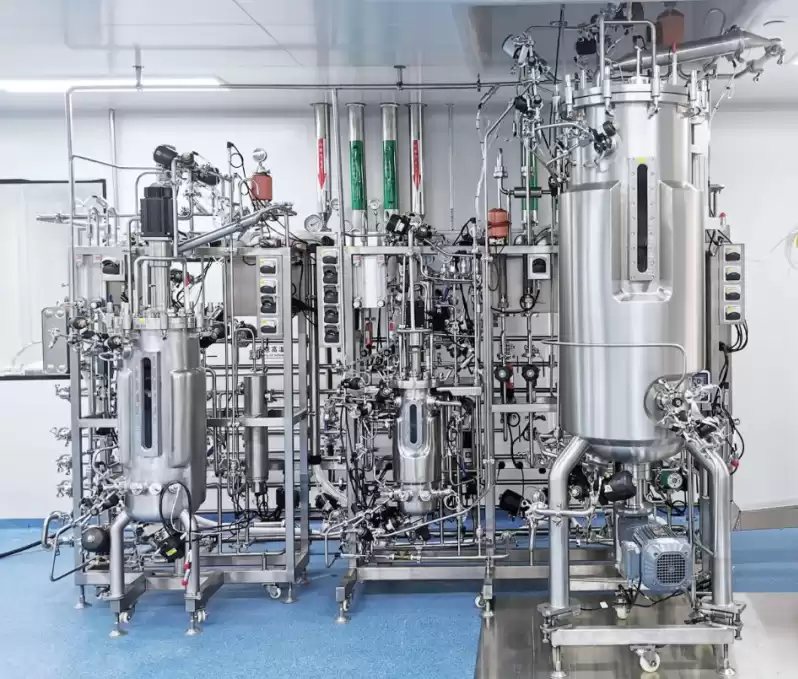
Bioreactor types commonly used for high cell density cultures include ordinary stirred fermenters, stirred fermenters with external or internal cell retention devices, dialysis membrane reactors, cyclonic reactors, airlift reactors, and vibration Ceramic bottle reactor, etc.
Utilizing high cell density fermentation has the following advantages:
•It can increase the concentration of bacteria in the culture solution per unit volume and increase the volume productivity.
•Correspondingly reduce the reactor volume, shorten the production cycle, and reduce equipment investment.
•Strengthen subsequent separation and extraction to reduce the amount of wastewater to a certain extent
•Reduce production costs and improve overall production efficiency
◆Methods for high cell density fermentation
Methods to achieve high cell density fermentation mainly include fed-batch culture, cell circulation culture, dialysis culture, cell immobilization culture, etc. Among them, fed-batch culture is the most well-researched and widely used.
❶Fed-batch culture
Fed-batch culture is to feed nutrients into the reactor continuously or according to a certain pattern under the premise of batch culture to maintain a low nutrient concentration in the fermentation system. Currently, there are two main strategies for controlling fed nutrients: feedback control and non-feedback control.
The use of fed-batch culture can eliminate the repressive effect caused by rapid utilization of carbon sources, avoid the poisoning caused by the accumulation of inhibitory by-products produced during the culture process, and also avoid the problem of plasmid instability caused by rapid growth of bacteria. However, it also has certain disadvantages, such as the accessory equipment used for feedback control is relatively expensive and requires operators to have high operating skills.
❷Cell cycle culture
Cell circulation culture uses a certain method to separate cells from the mash, and the cells are returned to the container for recycling. The cell-free mash is continuously transferred at a given rate and replaced with fresh culture medium. Generally include standing, settling and membrane filtration.
This technology can continuously transfer metabolic waste products out, avoid feedback inhibition on cell growth, and facilitate the separation of target products.
❸Dialyis culture
Dialysis culture is a culture method in which microorganisms are wrapped with a dialysis membrane and fresh culture fluid flows outside. It can effectively remove harmful low molecular weight metabolites while providing sufficient nutrients to the culture solution for bacterial utilization. The semipermeable membrane is not perfused during the dialysis process, which avoids the membrane clogging problem in microfiltration and ultrafiltration. Moreover, the “nutrient distribution” feeding strategy is adopted to greatly improve the utilization rate of nutrients.
Compared with other culture methods, dialysis culture can increase cell density 30 times. The use of dialysis culture in high cell density fermentation can eliminate the time-consuming media optimization process and improve the efficiency of production operations. However, the equipment investment for dialysis culture is large and the operation technology requirements are high, so it is rarely used in actual production.
❹Immobilized cell culture
Cell immobilization is the restriction or positioning of free cells to a specific spatial location through physical or chemical means. The use of immobilized cells can convert traditional microbial fermentation into continuous enzymatic reactions, improve productivity, and at the same time reduce the inhibitory effect of metabolites on cell growth.
Lactic acid bacteria liquid core microencapsulation culture is a type of cell immobilization culture. It uses a layer of hydrophilic semipermeable membrane to surround the cells in bead-shaped microcapsules. Through continuous culture, a very high concentration can be achieved in the capsules. Cell density.
◆Factors affecting high cell density fermentation
There are many factors that affect high cell density fermentation, such as the composition of the culture medium, dissolved oxygen concentration, culture temperature, pH value and harmful metabolites.
❶Medium composition
High cell density fermentation generally uses semi-synthetic culture media, and the concentration and proportion of each component of the culture medium must be appropriate, especially the carbon-nitrogen ratio. Glucose is the most commonly used carbon source material in recombinant bacterial fermentation, but excessive glucose concentration will inhibit cell growth and lead to the accumulation of the metabolic inhibitory substance acetic acid, which will adversely affect bacterial growth.
❷PH value
Substances such as acetic acid and carbon dioxide produced during high cell density fermentation will change the pH value, thereby adversely affecting cell growth and metabolism. Online detection methods can be used to adjust the pH value in time with acid and alkali to avoid intense pH changes. Variety.
❸Temperature
Changes in temperature will affect the reaction rates of various enzymes and protein properties, affect the physical properties of the fermentation broth, and indirectly affect the bacteria. For genetically engineered bacteria, using different temperatures at different culture stages is beneficial to increasing the growth density of the bacteria and the expression of target products, and shortening the culture cycle.
❹Dissolved oxygen concentration
For aerobic fermentation bacteria, too high or too low dissolved oxygen concentration will affect the growth and metabolism of the bacteria. Dissolved oxygen can be increased by increasing the stirring speed, increasing air flow, increasing oxygen partial pressure, using oxygen carriers and modifying the oxygen-obtaining capacity of microorganisms. However, the higher the dissolved oxygen content, the better. It is necessary to examine the critical dissolved oxygen concentration and optimal dissolved oxygen concentration of each fermentation product, and maintain the optimal dissolved oxygen concentration during the fermentation process.
❺Regulation of harmful metabolites
During the high cell density culture of microorganisms, the accumulation of metabolic by-products such as carbon dioxide and acetic acid is one of the main factors affecting bacterial growth and product expression. In order to reduce the concentration of metabolic by-products during bacterial culture, the composition of the culture medium, especially the content and type of carbon sources, can be adjusted to prevent the production of inhibitory substances. For example, as mentioned earlier, using glycerol instead of glucose as the carbon source can also be used. It is expected to prevent the production of inhibitors by changing the metabolic pathways of bacteria through metabolic engineering.
◆High-density fermentation applications
Application in biological products: Research shows that high-density fermentation technology has been widely used in the production of various interferons, growth factors, biological enzymes, peptides, polysaccharides and other active ingredients using engineered bacteria.
Application in the food industry: High cell density fermentation technology can be used to culture living cells (that is, the desired product). For example, by improving the culture environment and regulation methods, high-density fermentation of lactic acid bacteria can be obtained and applied to the dairy industry. In addition, high cell density fermentation can also be used to produce alcohol by yeast and use spirulina cells to produce spirulina.
Conclusion
High-density fermentation technology has unique advantages over ordinary fermentation technology. Applying it to the efficient expression of various microbial products can greatly reduce production costs and improve production efficiency. With the development of science and technology, high-density fermentation technology will be increasingly used in the fermentation production process.