
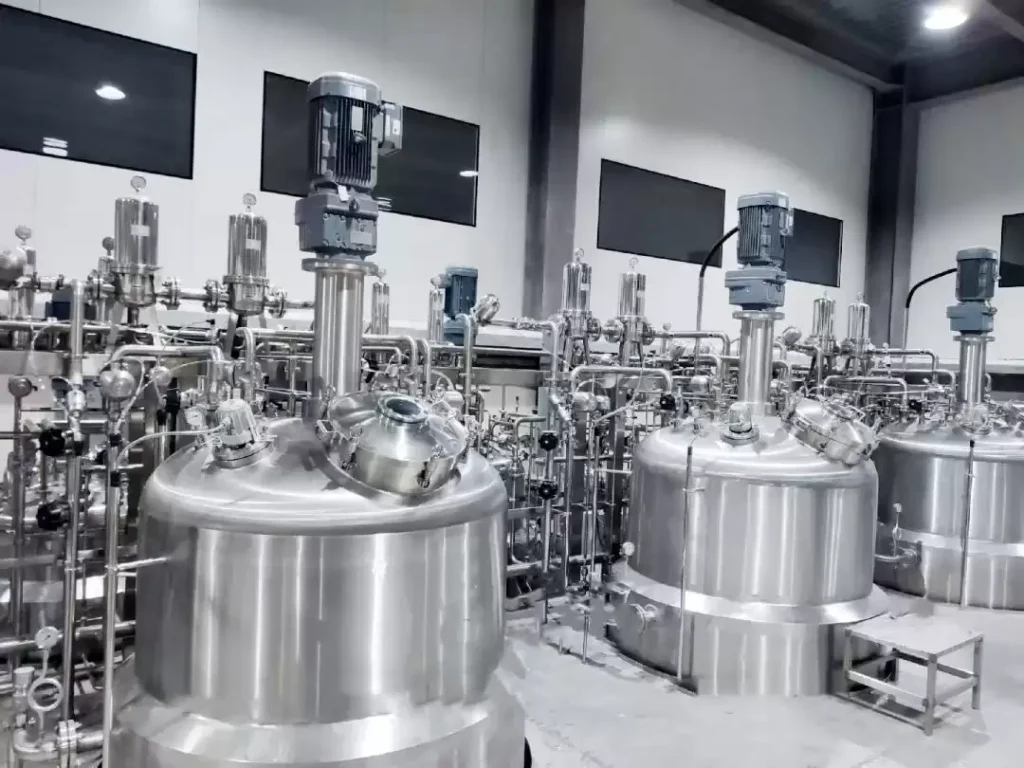
◆Technical preparation
❶Technical training before taking up the job: The GRJ-D fermentation tank is a high-tech equipment with electromechanical integration. Therefore, operators must undergo technical training before taking up the job to make them familiar with the working principle of the entire system, the operating procedures of pipelines and valves, And be able to operate and use air compressors and electric steam generators correctly. Untrained personnel are not allowed to operate alone.
❷Before using the equipment, check whether the power supply is normal and whether the air compressor, steam generator, and circulating water system can work normally.
❸Check whether the valves, joints and fastening screws on the system are tightened.
❹Start the air compressor and use 0.15Mpa pressure to check whether the sealing performance of the fermentation tank, filter, pipeline and valve is good and whether there is any leakage.
❺Dissolved oxygen meters, pH meters, and PLC systems should be checked and calibrated according to the instructions for use.
❻Personnel employed must be able to operate the above items proficiently.
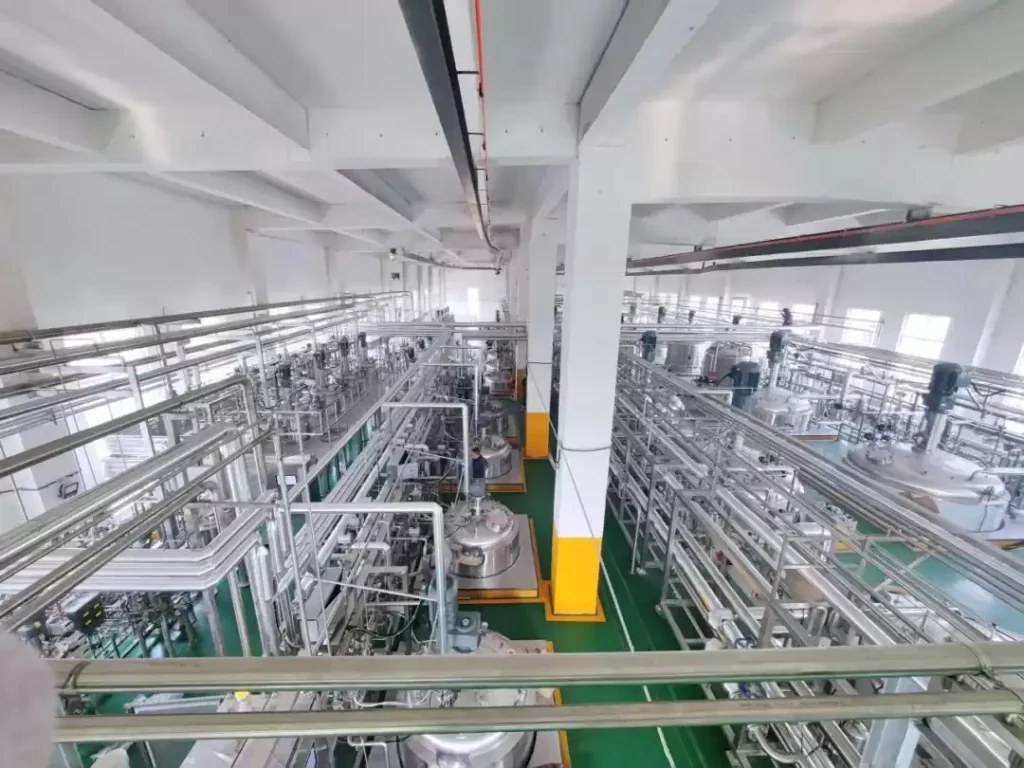
◆Air disinfection
Before feeding, the gas path, material path, and fermentation tank must be sterilized with steam to eliminate all dead bacteria and ensure that the system is in a sterile state.
【Air line】
❶There is a water-removing pressure reducing valve and a sterilizing filter on the air pipeline. The water-removing pressure reducing valve cannot be sterilized with steam, so before steam is passed through the air pipeline, the valve KQF1 leading to the water-removing pressure reducing valve must be closed to allow the steam to pass through the steam filter and then enter the sterilizing filter.
❷During the air sterilization process, the exhaust valve at the lower end of the sterilization filter should be slightly opened to drain out condensed water.
❸The air sterilization time should last about 40 minutes. When the equipment is used for the first time or is started after long-term use, it is best to use intermittent air sterilization. That is, after the first air sterilization, it is tentatively scheduled to be air sterilized once every 3 to 5 hours to eliminate spores.
❹The filter after air sterilization should be ventilated and blown dry for about 20 to 30 minutes, and then the air valve should be closed.
【Fermentation tank】
❶Fermentation tanks pass steam directly into the tank for air sterilization.
❷During air sterilization, the inoculation port, exhaust valve, and material path valve on the tank should be slightly opened to allow steam to be discharged through these valves, while maintaining the tank pressure at 0.13~0.15Mpa.
❸The air elimination time is 30 to 40 minutes. Under special circumstances, intermittent air elimination can be used.
❹After the air sterilization is completed, the condensed water in the tank should be drained.
Notice:
1. When air sterilizing the fermentation tank, the water in the jacket should be drained. It is best to open the jacket drain valve during air sterilization to prevent the jacket water from being drained cleanly.
2. During air sterilization, the dissolved oxygen and pH electrodes should be taken out to extend their service life.
◆Sterilization
Sterilization is the process of using steam to sterilize the culture medium after the culture medium is added to the tank.
❶After the air sterilization is completed, first calibrate the pH and Do electrodes and install them into the joints in the tank. Then add the prepared culture medium into the tank from the feeding port. At this time, there should be no cooling water in the jacket.
❷The culture medium should be gelatinized before entering the tank. Generally, the formula amount of the culture medium is calculated as about 70% of the total volume of the tank (a culture medium with more foam is about 65%, and a culture medium with less foam can reach 75-80% ), taking into account the factors of condensed water and inoculum volume, the amount of water added is about 50~60% of the full volume of the tank. The amount of water added is related to factors such as culture medium temperature and steam pressure, and needs to be explored in practice.
❸In order to reduce steam condensation, the actual consumer first uses the jacket to pass steam to preheat the culture medium, keeping the jacket pressure ≤ 0.1Mpa. After the culture medium temperature reaches 90°C, turn off the jacket steam and instead directly pass the steam into the tank.
❹When the tank pressure rises to 0.12Mpa and the temperature rises to 121~123°C, control the opening of the steam valve to keep the tank pressure unchanged, and stop steam supply after 30 minutes.
❺Open the cooling water inlet and outlet valves and flow water into the jacket for cooling.
Note: When the jacket is cooled by water, the tank pressure will drop sharply. When the pressure in the tank drops to 0.05Mpa, slightly open the exhaust valve and air inlet valve, turn on the motor for ventilation and stirring, accelerate the cooling speed, and maintain the tank pressure. is 0.05Mpa until the tank temperature drops to the inoculation temperature.
◆Inoculation
•This equipment uses flame sealing for inoculation. Alcohol cotton, pliers, tweezers and inoculation loops should be prepared in advance before inoculation.
•The bacterial strain is put into an Erlenmeyer flask, and the inoculum amount is determined according to the process requirements.
•Place alcohol cotton around the inoculation port and light it. Use pliers or an iron rod to unscrew the inoculation port. At this time, ventilate the tank so that air can be discharged from the inoculation port.
•Pour the culture in the Erlenmeyer flask into the jar in the middle of the fire ring.
•Sterilize the inoculation port cover over a flame and tighten it.
•After inoculation, aeration culture can be carried out, and the tank pressure is maintained at 0.05Mpa.
•The fermentation temperature is determined according to the process requirements. The fermentation temperature is controlled by •adjusting the temperature of the circulating water. When the ambient temperature is higher than the fermentation temperature, cold water needs to be used to cool down.
•The amount of dissolved oxygen is mainly achieved by adjusting the air intake.
•The pH adjustment is realized by the control system automatically adding alkali through the actuator (peristaltic pump).
•The foam alarm is realized by the foam level signal detected by the foam probe in the form of an indicator light on the touch screen.
•When sampling for inspection is required during fermentation, samples can be taken through the sampling port. Before sampling, the sampling pipeline valves need to be sterilized with steam to prevent bacterial contamination and misleading. After sampling, the sampling pipeline valves must also be flushed with steam.
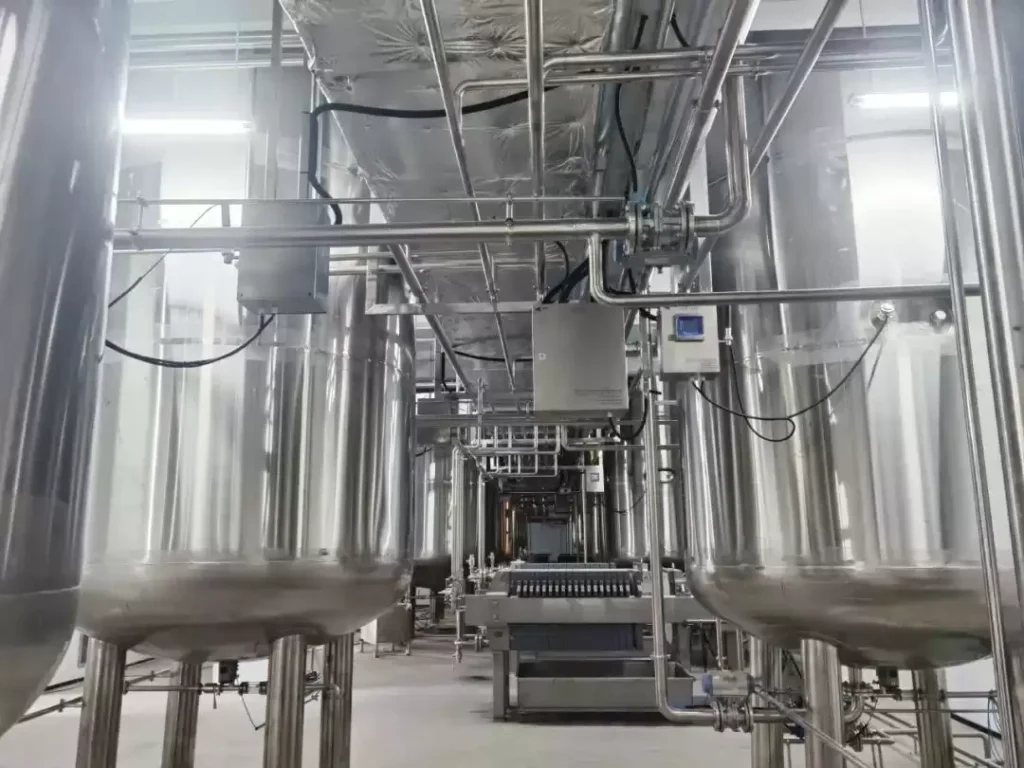
◆Discharge
1. The discharging of this equipment uses tank pressure to discharge the fermentation liquid from the discharging pipe. According to the concentration of the fermentation liquid, the tank pressure can be controlled at 0.05~0.1Mpa.
2. After discharging, take out the dissolved oxygen and pH electrodes for cleaning and maintenance.
3. After discharging, immediately release water to clean the fermentation tank and material pipeline valves, start the air compressor, supply air to the fermentation tank for stirring, and flush the fermentation liquid in the pipeline.
◆Repair and maintenance
❶The environment where the equipment is placed should be clean, dry, and well-ventilated. Water and steam must not be poured directly onto the electrical appliances.
❷After the equipment is put into use, it must be cleaned in time to prevent the fermentation liquid from drying up in the fermentation tank, pipelines and valves.
❸Dissolved oxygen, pH probes, and instruments should be maintained and stored in accordance with regulations. Pressure gauges, safety valves, and thermometers should be calibrated once a year.
❹The equipment should be cleaned and dried when out of use. The filter element of the filter should be taken out, cleaned, dried, and properly kept. The flange compression nut should be loosened to prevent permanent deformation of the sealing ring.