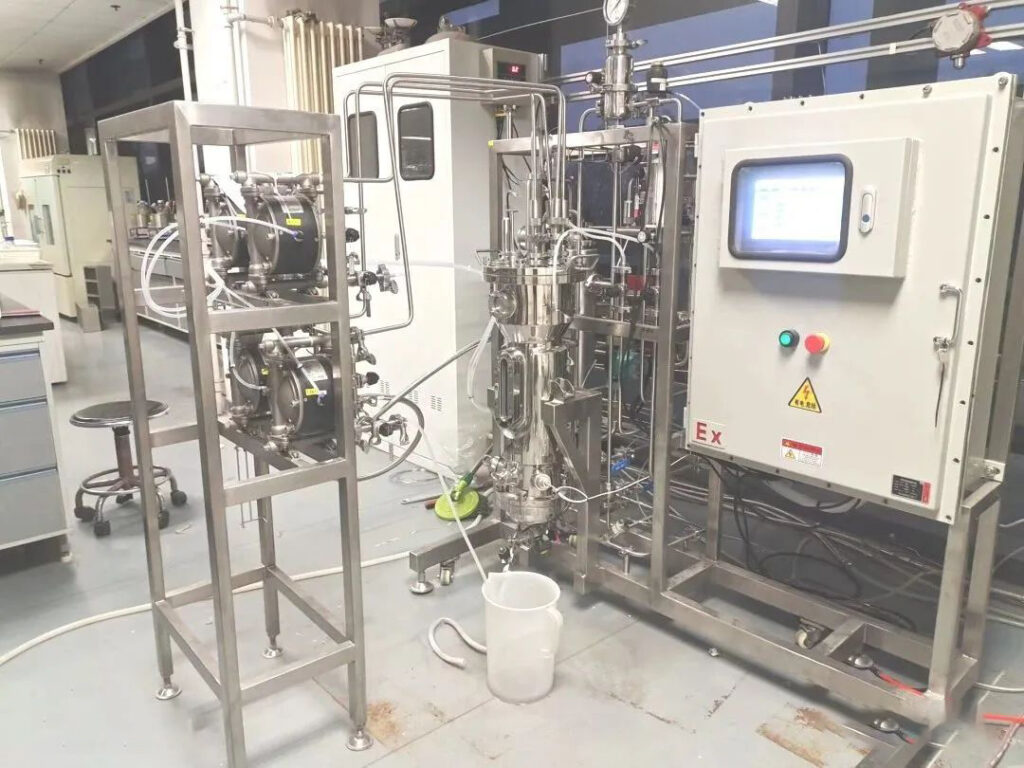
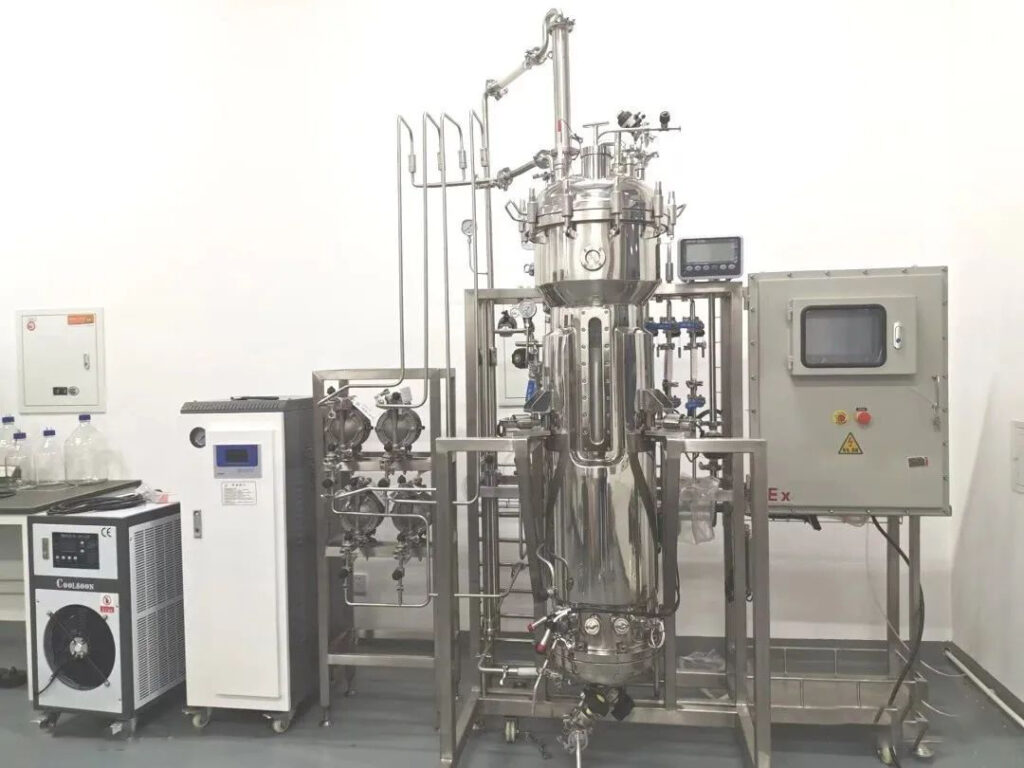
Airlift fermenters are the most widely used bioreactors.The airlift reactor is developed on the basis of the bubble column reactor. It uses the jet function of the air and the difference in fluid weight to cause the circulating flow of the reaction liquid to realize the stirring, mixing and oxygen transfer of the liquid. That is, without mechanical agitation, the liquid is circulated and turbulent by the lift of the gas, so as to achieve the purpose of gas-liquid mixing and transmission.
Structure of Airlift Bioreactor (ALR)
The structure of the airlift reactor is relatively simple, without stirring, easy to clean and maintain, not easy to be infected with bacteria, low energy consumption, and high efficiency of dissolved oxygen. At present, the internal circulation air-lift fermenter has been widely used in aerobic fermentation in the field of bioengineering, such as the cultivation of animal and plant cells, the cultivation of single-cell protein, the cultivation of certain microbial cells and sewage treatment. The resulting products are single-cell proteins, alcohols, antibiotics, biosurfactants, etc.
China uses bioreactors to produce a large number of biological agents, most of which are airlift cell culture bioreactors. Airlift cell culture bioreactor is the abbreviation of airlift bioreactor.
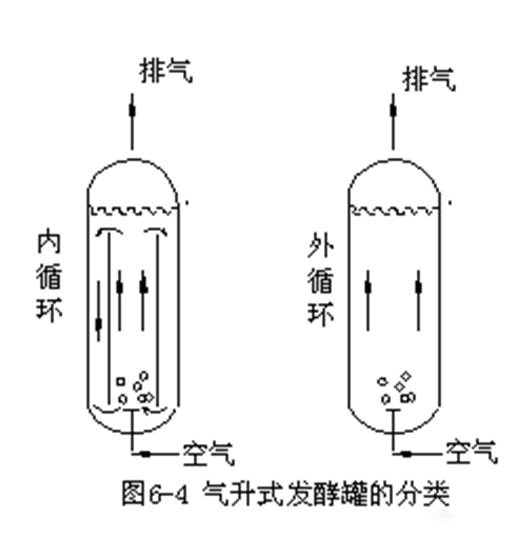
Air-lift fermenters can be divided into internal circulation air-lift fermenters and external circulation air-lift fermenters according to the different liquid circulation methods they adopt. The former makes the ascending pipe and the descending pipe in the circulation process both arranged inside the same fermenter; while the latter makes the ascending pipe and the descending pipe arranged separately. (as shown in Figure 6-4)
Airlift bioreactors mainly use internal circulation, but some also use external circulation. There are four components inside the internal circulation bioreactor:
(1) Liter hydraulic pressure is in the center of the reactor, inside the draft tube. If the air is sprayed at the bottom of the draft tube, due to the static pressure difference between the inside and outside of the tube, the gas-liquid mixed fluid rises along the tube, and after separating part of the gas in the upper part of the reactor, it descends along the pressure-reducing tube to form a circular flow. If air is sprayed at the bottom of the downcomer, the fluid circulation is in the opposite direction.
(2) Downcomer zone The annular gap between the draft tube and the reactor wall, the fluid rises or falls along the downcomer zone, depending on the position of the injected air.
(3) Bottom: The connecting area between the ascending liquid area and the lower part of the descending liquid area has little influence on the characteristics of the reactor.
(4) The top connecting area between the ascending liquid area and the upper part of the descending liquid area. A gas-liquid separator can be installed at the top to remove the liquid entrained in the exhaust gas.
In addition, the device is also equipped with a ring pipe gas injector and so on. The basic structure of the internal circulation air-generated bioreactor is shown in Figure 6-5.
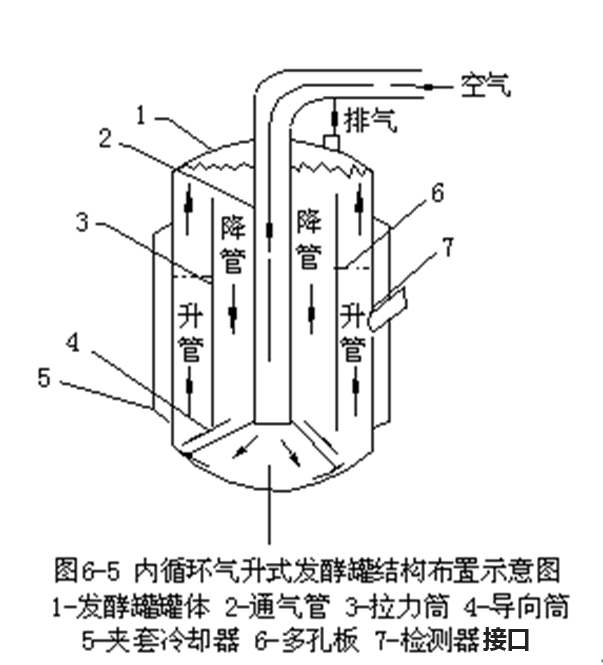
After the air enters the bottom of the fermenter (1) from the ventilation pipe (2), it is guided by the guide cylinder, and the fermentation liquid is pushed up along the riser, because the space of the riser in the upper part of the fermenter is not enough to provide conditions for complete gas-liquid separation (short residence time) , so the circulating fermentation liquid with a high flow rate descends along the downcomer by virtue of its own weight, and when it reaches the bottom of the tension cylinder (3), it is pushed by the compressed air from the bottom of the tank and rises along the riser again to start the next gas-liquid mixing cycle process.
During the circulation process, the gas and liquid achieve the necessary mixing, stirring and obtaining sufficient dissolved oxygen.The function of the jacket cooler is to adjust and control the temperature of the fermentation liquid according to the process requirements in different fermentation stages, and the porous plate makes the air distribution uniform.
The applications of airlift reactors in the field of biotechnology are mainly fermentation, wastewater treatment and biological cell culture. Due to the high viscosity, in order to increase the mass transfer rate, mechanical stirring tanks were often used for fermentation broth and biological cell culture fluid in the past.
In fact, as long as a suitable polymer is added to the medium, the use of an airlift reactor can not only enhance mass transfer and increase production, but also reduce energy consumption.