
When you’re running a bioprocess, it would be rare for everything go perfectly in a single step. Microbial or cell growth at different stages frequently requires different conditions such as temperature, pH or oxygen levels to attain peak performance. That’s where multi-stage fermenters come into the picture. Instead of trying to make everything happen at once in one tank, this configuration lets you break the process into stages, and tailor each to what the microbes need at that phase. Whatever you are manufacturing, whether it’s enzymes, probiotics or biofuels, this type of system can ramp up both your production and the control you have over the process.
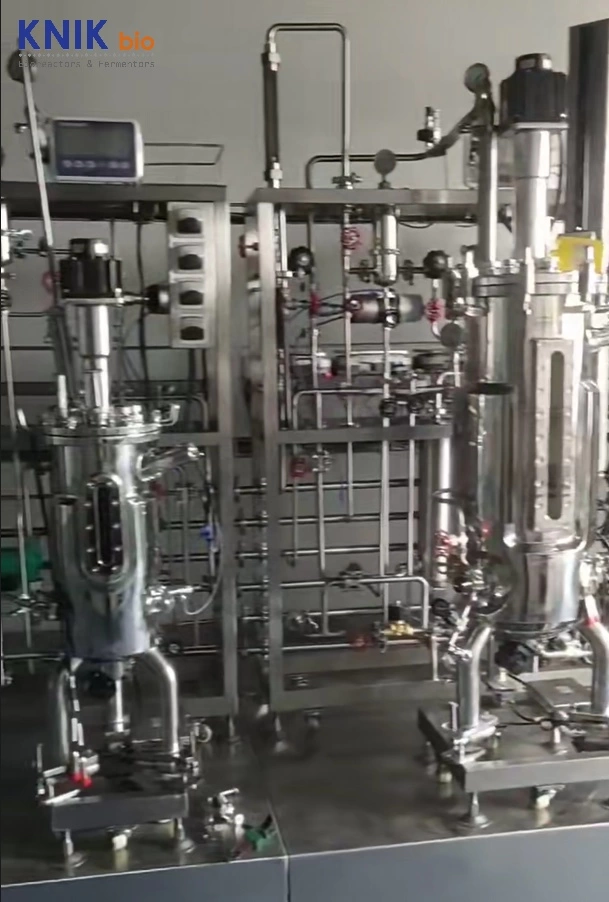
Why Single-Stage Fermenters Fall Short?
A one-stage fermenter is like trying to cook a whole meal in one pot, all at the same time. It might be fine for soup, but not if you’re making a full balance of appetizers and mains with varying cooking requirements. The same goes for fermentation. Microorganisms grow in stages — lag, exponential, stationary and each stage does best under different circumstances. With a single-stage production, you’re committed to one environment for a whole run, so you often have to meet in the middle.
Consider, for instance, production of enzymes with bacteria. During early growth, cells require abundant nutrients and oxygen to replicate. Later, when the population peaks, they turn to producing the enzyme. And if your fermenter can’t go back and forth between growth and production modes, you’re not getting enough cells or not getting enough product.
Another issue is contamination risk. In a single-stage system, if something goes wrong and say a temperature spike or an oxygen drop, you can lose the entire batch. And since all takes place in a single tank, there’s no backup or fallback. You either fix it quick or do it over.
There’s also the issue of scale. Let’s say you’d like to create a product with a high value, like a specialized probiotic. The conditions for growth may be very different than those promoting the production phase. The dilemma, of course, is that if you have just one environment to work with, you have to pick a phase and make it a priority. That typically translates to lower yield or longer run times.
Producers in the real world who have transitioned from single- to multi-stage systems frequently say the same thing: the old way got the job done, but it limited them. Upgrading isn’t so much about more product, as it is about better control, more flexibility and a lot less head-pounding with every brew.
How Multi-Stage Fermenters Revolutionize Production?
Multi-stage fermenters allow you to do that, because you can treat every part of that brew like a separate task, with its own settings, its own timing, and its own tank if you want. Instead of cramming all your steps into one container, you spread them out. That might seem more complex at first, but it also means easier control and greater efficiency throughout.
Say you’re making lactic acid bacteria for food-grade probiotics. Those microbes require oxygen for growth in the early days, to race ahead, but when production time comes, oxygen can hold them back, or even harm yields. With a multi-stage system, you let the cells grow in one tank under high-oxygen conditions, and then you transfer them to another tank prepared for low-oxygen production. This way, you won’t need to compromise between one stage or the other.
It’s also much simpler to control waste and byproducts. Things like carbon dioxide or the wrong kind of acids can accumulate and muck with cell health during fermentation. In a one-stage system, you’re locked into dealing with that in real time. In a multistep process, though, you can take your culture and transplant it in a new environment long before all these other issues have snowballed.
Another benefit is scheduling. You can have one stage on while you prep the following. That reduces downtime between batches, and helps teams better manage their workloads. For instance, as stage one grows cells, stage two may be completing production from the previous cycle. It’s a factory line rather than a single overloaded workbench.
People who move to this approach often will achieve improved consistency, higher productivity, and reduced process failures. In practical terms, that translates to less waste, more product and smoother operations overall.
Key Applications Driving Industry Innovation.
Multiple stage fermenters are more than just about making things run smoothly – they’re opening up opportunities in areas such as pharmaceuticals, biotechnology and biofuels where precise, reliable runs and fast turnarounds are absolutely vital. One of the most promising growth segments undergoing transformation is that of biopharmaceuticals. The preparation of vaccines or therapeutic proteins frequently requires delicate cells that must be provided precisely the right environment to prosper. With multi-stage systems, companies can optimize each of the phases from early cell growth to the final expression of proteins without jeopardizing the entire batch.
The food and beverage world is also getting in on the act. Consider commercial-level probiotic production or fermenting for flavor development in, say, plant-based dairy products. Producers can cultivate cultures in one tank and move them to another for flavor formation, or production of a metabolite. This prevents overgrowth, keeps the taste profile clean and aids in the extension of shelf life.
Another area of growth is biofuels. When you ferment agricultural waste with the goal of producing bioethanol or biodiesel, the microbes experience intricate metabolic changes. It seems that the clogging and then poor conversion or stopped reaction is frequently caused by how the setup is configured for a single tank. Multi-stage fermenters allow operators to fine-tune each step — pre-treatment, fermentation and even detoxification to keep the microbes active and efficient.
They are even making inroads in agriculture. This form of fermentation is utilized for the formation of microbial-based fertilizers or biopesticides by the farmers and agritech companies. They generally need to be built up first, and then conditioned. The fact that these steps exist in separate tanks makes it much easier to scale and control them.
In all these industries, the thing that is driving adoption is very simple: better outcomes with fewer surprises. Whether you’re trying to make a life-saving drug, a cleaner-burning fuel, or a more shelf-stable food product, multi-stage fermenters are aiding people to push what is possible without reinventing the wheel each time.
Why Choose KNIKbio?
When you are investing in a multi-stage fermentation, the machinery is only a fraction of the equation. What we really need is a partner who has the experience of the real-world pain of each of these processes. That’s where KNIKbio stands out. They don’t just construct fermenters—they assist you in developing more intelligent workflows, tailor made to your exact production specifications.
Flexibility is one of the key reasons why people use KNIKbio. Their systems aren’t one-size-fits-all. Bacteria, yeast, mammalian cells, they have modular configurations that can be customized around your process. Want an aggressive-growth phase followed by shear limited performance? No problem. Need single-controls for pH, DO, temperature and foam? It’s native, and easy to control.
KNIKbio makes scaling easier, too. If you’re beginning with R&D or pilot-scale runs, their designs allow for easy expansion without the need to reconfigure your entire system. Tanks, sensors, pumps and control boxes are designed to work together as your process scales in size and complexity from the lab to full production.
Yet, it’s support that truly builds trust. Fermentation doesn’t always go as planned. Maybe a run is getting tired, or your microbes aren’t responding in the manner they used to. KNIKbio’s staff doesn’t just abandon you after setup. They are on hand for tuning, troubleshooting, and even helping to reconfigure stages as your aspirations change.
There are no shortage of companies hawking equipment. But if you prefer someone who knows how each stage relates to the others and who’s prepared to accompany you through the process from planning to production, KNIKbio provides that big-picture perspective. The sort of backup provided by the ability to manufacture is just as important, for teams that want to make better stuff, faster, at less risk, as the hardware it applies to.
Ready to Transform Your Bioprocess?
Maybe single-stage fermentation has been holding you back; you’re not getting the yields you want, runs just aren’t consistent, you’re getting frustrated with how much time you’re spending on troubleshooting. Multistage fermenters provide a path to gaining control over every part of your process, rather than clashing with a system that wasn’t designed to accommodate the complexity of actual production.
Revolutionizing your bioprocess doesn’t require starting from scratch. It’s about finding the parts of your existing set-up that are falling short, and seeing how a staged approach can address them. Perhaps your volume is fine but your production lags. Perhaps the cells act differently in larger quantities. Multi-stage systems excel in these scenarios. By affording each phase its own space and circumstances, you’re not simply solving problems, you’re solving problems before they start.
Consider what is keeping your process from moving forward. Is it contamination? Low conversion rates? Limited scalability? These are all normal, and they don’t indicate that your product or idea is flawed, they simply indicate that the system needs to evolve to match your intentions.
Teams that transition find benefits early on: shorter cycle times, better yields, more predictable outcomes. And, perhaps most crucial, they have the freedom to experiment and improve without the potential risk of ruining entire runs.
Whether you are making food cultures, pharmaceuticals, enzymes, or next-gen biomaterials, the right fermentation set-up can make all the difference. If you’re ready to get create something smarter, more consistent, and personalized to your process not just the average process—it’s time dig into what multi-stage fermentation can mean for you.