
Firstly, the feed rate and specific growth rate directly affect the production rate and accumulation of acetic acid (mainly because the feed rate and specific growth rate affect the amount of residual sugar in the fermentation broth, and thus). Therefore, proper control of the feed rate and specific growth rate has a good effect on controlling acetic acid.
Secondly, we should ensure sufficient dissolved oxygen, strictly control the pH value, and try to moderate the rate of acid and alkali replenishment as much as possible, not too fast. Temperature also has an important effect on protein expression. Most of the proteins produced by low-temperature fermentation are active, while most of the proteins produced by high-temperature fermentation exist in the form of inclusion bodies.
Thirdly, it is very important to choose a reasonable induction time. Generally, the induction time is selected at the late stage of exponential growth, and the specific growth rate is controlled within 0.2 at the time of induction. Induction at this time:
1. Separate the rapid growth phase from the protein synthesis phase, the two phases do not affect each other, which is conducive to the high expression of proteins;
2. a large number of organisms were obtained, and the biomass of the organisms was basically close to stable, which was reasonable from the viewpoint of kinetics, energy consumption and material cost.
Fourth, the carbon to nitrogen ratio in the replenishment process is also important. If the nitrogen source is too high, the bacterium grows vigorously and the pH is too high, which is unfavourable to the accumulation of metabolites. If the nitrogen source is insufficient, the bacteria proliferate less, affecting the yield. If the carbon source is too much, it is easy to form a low pH and inhibit the growth of the bacteria. If the carbon source is insufficient, it is easy to cause aging and autolysis of the bacteria. In addition, improper carbon and nitrogen ratios will also cause the proportion of nutrients absorbed by the bacteria to be out of proportion, which directly affects the growth of the bacteria and the synthesis of the products.
According to experience, in general, for a stable fermentation process, if the lysis phenomenon always occurs during a fixed fermentation period, phage and bacteria can be excluded, then it may be caused by unreasonable carbon and nitrogen ratio. The carbon and nitrogen ratio can be adjusted appropriately.
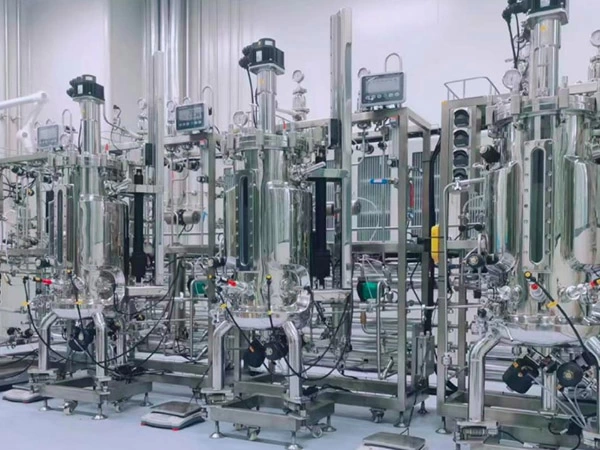
Byproducts, temperature, and incubation methods
I. Control of metabolic by-product-acetic acid
Acetic acid is a metabolic by-product of the fermentation process of E. coli, and there have been different opinions on what concentration of acetic acid can produce inhibitory effects. It is generally accepted that under good gas conditions, acetic acid concentrations of 5-10 g/L can produce significant inhibition of lag phase, maximum specific growth rate, bacterial concentration and final protein yield. Cell growth stopped when the acetic acid concentration was greater than 10 or 20 g/L, and the expression of exogenous proteins was completely inhibited when the acetic acid concentration in the medium was greater than 12 g/L.
Measures to prevent the generation of acetic acid:
1. Reduce acetic acid production by controlling the growth rate:
The higher the specific growth rate, the more acetic acid is produced, when the specific growth rate exceeds a certain value. The growth rate can be reduced by lowering the temperature, adjusting the pH and controlling the supplement.
2. Dialysis culture:
In the process of E. coli culture, dialysis technology can be used to remove harmful substances in the fermentation broth and reduce the content of acetic acid, so as to achieve high-density fermentation and product expression of recombinant bacteria.
3. Control the concentration of glucose:
Glucose is one of the important carbon sources in E. coli fermentation. The purpose of using glucose as a carbon source is to control it at a low level to reduce the production of acetic acid.
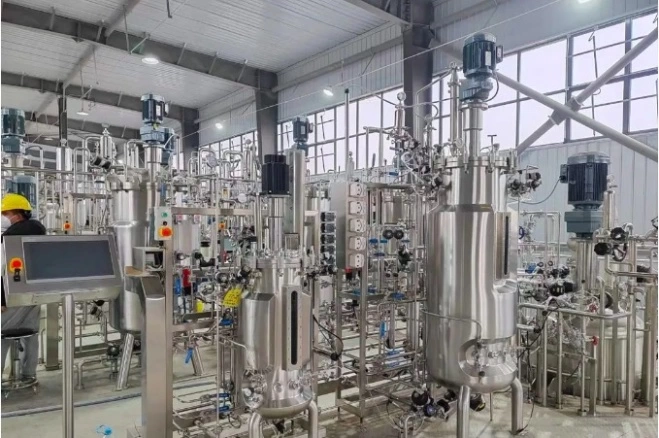
KNIK BIO 30KL fully automatic production line
The main control methods commonly used are:
Constant pH method: E. coli metabolises grapes and produces acetic acid, which lowers the pH value. Therefore, the level of pH can be used as an indicator to control the amount of sugar. The disadvantage of this method is that the change of pH value is not entirely the result of sugar metabolism, which is easy to cause errors in the replenishment system.
Constant Dissolved Oxygen Method: Bacterial metabolism consumes oxygen, which reduces the amount of dissolved oxygen. When the glucose concentration is low to a certain degree, the metabolism of bacteria will be reduced, oxygen consumption will be reduced and dissolved oxygen will be increased. Therefore, glucose can be controlled at a certain level by adding glucose according to the dissolved oxygen curve and keeping the dissolved oxygen constant.
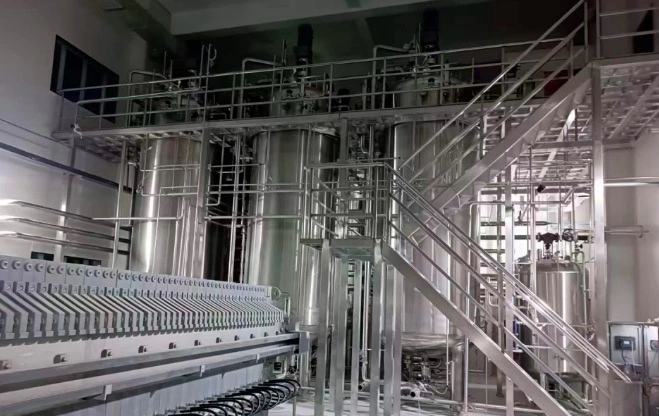
II. Temperature
The optimum temperature for E. coli fermentation is 37 degrees Celsius, when the temperature is most suitable for bacterial growth, than the growth rate will increase. As the temperature rises, the metabolism of the bacteria speeds up and the production of metabolic by-products increases. These by-products can inhibit the growth of the bacteria to a certain extent. The stability of the plasmid can also be affected by the rapid growth of the bacteria. When the incubation temperature is lowered, nutrient uptake and bacterial growth rate are reduced. It also reduces the production of toxic metabolic by-products and metabolic heat. Sometimes lowering the temperature is more conducive to the correct folding and expression of the target protein.
During the fermentation of recombinant E. coli, the optimal temperatures of different fermentation stages are different. To obtain a large number of target proteins, the number of bacteria should be ensured first. Therefore, the strain can be cultivated preferentially in the early stage, and the target product can be expressed preferentially in the induction stage.
Third, the cultivation method
Most E. coli fermentation adopts batch replenishment culture, which is a way to optimise the modern fermentation process, which can effectively optimise the chemical environment in the microbial cultivation process. So that the microorganisms are in the best growth environment.
This method can avoid the substrate inhibition phenomenon when the initial concentration of certain nutrients is too high, on the other hand, it can prevent the exhaustion of limiting nutrients and affect the cell growth and product formation. Supplementary batch cultures have been widely used in the fermentation of various primary and secondary biological products and proteins.