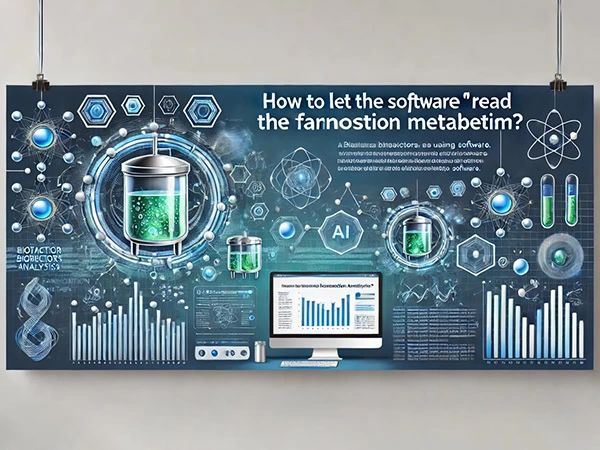
How can fermentation control software dynamically analyse metabolic pathways, realise intelligent control from ‘experience-driven’ to ‘model prediction-driven’, and significantly improve the efficiency and stability of the fermentation process?
Step 1: Data Collection – Drawing a ‘Digital Picture’ of Fermentation
The first step in making the software ‘understand’ the fermentation process is to collect a large amount of key data.
These data include parameters such as temperature, pH, dissolved oxygen levels, stirring rates and substrate concentrations during fermentation, as well as metabolic data such as metabolite concentrations (e.g. glucose, lactate, amino acids), enzyme activities and ATP/NADH levels.
In addition, researchers integrate genomic, transcriptomic, proteomic and metabolomic data to fully profile the metabolic potential of microorganisms. Through sensors and online monitoring devices, these data can be transferred to the software in real time, providing a solid foundation for subsequent analyses.
Step 2: Metabolic modelling – from data to model
With this data in hand, the next step is to construct a metabolic network model.
The researchers extract the metabolic pathways of the target strains from the genomic data and transform them into mathematical models using professional tools (e.g. COBRApy, metaFlux).
With time series data (e.g., substrate consumption rate, product generation rate), the model can infer changes in metabolic fluxes and identify rate-limiting steps and critical metabolic nodes.
Depending on the requirements, researchers can choose different types of kinetic models, flux balance analysis models, machine learning models, or even hybrid models to provide accurate prediction and control strategies for the fermentation process.
Step 3: Software Integration
Integrating metabolic models with fermentation control software is a key step to achieve intelligence.
Through OPC-UA or API technology, sensor data can be input into the model in real time, and the software dynamically adjusts fermentation parameters according to model predictions.
At the same time, combining feed-forward and feedback control strategies, the software is able to predict and optimise the fermentation process in advance and in real time. In addition, the design of the visualisation interface is also crucial, which can help operators intuitively understand the fermentation process and the software’s control strategy, and improve operational efficiency.
Step 4: Model validation and optimisation
The researchers assessed the reliability and accuracy of the model through offline simulations and small pilot fermenter tests.
Based on the experimental data, model parameters can be further calibrated, secondary metabolic pathways can be simplified, and even reinforcement learning algorithms can be embedded for adaptive optimisation.
In the case of yeast production of ethanol, for example, through real-time monitoring and model prediction, the ethanol yield was increased by 15% and the fermentation cycle was shortened by 10%.