
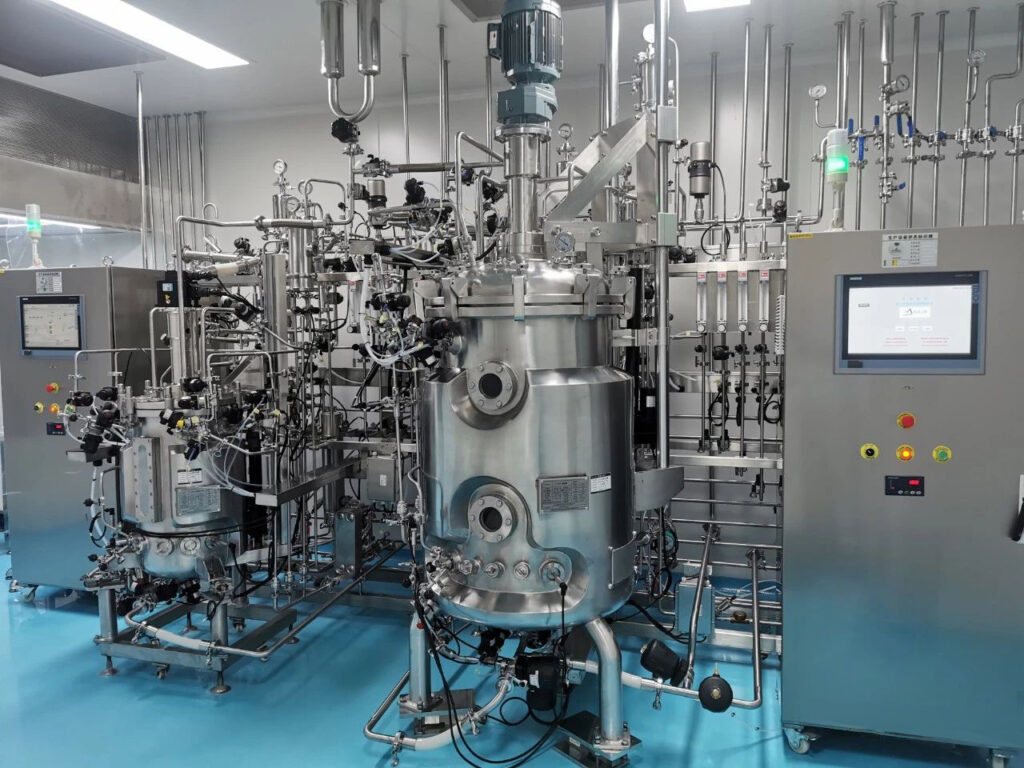
1.A good bioreactor should meet the following requirements.
2. A tight structure that can withstand repeated sterilization by steam, smooth interior walls, and good corrosion resistance to facilitate complete sterilization and reduce the impact of metal ions on.
3.Biological reactions.
4. Good gas-liquid-solid contact and mixing performance and efficient heat, mass and momentum transfer performance.
5. Reduce energy consumption while maintaining the requirements of biological reactions.
6. Good heat exchange performance to maintain the optimum temperature for biological reaction.
7. Have feasible pipeline ratio and instrument control, suitable for sterilization operation and automation control.
Mechanical stirred bioreactor: Mechanical stirred bioreactor is one of the most common types of fermentation plants. It is using the action of mechanical stirrer to make the air and mash fully mixed, to promote the dissolution of oxygen in the mash, in order to ensure the supply of oxygen needed for the growth and reproduction of microorganisms, fermentation and metabolites.
Mechanical stirring fermenter structure: mechanical stirring ventilating fermenter mainly has tank body, stirrer, baffle, shaft seal, air distributor, transmission device, cooling tube, defoamer, into the hole, sight glass, etc.
1. Tank body: the tank body is made of cylindrical body and oval or disc-shaped head welded together, the material is stainless steel. To meet the process requirements, the tank must be able to withstand a certain pressure and temperature, usually required to withstand 130 ℃ and 0.25 MPa. tank wall thickness depends on the tank diameter, material and pressure resistance.
2. Stirrer and baffle: In order to strengthen the axial mixing, the worm wheel and propeller impeller can be used to share the mixing system. For the convenience of disassembly, large mixing impeller can be made into two halves, bolted into a whole assembly on the mixing shaft.
The main role of stirring is to mix and mass transfer, so that the incoming air dispersion bubbles and fully mixed with the fermentation broth, so that the bubbles broken to increase the gas-liquid contact interface to obtain the required oxygen transfer rate, and the biological cells suspended and dispersed in the fermentation system, in order to maintain the appropriate gas-liquid-solid three-phase to maintain proper gas-liquid-solid three-phase mixing and mass transfer, while strengthening the heat transfer process.
3. Shaft seal: The role of the shaft seal is to prevent bacterial contamination and leakage. The seal of the stirring shaft is a dynamic seal, which is due to the fact that the stirring shaft is rotating and the top cover is fixed and stationary, and there is relative movement between the two components, so the seal should be designed according to the principle of dynamic seal. The basic requirement for dynamic seal is that the seal should be reliable and the mechanism should be simple and have a long service life. There are two kinds of dynamic seals most commonly used in fermentation tanks: stuffing box seal and mechanical seal.
4. Mechanical defoaming device: In the fermentation process, the fermentation broth contains a large amount of protein, so a large amount of foam will be generated under strong aeration and stirring. Serious foam will lead to spillage of fermentation broth and increase the chance of contamination, there are two methods of defoaming in aeration fermentation production. One is to add defoamer method to remove, and the other is to use mechanical defoaming device. When the mechanical strength of the foam is poor and the amount of foam is small, the use of mechanical defoaming device has a certain effect. Its role is to break up the foam.
5. Ventilation device: Ventilation device refers to the sterile air into the tank device, the simplest ventilation device, is a single-hole pipe, single-hole pipe outlet is located at the bottom of the stirrer directly below the opening down, so as to avoid the accumulation of solids in the culture fluid in the opening and the bottom of the tank solids precipitation.