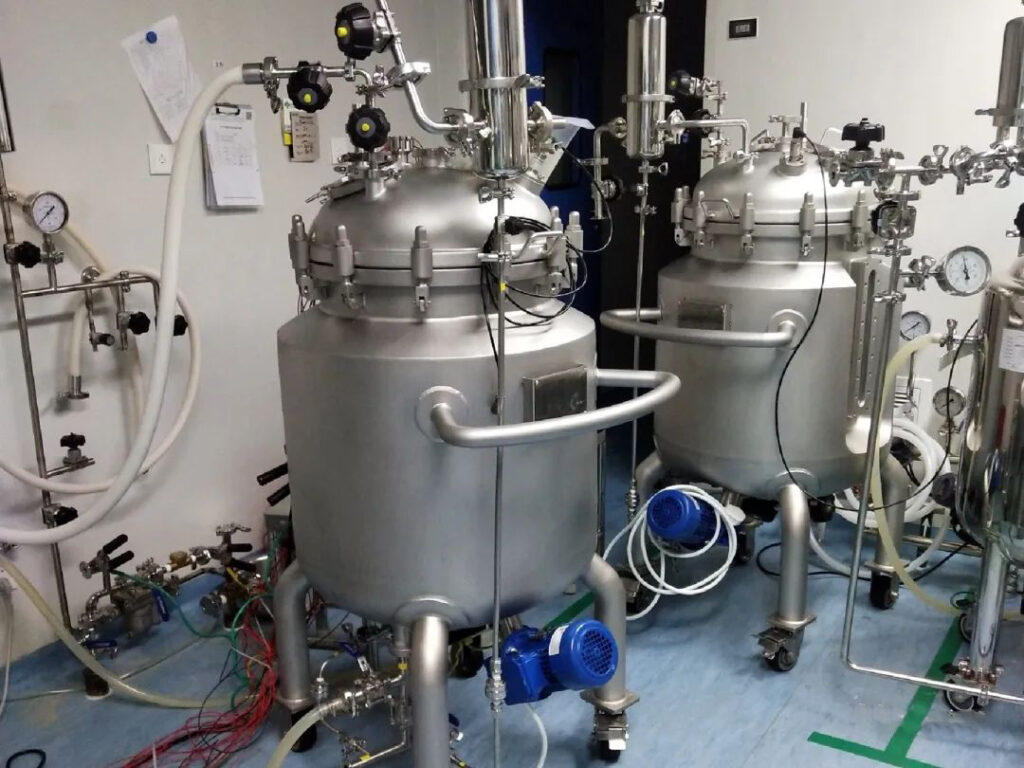
Fermentation broth pretreatment is an important step in extracting biochemical substances from microbial fermentation broth. Its purpose is not only to separate cells, bacteria and other suspended particles, but also to remove some soluble impurities and change the properties of the filtrate to facilitate subsequent operations.
The method of pretreatment depends entirely on the properties of the separable substance,such as the stability to PH and heat, whether it is protein or non-protein, the mass and size of the molecule, and so on. The specific methods mainly include the following:
Ⅰ.Heating method
The heating method is the simplest and cheapest pretreatment method, that is, the suspension is heated to the required temperature and held for an appropriate period of time. Heating can reduce the viscosity of the liquid, according to the principle of fluid mechanics, the rate of filtrate through the filter cake is inversely proportional to the viscosity of the liquid, it can be seen that reducing the viscosity of the liquid can effectively improve the filtration rate.
At the same time, protein can be condensed under appropriate temperature and heating time to form larger particle condensate, which further improves the filtration characteristics of the fermentation broth. For example, the streptomycin fermentation broth, after adjusting the acidity to pH 3.0, is heated to 70°C and maintained for half an hour, the viscosity drops to 1/6 of the original, and the filtration rate can be increased by 10 to 100 times.
When using the heating method, the heating temperature and time must be strictly controlled. Firstly, the heating temperature must be controlled within the range that does not affect the activity of the target product; secondly, if the temperature is too high or the time is too long, the cells will be dissolved, the intracellular substances will overflow, the complexity of the fermentation broth will be increased, and the subsequent separation and separation of the product will be affected. purification. Therefore, the key to the heating method depends on the thermal stability of the product.
Ⅱ. adjust the pH value of the suspension
Adjusting the pH value of the suspension is one of the more commonly used methods for the pretreatment of fermentation broth in the fermentation industry. The pH value directly affects the degree of ionization and charge properties of certain substances in the fermentation broth, so properly adjusting the pH value of the fermentation broth can improve its filtration characteristics. For amphoteric substances such as Aa and Pro, their solubility is the smallest at the isoelectric point, which is the isoelectric precipitation method.
For example, in the production of monosodium glutamate, the isoelectric point precipitation method is used to extract glutamic acid; in membrane filtration, the macromolecular substances in the fermentation broth are easily adsorbed to the membrane, and the charge properties of easily adsorbed molecules can be changed by adjusting the pH value. Reduce clogging and contamination.
Ⅲ. Coagulation and flocculation
Both coagulation and flocculation are important methods for suspension pretreatment. The treatment process is to pre-add chemical agents into the suspension to change the dispersion state of colloidal particles such as cells, cell fragments, bacteria and Pro, destroy their stability, and make them condense into larger particles, which is convenient for increasing the filtration rate. Moreover, it can effectively remove miscellaneous proteins and solid impurities, and improve the quality of the filtrate. However, coagulation and flocculation are two different methods, and their specific treatment processes are still different, which should be clearly distinguished and not confused.
Agglomeration refers to adding some kind of electrolyte to the colloidal suspension. Under the action of the electrolyte ion, the electric double layer potential of the colloidal particles is reduced, so that the colloid loses its stability and the particles coagulate into a block aggregate with a size of about 1mm. process.
Flocculation refers to the process of using flocculants to cross-link colloidal particles into a network to form flocs with a size of about 10mm. Among them, the flocculant mainly acts as a bridging agent. The aggregates obtained by the coagulation method are usually only about 1 mm in size, which is relatively small, and sometimes cannot be effectively separated. However, the flocculation method can often form thick flocs (about 10mm), which makes the fermentation broth easier to separate.
Ⅳ. Add filter aid
A filter aid is an incompressible porous particle that loosens the filter cake and increases the filtration rate. This is because after using the filter aid, a large number of fine particles in the suspension are adsorbed on the surface of the filter aid, thereby changing the structure of the filter cake, reducing the compressibility of the filter cake and reducing the filtration resistance.
Commonly used filter aids include diatomaceous earth, cellulose, asbestos powder, perlite, white clay, carbon particles and starch. Among them, the most commonly used is diatomite, which has great adsorption and penetration capabilities, can filter out particles of 0.1-1.0 μm, and has stable chemical properties. It is not only an excellent filter medium, but also an excellent filter aid.
Ⅴ. Add reactant
In some cases, by adding some reactants that do not affect the target product, the influence of certain impurities in the fermentation broth on filtration can be eliminated, thereby increasing the filtration rate.
The added reactants react with certain soluble salts to generate insoluble precipitates, such as CaSO4, etc. The generated precipitate can prevent the bacteria from sticking and make the hyphae have a block structure. In addition, the precipitate itself can be used as a filter aid and can solidify the jelly and suspended matter, thereby improving the filtration performance. If the reactants and reaction conditions are correctly selected, the filtration rate can be increased by 3 to 10 times.
If the fermentation broth contains insoluble polysaccharide substances, it is best to use enzymes to convert them into monosaccharides first to increase the filtration rate.
For example, vancomycin uses starch as the medium, and 0.025% amylase is added before the fermentation broth is filtered. After stirring for 30 minutes, 2.5% diatomaceous earth is added as a filter aid, which can increase the filtration rate by 5 times.