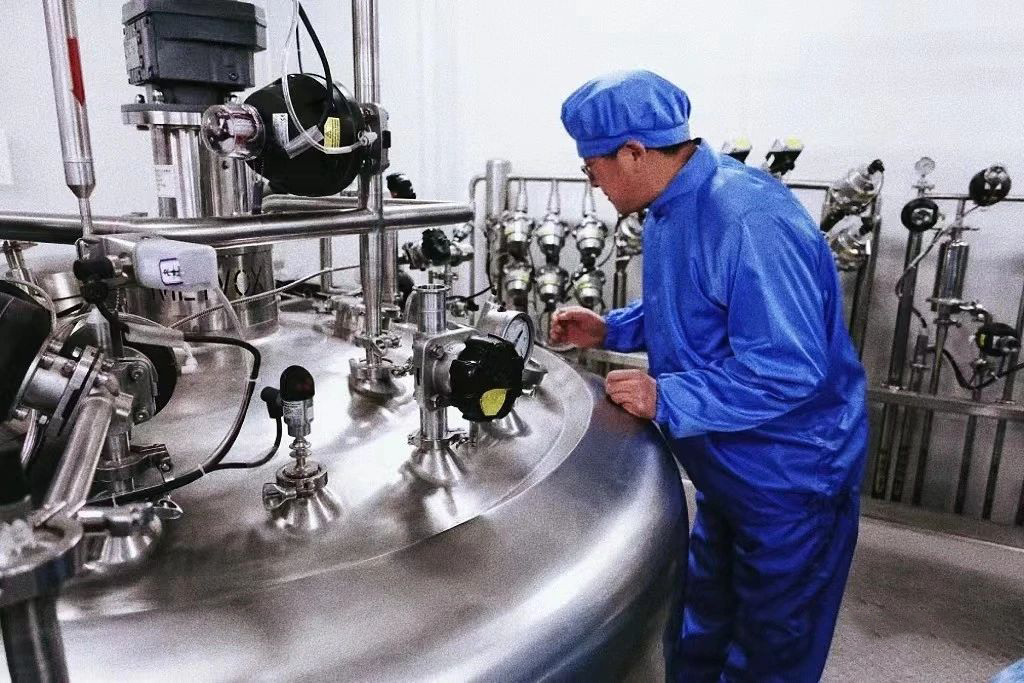
It is normal to produce a small amount of foam during the fermentation process, but too much foam will seriously affect the normal progress of fermentation. Defoaming can use physical methods and chemical methods, the most effective method is to add defoaming agent.
There are four types of defoamers commonly used in the fermentation industry: natural oils, high-carbon alcohols and fatty acids, polyethers, and silicones. Polyethers and silicones have superior performance and are widely used.
Natural oils and fats (i.e. soybean oil, corn oil, etc.)
Advantages: easy to source, low price, simple to use.
Disadvantages: easy to deteriorate and increase the acid value if stored poorly.
high carbon alcohol
High-carbon alcohols are linear molecules with strong hydrophobicity and weak hydrophilicity, and are effective defoamers in water systems. In the early 1970s, scholars from the former Soviet Union experimented in aqueous solutions of anionic, cationic, and nonionic surfactants, and proposed that the defoaming effect of alcohol is related to its solubility and diffusion degree in the foaming liquid. C7~C9 alcohols are the most effective defoamers.
Polyether defoamer
There are mainly the following types:
1.GP type defoamer
It is made by addition polymerization of propylene oxide or a mixture of ethylene oxide and propylene oxide with glycerin as the initiator. GP type defoamer has poor hydrophilicity and low solubility in foaming medium, so it should be used in thin fermentation broth. Its anti-foaming ability is superior to that of defoaming ability, and it is suitable to be added in the basic medium to suppress the foam generation in the whole fermentation process.
2. GPE type defoamer is foam enemy
Add ethylene oxide to the end of the polypropylene glycol chain link of the GP type defoamer to become a polyoxyethylene oxypropylene glycerin with a hydrophilic group at the chain end, also known as polyoxyethylene oxypropylene glycerin. According to the ethylene oxide addition amount of 10%, 20%, … 50%, respectively called GPE10, GPE20, … GPE50.
The GPE type defoamer has better hydrophilicity, is easy to spread in the foaming medium, has strong defoaming ability, but also has a large solubility, and the maintenance time of defoaming activity is short, so it has a better effect when used in viscous fermentation broth.
3.GPES type defoamer
A new type of polyether defoamer, the end of the GPE defoamer chain is capped with a hydrophobic stearate to form a block copolymer with hydrophobic chains at both ends and a hydrophilic chain in the middle. Molecules of this structure tend to gather at the gas-liquid interface in a flat state, so they have strong surface activity and high defoaming efficiency.
Silicon
The most commonly used is polydimethylsiloxane, also known as dimethicone.It has low surface energy, low surface tension, low solubility in water and common oils and high activity. Its main chain is a silicon-oxygen bond and is a non-polar molecule. It is not compatible with polar solvent water, and has little affinity with general oils. It is low in volatility and chemically inert, relatively stable and less toxic.
Pure polydimethylsiloxane cannot be used as a defoamer without dispersion treatment. It may be due to its high interfacial tension with water and low spreading coefficient, which makes it difficult to disperse on the foaming medium. Therefore, the compound formed by mixing silicone oil into SiO2 aerosol, that is, mixing SiO2 aerosol after hydrophobic treatment into dimethyl silicone oil, can be obtained after treatment at a certain temperature and for a certain time. the
Silicone defoamer is made of silicone grease, emulsifier, waterproofing agent, thickener, etc., mixed with appropriate amount of water and mechanically emulsified. It is characterized by low surface tension, high surface activity, strong defoaming power, less dosage and low cost. It is immiscible with water and most organic substances, and can defoam most of the bubble media. It has good chemical stability and is difficult to react with other substances. As long as it is properly configured, it can be used in acid, alkali, and salt solutions without damaging product quality.
Polyether modified silicon
Combining the advantages of polyether and silicone defoamer, it is non-toxic and harmless, harmless to bacteria, and the amount of addition is very small. It is a cost-effective product.