
The bioreactor is an irreplaceable main equipment in the large-scale cultivation of animal cells. The animal cell bioreactor is to simulate the internal environment of the organism. In order to obtain the effect of high-density proliferation of animal cells and ensure the efficient secretion of animal cells, it is necessary to Control the operating parameters of its cultivation.
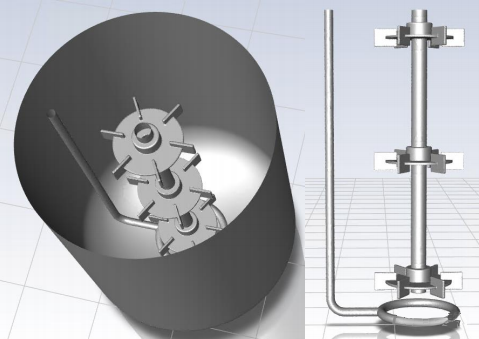
3D model of the knike 200L tetanus reactor for flow field simulation. The model includes the entire volume below the liquid level and the part of the volume above the liquid level.
Animal cell bioreactor is a system that simulates the internal environment of animals and conducts biological culture in vitro. It is a multi-disciplinary high-tech product integrating machinery, fluid, control, and biology. Its control parameters mainly include temperature, dissolved oxygen, pH, fluid dynamics, nutrients, and the concentration of metabolites.
The ultimate goal is to achieve high-density cell growth and efficiently produce target products such as enzymes, monoclonal antibodies, and vaccines with medical value. Compared with the traditional biological product production process, which has many defects such as long production cycle, cumbersome operation, heavy workload, and easy pollution, the bioreactor system has better stability and safety, and saves a lot of labor, production site and energy consumption , reducing production costs, has obvious advantages.
Studies have shown that bioreactor culture process parameters have a strong impact on cell metabolism and virus titer. In view of the impact of different bioreactors and different culture methods on the product quality of biological products, this article reviews the research status of animal cell bioreactors, the structure and principle of different types of animal cell bioreactors, and structural optimization, aiming to provide The selection of bioreactors that are more suitable for the cultivation process in the practical application of biological product development and production provides certain references.
Structure and principle of different types of kinetocell bioreactors
According to the different mixing methods, it can be divided into stirred type and non-stirred type. The biggest disadvantage of the stirred type bioreactor is the damage of cells caused by shear force. Although it has been continuously improved, this problem is still difficult to avoid. In contrast, non-stirred reactors generate less shear and are advantageous in animal cell culture.
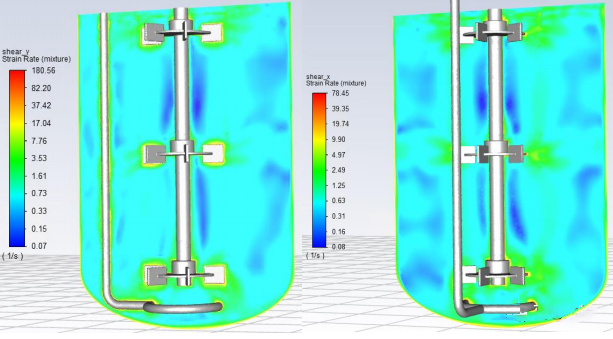
Average shear strain rate (1/s) during stirring rotation cycle on two longitudinal sections
Stirred Bioreactor
Liquid phase agitation is powered by the rotation of the impeller to drive the liquid flow. Its structure is similar to the traditional microbial fermentation tank, the main difference is the structure of the agitator. Since animal cells do not have cell walls, they are very sensitive to shear stress. In order to avoid cell damage, the stirred reactor has been improved, including improved stirring paddles, gas supply methods, and installation of accessories, so as to further optimize the suitable growth conditions of cells. environment.
The form of the stirrer has a great influence on the growth of the cells. The choice of the stirring paddle not only requires efficient mixing characteristics, but also reduces the shear force on the cells. The main purpose of this improvement is to culture cells in a flow field environment with low shear force. Currently, the most widely used type of agitator is the propeller blade.
The agitator whose propeller blade mainly produces axial flow belongs to the mixed flow blade, which can generate circumferential and axial flow field by itself when stirring, which is conducive to the full dissolution and mixing of gas, liquid and materials, and the flow field shear force is small . On the basis of stirring paddles, different types of stirrers have been developed by adding accessories and other improvements. Negative pressure is generated in the hollow shaft of the agitator, so that the culture medium is sucked from the bottom of the reactor and discharged from the top; a spin filter is added and the cell-free medium is collected using the spin filter.
Bubble distributor
The structure of the bubble distributor is closely related to the effect of dissolved oxygen in the culture medium. Bubble distributors commonly used in animal cell culture can be divided into L-shaped, ring-shaped, and microporous. The L-type sparger has a simple structure and is easy to process. It is widely used in reactors with small capacity. Due to the problem of uneven distribution of dissolved oxygen, it is not suitable for large-scale reactors. Annular bubble distributors are the most widely used, with 5 to 6 orifices with a diameter of 0.5 mm to 1 mm.
heating method
The culture temperature of animal cells is usually about 37°C, and the allowable range of control error is ±0.25°C. The heat source mainly consists of biological reaction heat, stirring heat, radiation heat and ventilation heat. The heating methods include integral wall heating, bottom heating and side wall heating. Generally, jacketed water circulation, electromagnetic heat generation, and electric blanket are used to control the temperature in the reactor. No matter which method is used to control the temperature, the temperature must be adjusted gradually to avoid excessive temperature damage and cell apoptosis.
non-stirred bioreactor
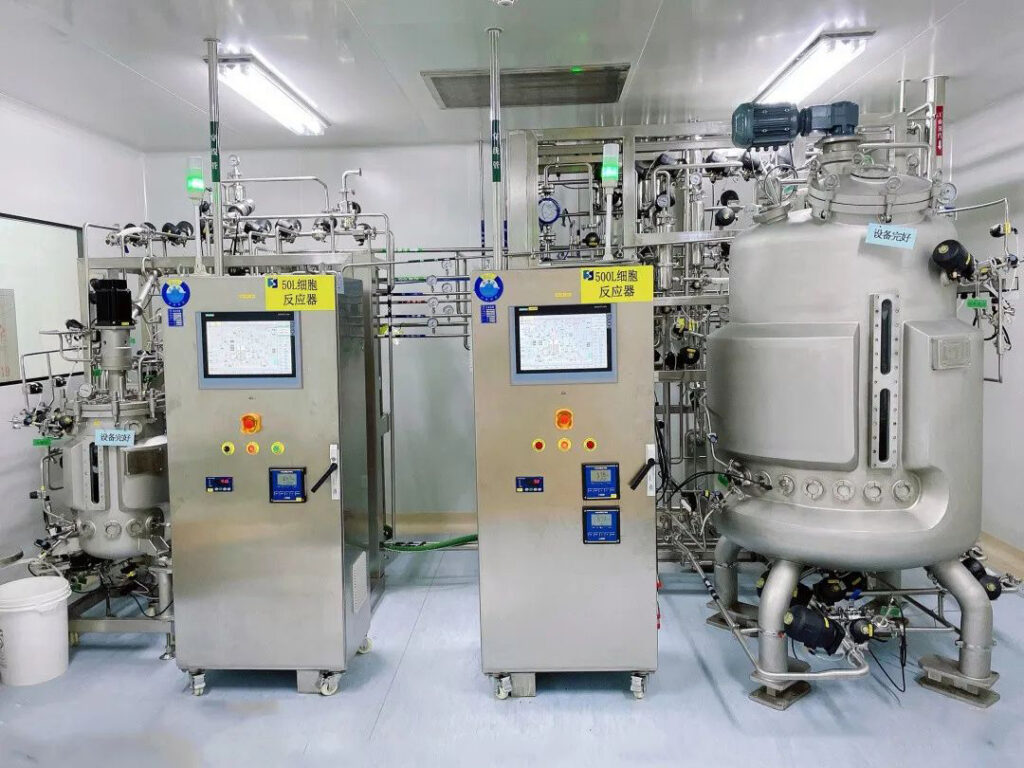
The biggest disadvantage of the stirred bioreactor is that the shear force causes cell damage, while the non-stirred bioreactor produces less shear force and has outstanding advantages in animal cell culture.
Its principle is to adopt the circulation air-lift central air intake, no stirring device, and add a guide tube to the traditional bubble tower. Its advantages are simple structure, convenient operation, relatively mild turbulent flow, little damage to cells by shear force, and high-density culture of animal cells is easy to achieve. Since the airlift reactor is enlarged, the operating range not affected by the shear force cannot be determined, and it is rarely used on a large scale.
Optimization measures
In this section, the height-to-diameter ratio and bottom radius of the reactor tank, the installation height of the agitator, and the baffle are optimized. Due to the different functions of each component in the flow field, the optimization target parameters of each component cannot be given. Only The mechanical properties of CHO cells can be optimized by referring to the role of each component in the flow field.
(1) Aspect Ratio Optimization
The general selection range of the height-diameter ratio of the bioreactor is relatively large, which is related to the specific reactor form. For the airlift reactor, a slender structure is generally used, while for the stirred bioreactor, the height-diameter ratio is generally selected to be 1. This is because the mixing power of the stirred bioreactor comes from the agitator, and the mixing performance of a single agitator generally does not allow the aspect ratio to be too large or too small, which is not conducive to the mixing of the culture medium. Based on domestic and foreign products and literature, this paper determines the optimal range of height-to-diameter ratio as 1-1.5.
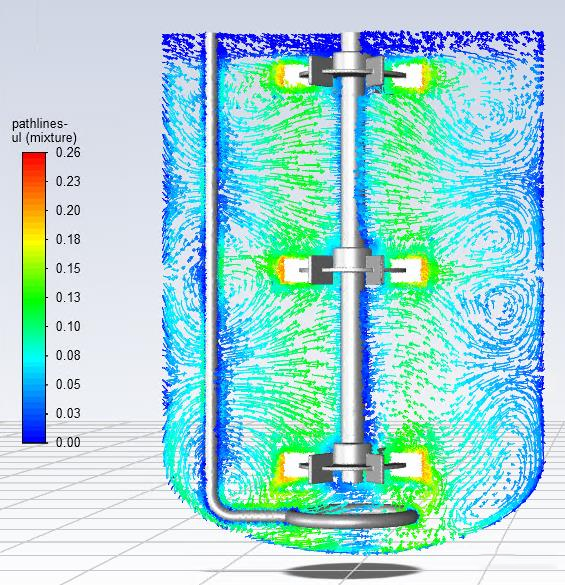
The rotation speed is 80r/min, which is usually selected, and the baffle is fully optimized. Different tank bottom radii also have a significant impact on the statistical distribution of the velocity field of the reactor. R0=0.5t has no zero-velocity zone, less low-velocity zone, the best mass transfer efficiency and the least power loss.
(2) Optimization of tank bottom radius
The use of flat bottom or other tank bottoms with poor streamlines is not conducive to the mixing of the flow field. No matter what optimization method is adopted, there will be a zero-velocity zone, which is not conducive to the flow field mixing of the bioreactor. In this paper, based on the hemispherical tank bottom, the radius of the spherical tank bottom of the tank body is optimized. Usually, the hemi-diameter of the tank bottom is proportional to the diameter of the tank body, and the range generally varies between 0.5 and 1. The flow field in the reactor not only has a near-zero velocity zone (0-0.001m/s), but also has a higher volume percentage in the low-velocity zone (0-0.01m/s). Overall, the aspect ratio is 1/3 It can form a better mixed flow field, which is conducive to the transportation of nutrients, so the height-to-diameter ratio is 1/3.
(3) Optimization of the number of baffles
Under the action of no baffle in the bioreactor, no matter what kind of agitator is used, the mainstream field will form a large vortex, mainly laminar flow, which cannot form the overall circulation of the flow field, which is not conducive to the exchange of nutrients. Cell growth and metabolism are inhibited. Generally, baffles are equipped above 20L. The main function of the baffle is to convert the circumferential flow into axial flow, so as to balance the circumferential flow and axial flow in the main field and enhance the fluid mixing in the reactor. After testing, compared with the three pairs of baffles, the velocity field distribution of the other two schemes is asymmetrical in the liquid surface area, which will form a large vortex turbulence in the main flow field, which will generate many bubbles, which is not conducive to the growth of cells, and the three pairs of baffles The speed distribution of the plate is also the most uniform, and three pairs of baffles are the best in comparison.
outlook