
Enzymes are biological catalysts produced by living organisms for their own metabolic activities. The equipment required for biological reactions using enzymes as catalysts is called an enzyme reactor. It is an important content of enzyme engineering research today. Through the study of enzyme reactor kinetics and thermodynamic models, it can provide an important theoretical basis for the design, selection and application of enzyme reactors.
Classification of Enzyme Bioreactors
Depending on the type of enzyme catalyst
Enzyme reactors can be divided into free enzyme reactors and immobilized enzyme reactors. Immobilized enzyme reactors can be further divided into immobilized single enzymes, complex enzymes, organelles, and cells.
Enzyme-catalyzed bioreactors are classified according to their type and operation mode, as shown in Table 6-3.
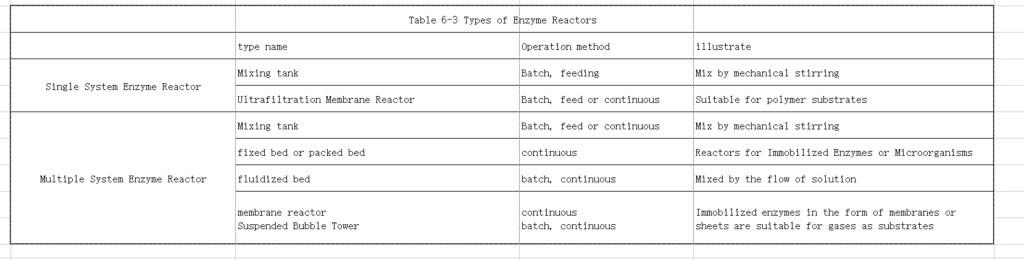
Divide by geometry or structure
Enzyme reactors can be roughly divided into three types: tank type, tube type and membrane type. There are many types of each type, and some reactors can be combined with each other to form enzyme reactor systems with different performances. The tank-type reactor is generally equipped with a stirring device, so it is called a “mechanical stirring bioreactor” and is suitable for the above-mentioned various operations.
Tubular reactors and membrane reactors are generally used for continuous operation, and tubular reactors with relatively large diameters and short longitudinal directions are also called tower reactors. At present, the saccharification tanks and liquefaction tanks widely used in the fermentation industry are typical enzyme reactors.
The first requirement for successful continuous operation of an enzyme reactor is to confine the enzyme to a certain area to react with the substrate. With a continuous operation reactor, since the flow state of the fluid in the reactor will affect the conversion rate of the substrate, it is very important to grasp the flow state of the reaction liquid and the mixing degree of the fluid.

According to the characteristics of fluid flow
Continuously operated enzyme reactors can be divided into piston type and fully mixed flow reactors. (as shown in Figure 6-4)
Piston flow means that the reaction liquid has a strictly uniform velocity distribution in the radial direction of the reactor. The flow is like a piston movement, and the reaction velocity only changes with the spatial position.
Fully mixed flow means that the mixing in the reactor is strong enough, so that the concentration distribution in the reactor is uniform and does not change with time.
Of course, this is also an idealized assumption, which is another extreme ideal flow pattern corresponding to piston flow. The above idealized flow form does not exist in the actual enzyme reactor, because the flow state and parameters such as temperature and concentration change with space or time.
Compared with the continuously operated piston reactor (CPFR) for enzymatic reaction, although there are obvious differences in structure and flow state, if the elapsed time and residence time are all focused on the same In terms of fluid elements, both reactors have similar characteristics.
That is, in a CPFR reactor, the state of a particular location depends on how long the fluid is present in the reactor as it passes through that location, so the two reactors are similar in this respect.