
Transfer phenomena and processes in bioreactors are governed by two mechanisms: convection and diffusion. In bioreactors, the processes involved in flow and diffusion are: agitation shear, mixing, dissolved oxygen mass transfer, heat transfer, and apparent kinetics.
For microbial reaction systems, due to the characteristics of biological cells such as growth, adaptation, delay, degradation, variation, and shear sensitivity, bioreactors are more complex than ordinary chemical reactors, and the scale-up process is more difficult.
Theoretically, the development and design process of bioreaction processes and bioreactors should consist of the following three steps, namely:
① Test the biological cells used under a wide range of culture conditions to grasp the characteristics of cell growth kinetics and product generation kinetics;
② According to the above series of experiments, determine the optimal medium formula and culture conditions for the biological reaction;
③ Solve the relevant micro-balance equations such as mass transfer, heat transfer, and momentum transfer, and derive the environmental conditions and main operating variables (stirring speed IV, ventilation rate Q, stirring power, matrix flow acceleration v etc.), and then apply this mathematical model to calculate the values of the main variables under the optimized conditions.
However, due to the complexity of the biological reaction process, the kinetic equations that can fully describe the biological reaction process are extremely complex, so it is still very difficult to solve some differential balance equations. As a result, it is difficult to completely follow the above ideal process to complete the design and scale-up of bioreactors.
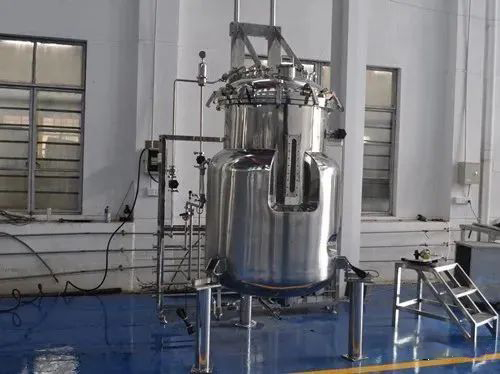
In addition to the above-mentioned theoretical methods for the scale-up of bioreactors, there are also semi-theoretical methods, dimensional analysis methods, and empirical scale-up methods that are commonly used.
(1) Theoretical amplification method
The so-called theoretical amplification method is to establish and solve the momentum, mass and energy balance equations of the reaction system. As mentioned earlier, this amplification method is very complicated and difficult to apply in practice at present. But this method is the most systematic and based on scientific theory.
Theoretically, the biological reaction rate has nothing to do with the size and shape of the reaction vessel. But in fact, the reaction rate is affected by physical processes such as mass transfer, momentum transfer, and heat transfer, so the biological reaction is inevitably affected by the type of reactor and the three-dimensional structure. The basic theoretical basis of amplification is the similarity theory, and the basic characteristics of the similarity theory are: two reaction systems can be described by the same differential equation, and power, heat and mass transfer and biochemical reactions exist simultaneously in one system.
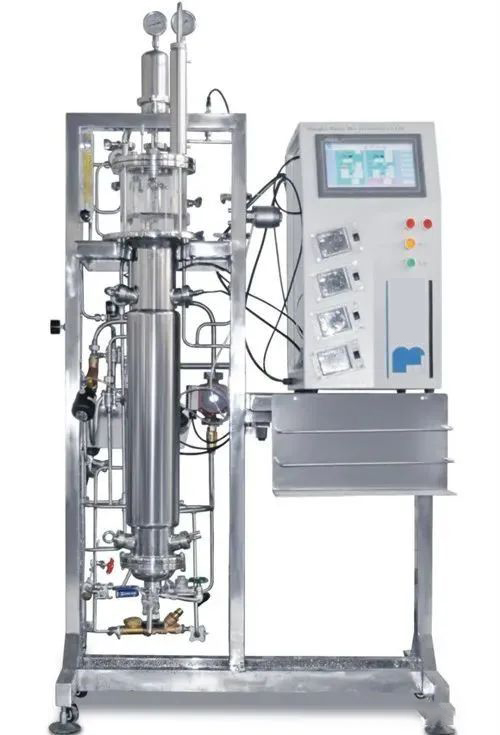
(2) Semi-theoretical amplification method
The theoretical amplification method is difficult to solve the momentum balance equation. To solve this contradiction, the momentum equation can be simplified. There have been a lot of research progress on the flow model of the stirred tank reactor. The common point is that only the flow of the main body of the liquid flow is considered, and the local complex flow such as the stirring impeller or the reactor wall is ignored. There are three types of flow patterns, namely plug flow , plug flow with liquid micro-dispersion and complete mixed flow.
(3) Dimensional analysis method
The so-called dimensional analysis amplification method is to keep the dimensionless group (also known as the quasi-number) composed of the parameters of the biological reaction system constant during the amplification process. Although the application of the dimensional analysis method has strict restrictions, this method is still very useful. of. If the momentum, mass, heat balance of the reaction system and related boundary conditions and initial conditions are written in a dimensionless form for the amplification process, it is a dimensional analysis amplification method.
(4) Experience amplification method
At present, the most widely used design is based on experience. According to empirical amplification, generally only individual criteria can be guaranteed to be equal after amplification. For this reason, it is necessary to consider whether changes in other criteria will lead to changes in flow patterns or cause damage to microorganisms, and make modifications accordingly.
conclusion
Although the structure of stirred reactors is relatively simple, the fluid flow and mixing process in different stirred reactors is quite complicated due to the simultaneous involvement of biochemical reactions and physical processes.
At present, the design and scale-up of stirred reactors are mainly solved by empirical methods, and problems such as long design cycle and large deviation have brought huge economic losses. How to accurately describe and simulate the mixing process and flow conditions in a stirred reactor, and provide theoretical guidance for its optimal design and scale-up, is an important development direction of bioreactor technology research.