
With the deep integration of artificial intelligence and biological fermentation, the traditional fermentation process has been completely changed. Through the intelligent learning technology of biological reaction equipment, we can continuously optimize and adjust the fermentation process and reaction conditions, thereby significantly improving production efficiency. This integration will further promote the transformation of the bioindustry and promote industrial upgrading.
Parallel bioreactors are an important tool for the industrialization of synthetic biology. With the support of machine learning and big data mining technology, the process of strain screening and process amplification can be accelerated by analyzing a large amount of experimental data. Based on intelligent bioreactor manufacturing, combined with a multi-variable dynamic prediction model based on machine learning, and model prediction through machine learning algorithms, the full-chain docking of high-throughput data and process optimization can be achieved.
The design and development of smart bioreactors is a complex process involving a large number of variables and parameters, as well as the intersection of multiple disciplines. At present, there have been many studies combining artificial intelligence technology with bioreactors and have achieved certain results.
Intelligent technology of biological reaction equipment
In recent years, interdisciplinary computational fluid dynamics has been continuously developed and improved, and numerical simulation of the internal flow field of gas-liquid stirred reactors using computational fluid dynamics methods has gradually become a research hotspot. This method is mainly based on the conservation principles of mass, momentum and energy in the flow field to solve the system of equations. It can predict and obtain information such as flow field distribution and turbulence characteristics in the gas-liquid system, thereby optimizing the performance of biological reaction equipment. In simulation studies, methods based on computational fluid dynamics are used to design intelligent bioreactors, and optimal design of intelligent bioreactors is achieved by combining genetic algorithms and multi-objective optimization algorithms.
More and more researchers are using numerical simulation methods to conduct in-depth exploration of the flow field and dispersion characteristics of gas-liquid stirred reactors. It is not only of great significance to the basic theoretical research on stirring and mixing, but also promotes the design optimization of reactors and the development of new propellers. There have been a large number of reports on the use of CFD methods to optimize research on gas-liquid stirring reactors. Using CFD-based methods, researchers can simulate the complex fluid dynamics behavior inside bioreactors. By modeling the physical phenomena, reaction kinetics and other key parameters inside the reactor, CFD simulations can provide prediction and optimization of fluid flow, mixing effects and heat transfer performance. In addition, combining genetic algorithms and multi-objective optimization algorithms, researchers have also achieved optimal design for the overall intelligent bioreactor. By using these algorithms, multiple optimization goals can be integrated, such as maximizing output, minimizing energy consumption, and reducing waste generation. Researchers can perform optimized searches on CFD simulation results to obtain smart bioreactor designs that better meet their requirements.
In terms of bioreactor amplification, the application of CFD simulation technology is also increasing. Through CFD simulation of biological process research, researchers can expand experimental results to larger-scale reactors and optimize them. This method can improve the in-depth understanding of fluid characteristics and reaction effects in large-scale reactors, reduce test costs and time, and guide the improvement of actual industrial production. Machine learning has made significant progress in the fabrication of smart bioreactors. Machine learning algorithms are developed by using a large amount of experimental data and CFD simulation results as training sets. This predictive model can help researchers conduct efficient reactor design and optimization to increase production efficiency and reduce resource consumption.
In addition, artificial intelligence is gradually being applied in machine learning of bioreactors. By embedding intelligent algorithms into smart bioreactor systems, prediction models can be established to predict reactor behavior under different parameters and operating conditions, enabling autonomous control and optimization of the production process, thereby maximizing reactor performance. Researchers use online sensor data to predict status and performance variables and build deep learning models. DEL RIOCHANONA et al. used predictive kinetic models and data-driven models to calculate optimization strategies for production during fed-batch operations, demonstrating the advantages of data-driven modeling to optimize and predict complex dynamic biological processes.
Fermentation data processing automation technology
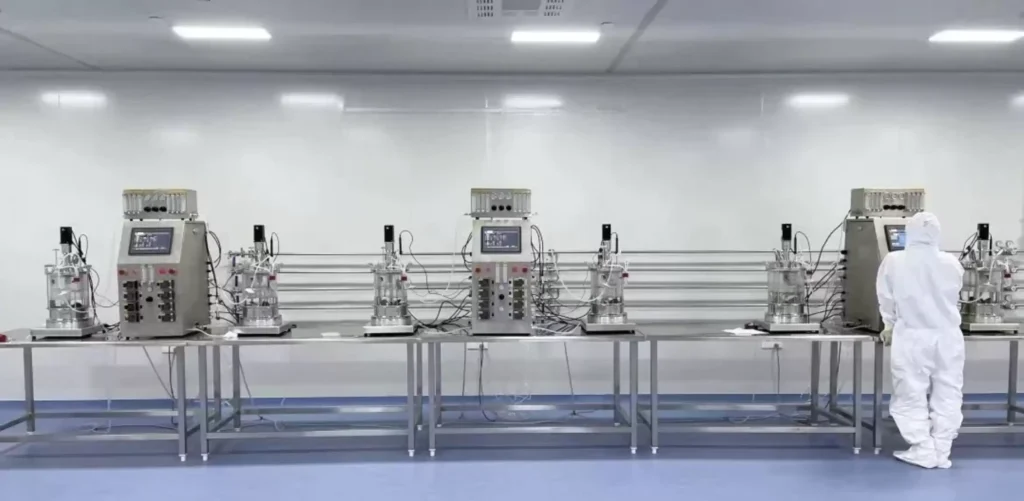
Data processing automation technology is a key link to achieve monitoring, control and optimization during the fermentation process. Real-time data, such as temperature, pH value, dissolved oxygen content and other key parameters, are collected through sensors and instruments. These data are transmitted to the data acquisition system in the form of analog signals or digital signals. Data storage and management ensure the reliability and security of data and provide the basis for subsequent data analysis and application. BERTAUX and others developed a programmable pipetting robot based on the ReacSight platform to improve the automatic measurement and control capabilities of bioreactors, making continuous microbial culture less costly and more efficient, and building a fully automatic fermentation platform. Automated control is the ultimate goal of data processing automation technology. Based on the results of data analysis and model establishment, the control parameters in the fermentation process can be automatically adjusted. This closed-loop feedback control enables precise control of key parameters such as temperature, pH, and dissolved oxygen content during the fermentation process. Through automated control, the stability and consistency of the fermentation process can be improved, thereby ensuring product quality and yield.
In order to improve the efficiency of data analysis, combining artificial intelligence technology with fermentation data processing can help find valuable information from massive fermentation data. Through data processing automation technology, process conditions are continuously optimized, production efficiency is improved, and resources are saved. Optimum process conditions not only have a direct impact on product quality, yield, ease of downstream separation and extraction and other indicators related to economic benefits, but can also reduce waste emissions and save energy and water. Therefore, in the future fermentation process, we need to continuously promote the research and development of data visualization tools and automated data analysis methods for the fermentation process to adapt to the needs of the big data era of biomanufacturing. This will enable fermentation engineers to use data more effectively to optimize the fermentation process and further promote the development of biomanufacturing technology.
Digital twin
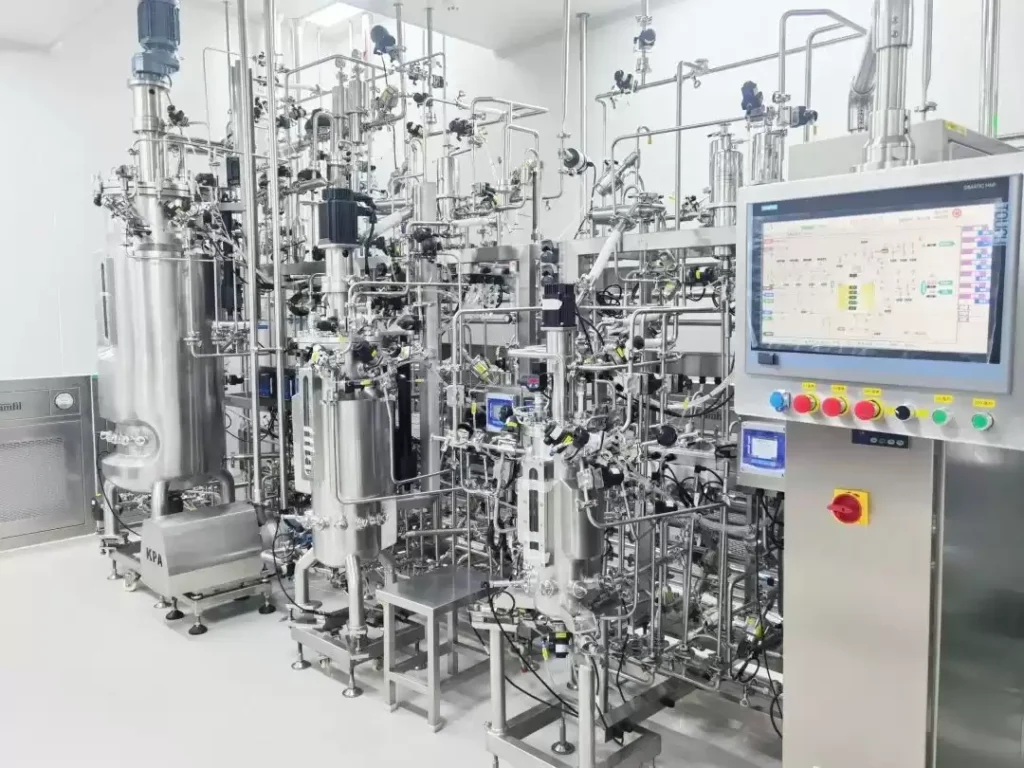
In recent years, digital twins and artificial intelligence technology have developed rapidly and are important factors in realizing Industry 4.0. Digital twins are virtual forms of physical entities, with algorithms and models at their core. Simulations based on artificial intelligence are rapidly being promoted and applied. Digital twin is a virtual simulation of physical entities in the real world through digital technology and artificial intelligence algorithms. It is a digital mapping of physical entities and can provide real-time feedback. For bioengineering, digital twins are based on computer simulation theory to build models of biological processes and supporting equipment, and embed them into control systems or data management systems to achieve two-way data communication with physical entities. In this sense, it is obviously not enough to simulate only a single factor. It is necessary to combine multiple sensor data and consider their joint impact on the fermentation process to obtain accurate simulation results. However, the complexity and computational workload of the model will also increase exponentially.
Smart bioreactors are closely linked to digital twin technology. Digital twin technology helps improve fermentation process efficiency, product quality and production safety. The field of industrial biomanufacturing is actively embracing this concept. In smart bioreactors, digital twins can predict the end of fermentation based on real-time data and can also test multiple operating strategies, which helps operators make informed decisions. The development of digital twin technology has promoted the intelligence of bioreactors. Digital twins have the ability to communicate two-way with smart bioreactors. It receives information and returns it in real time, thereby affecting the operation of the bioreactor in real time. Although the literature on digital twin technology in the field of smart bioreactors is limited and the concept is rarely implemented in practical applications, various elements of digital twin technology can be found in applications related to real-time monitoring and control of fermentation processes. . As computing power increases and digital infrastructure develops, as these digital twins evolve over their lifecycle, they will become more accurate and efficient, and more powerful.